At a Glance
Dynamic spawning of specialized agents during long coding tasks raises successful completion by 34% while cutting the working context size by 42%; most of the gain (+18%) comes from adaptively creating specialists when task complexity spikes.
ON THIS PAGE
What They Found
Adaptive, runtime spawning of specialized agents helps handle long, multi-file programming tasks that single or statically arranged agent teams struggle with. Selective memory slicing keeps context sizes small without losing relevant information, enabling a 42% reduction in tokens needed to represent the task. A coherence protocol lets multiple spawned agents work in parallel and resolve overlapping edits, reducing conflicts while preserving throughput.
Not sure where to start?Get personalized recommendations
Data Highlights
134% higher task completion rate versus static multi-agent baselines on mixed-code benchmarks
242% reduction in context memory (example: 87k → 51k tokens) via automatic memory slicing
3Adaptive spawning itself contributes an additional +18% to completion by calling specialists when complexity exceeds a threshold
What This Means
Engineers building long-running code generation agents and toolchains — because the approach shows a practical way to break big coding jobs into specialist subteams at runtime. Technical leaders evaluating multi-agent orchestration or agent delegation strategies can use these results to prioritize adaptive composition over fixed workflows. Researchers tracking agent trust and reliability will find the coherence and state-transfer ideas useful for reducing conflict and improving resumability.
Key Figures
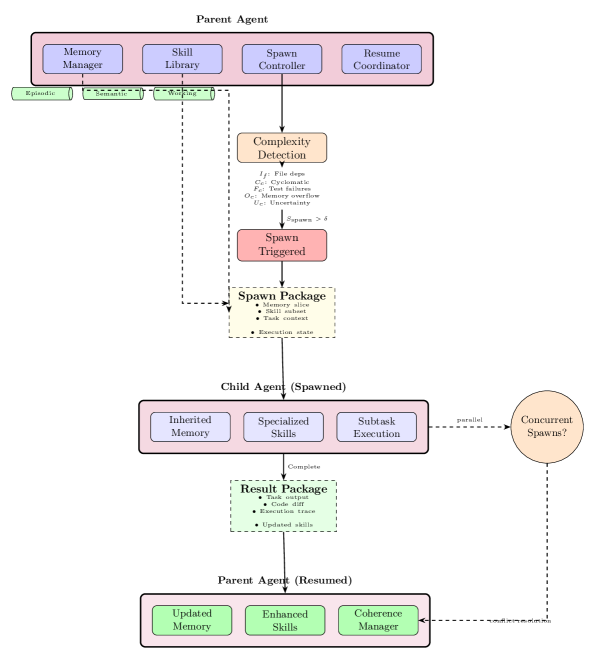
Fig 1: Figure 1: AgentSpawn architecture showing parent agent spawning specialized children based on runtime complexity detection, with automatic memory slicing and coherence management for concurrent spawns.
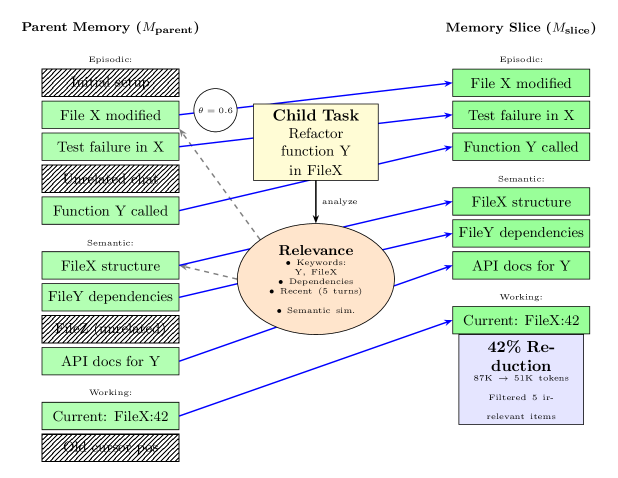
Fig 2: Figure 2: Memory slicing algorithm showing selection of relevant episodic, semantic, and working memory items. Irrelevant items (shown with gray pattern) are filtered, achieving 42% reduction (87K → \rightarrow 51K tokens) while maintaining task-relevant context.
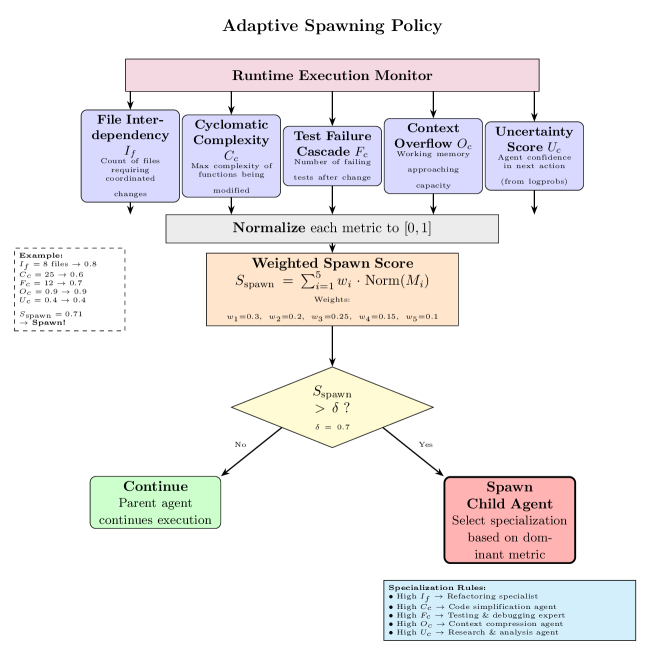
Fig 3: Figure 3: Adaptive spawning policy showing five complexity metrics normalized and combined via weighted sum. When spawn score exceeds threshold ( δ = 0.7 \delta=0.7 ), child agent is spawned with specialization determined by dominant metric.

Fig 4: Figure 4: Memory coherence protocol for concurrent spawns. Four children execute independently on memory snapshots. Conflict detection identifies overlapping changes. Resolution strategies: automatic merge (15%), semantic merge via LLM (73%), or parent escalation (12%).
Ready to evaluate your AI agents?
Learn how ReputAgent helps teams build trustworthy AI through systematic evaluation.
Learn MoreYes, But...
Reported results describe an architecture and simulated evaluation; a full production prototype with large language models is listed as future work, so real-world gains may vary. Effectiveness depends on good complexity metrics and spawn policies; poor thresholds could spawn too many agents or miss needed specialists. Conflict resolution still requires expensive semantic merges in many cases, and costs/latency trade-offs were not exhaustively explored.
Methodology & More
AgentSpawn proposes treating the choice of how many and what kind of helper agents to use as a runtime decision: when the main agent detects rising complexity it spawns one or more specialized child agents (for example, a refactorer, tester, or API integrator). To keep the running context compact, it maintains a memory manager that slices episodic (recent actions), semantic (high-level facts), and working memory and transfers only the relevant pieces to children. A coherence manager coordinates parallel edits by detecting overlapping changes and resolving them via automatic merges, model-guided semantic merges, or escalation back to the parent. coherence protocol. Evaluation used three code-focused collections (multi-file bug fixes, refactorings, and repository tasks) and compared AgentSpawn to single-agent and static multi-agent baselines. Key outcomes were a 34% higher task completion rate and a 42% reduction in tokenized context size; adaptive spawning accounted for an 18% performance boost on top of other features. The design emphasizes practical concerns — stateful resumption after a specialized agent finishes, inheritable skill profiles for reusing agent roles, and lightweight conflict handling — making it a candidate architecture for teams building robust, long-horizon code generation systems. Next steps noted by the authors include implementing and validating the design with current large language models and learning spawn policies automatically. Handoff Pattern automatic merges
Avoid common pitfallsLearn what failures to watch for
Credibility Assessment:
Single author with no affiliation or h-index provided; minimal recognizable signals—lowest credibility by rubric.