At a Glance
Run large, realistic simulations by reasoning at the group level: clustering agents and fusing simple rules with learned models cuts cost and time dramatically while keeping predictions calibrated and accurate.
ON THIS PAGE
Key Findings
Grouping agents and doing expensive reasoning once per group — not for every individual — produces population-consistent forecasts that keep individual variety. A symbolic rules pathway and a neural prediction pathway each estimate transition tendencies per group; combining them with uncertainty-aware fusion yields well-calibrated probabilities. An LLM-guided clustering method decides where to abstract behavior, which keeps the clusters semantically meaningful and adaptive as dynamics change. Across disease, market, and attention simulations, this approach matched or beat baselines while reducing runtime and API/token cost substantially. Hierarchical Multi-Agent Pattern
Need expert guidance?We can help implement this
By the Numbers
1API calls per timestep dropped from 8,250 to 1,233 (6.7× fewer calls) by centralizing reasoning at the cluster level.
2Token usage fell from 2.3M to 0.79M tokens per timestep at full per-agent fallback and to 0.49M at partial fallback (2.9×–4.7× reductions).
3Wall-clock time per timestep fell from ~300s to ~40s and ~24s (7.5×–12.5× speedups) while a population-level F1 score stayed at 0.81.
Why It Matters
Engineers building multi-agent simulations who need to scale without exploding compute or cost will benefit: cluster-level reasoning amortizes expensive work and keeps per-agent behavior realistic. Technical leads evaluating agent orchestration and reliability can use the calibrated group priors to monitor collective dynamics and catch regime shifts earlier. Multi-Agent Marketing Automation
Key Figures
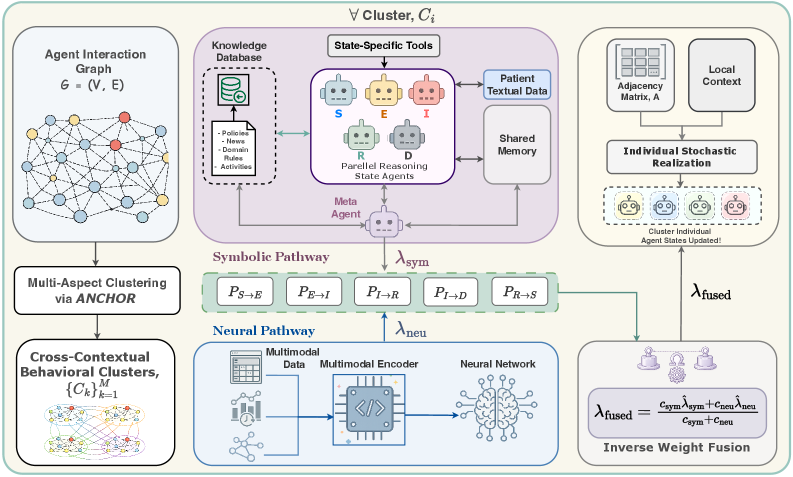
Fig 1: Figure 1 : Overview of PhysicsAgentABM Architecture. Inference is performed at the cluster level via symbolic and neural pathways with uncertainty-aware fusion, followed by stochastic agent-level realization. ANCHOR enables behaviorally coherent abstraction.
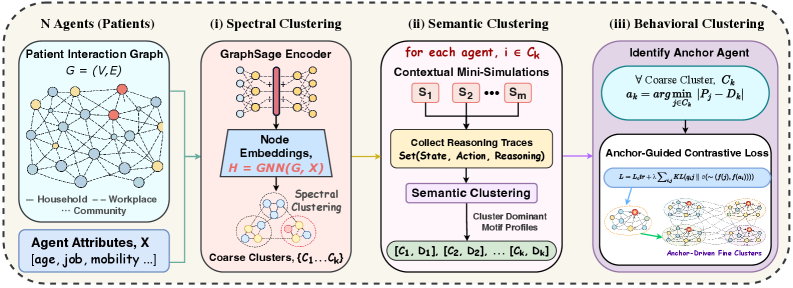
Fig 2: Figure 2 : ANCHOR Overview. An overview of our clustering mechanism.

Fig 3: Figure 3 : ANCHOR cross-contextual clusters (epidemiology). ANCHOR identifies four distinct clusters among 1,000 agents based on joint semantic and cross-contextual behavioral responses. We report normalized averages of the top-5 dominant behavioral motifs per cluster, capturing coordinated shifts in response intensity, isolation, and compliance across contexts, with signed values indicating motif direction and strength. See Appendix Section B for detailed motif descriptions and interpretation.
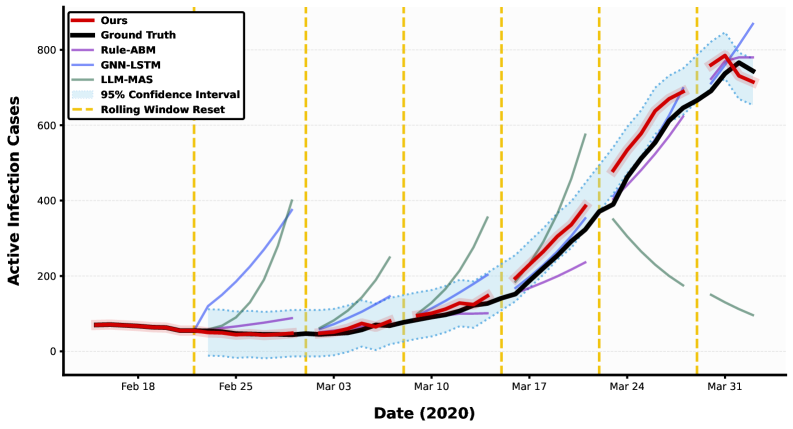
Fig 4: Figure 4 : SEIRD dynamics under rolling-window forecasting. Infection trajectories for a 1,000-agent COVID-19 simulation comparing Rule-ABM, neural and LLM baselines with our model.
Ready to evaluate your AI agents?
Learn how ReputAgent helps teams build trustworthy AI through systematic evaluation.
Learn MoreYes, But...
Results come from three domains (epidemics, a synthetic market, and attention diffusion) with structured interaction graphs; performance may differ on wholly different dynamics or unstructured interactions. Clustering quality matters: poor clusters can harm timing and calibration, so ANCHOR’s semantic clustering must be validated for new settings. The approach still depends on LLM-driven components for clustering and occasional agent-level calls, so availability, latency, and model cost are practical constraints to account for in production. Human-in-the-Loop Pattern
The Details
The method treats simulation as a two-level problem: infer coherent transition tendencies at the cluster (group) level, then let individuals realize those tendencies stochastically using local attributes and neighborhood signals. Two parallel estimators run per cluster: a symbolic, rule-like pipeline (state-specialized agents coordinated by a meta-agent) that captures mechanistic constraints and context, and a multimodal neural model that learns temporal and interaction-driven regularities. Each produces per-transition hazard estimates plus uncertainty; a small learner fuses those estimates to produce calibrated group-level priors, which are then modulated for each agent during realization. Handoff Pattern LLM-as-Judge Pattern A key component is ANCHOR, an LLM-guided clustering controller that forms clusters based on evolving behavioral similarity, interaction structure, and transition tendencies rather than only graph structure. Experiments use a rolling 28-day lookback → 7-day forecast protocol on three domains (Singapore COVID-19 case data, a synthetic trader population, and attention to climate change). Compared to rule-based, purely neural, and flat LLM multi-agent baselines, the hierarchical approach kept or improved event-timing, calibration, and regime coherence while reducing API calls, token usage, cost, and runtime. Ablations show clustering and uncertainty-aware fusion are necessary to avoid temporal misalignment or overconfidence. The design scales well: cluster-level reasoning keeps expensive work proportional to the number of clusters, so increasing population size can improve stability without proportional cost growth. LLM-as-Judge Pattern Hierarchical Multi-Agent Pattern
Explore evaluation patternsSee how to apply these findings
Credibility Assessment:
Authors have low to modest h-indices (≈3–5) and no listed affiliations or venue prestige; limited established reputation.