The Big Picture
You can produce interaction plans that are nearly equilibrium-consistent without knowing other agents' objectives by learning their best-response from past data and enforcing it as a constraint in your planner.
ON THIS PAGE
What They Found
Learning a map from an ego agent’s observable trajectory to an opponent’s best response lets the ego solve a single constrained optimization instead of repeatedly solving nested opponent problems. When the learned map is exact, the reduced solve recovers Nash equilibria; when approximate, the deviation is measurable via a best-response residual. In a two-player racing benchmark, the reduced approach produced feasible interaction plans in most test cases and achieved ego costs comparable to full-information baselines on instances where both methods succeeded. Reasoning.
By the Numbers
11200 Monte Carlo interaction scenarios were evaluated in the racing benchmark
2Planning horizon used in experiments: 10 discrete steps
3The reduced method produced feasible interaction plans in the majority (>50%) of test cases and matched full-information ego cost on paired-success runs
What This Means
Engineers building multi-agent planners and autonomous vehicle teams who must interact with agents whose objectives are private — you can plan online without access to opponents' reward functions. Technical leads evaluating safety and trust for deployed agents can treat the learned response operator as a verifiable component (train/validate it offline and monitor its residual online). Human-in-the-Loop Pattern.
Explore evaluation patternsSee how to apply these findings
Key Figures
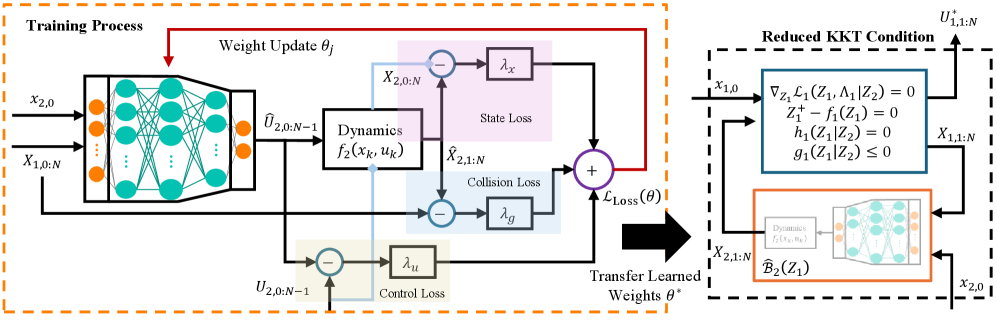
Fig 1: Figure 1 : Overall Pipeline . During the training process on the left, the MLP learns the policy π θ \pi_{\theta} (see ( V-B ) through three different loss functions. Then, the best response approximation ℬ ^ 2 \widehat{\mathcal{B}}_{2} is obtained by aggregating the learned policy and system dynamics of Player 2. Finally, we solve for the proposed reduced KKT Condition using the approximated best response surrogate.
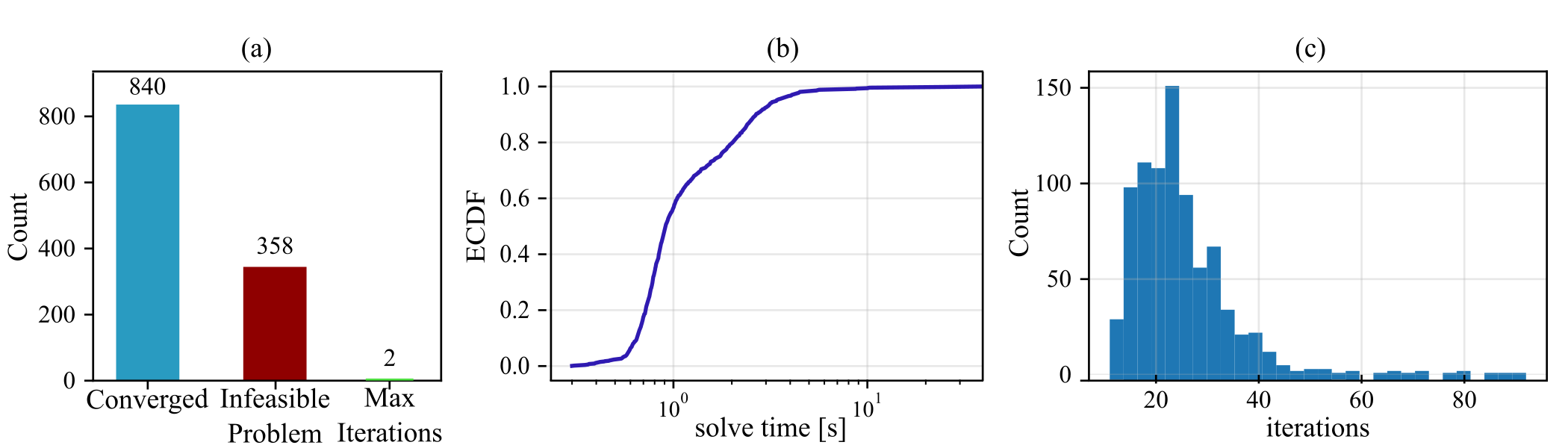
Fig 2: Figure 2 : Reduced formulation performance (ours) over N = 1200 N=1200 Monte Carlo instances. (a) IPOPT termination status counts. (b) Empirical CDF (ECDF) of wall-clock solve time (log-scale x-axis). (c) Distribution of IPOPT iteration counts on converged runs (clipped at the 99th percentile for readability).
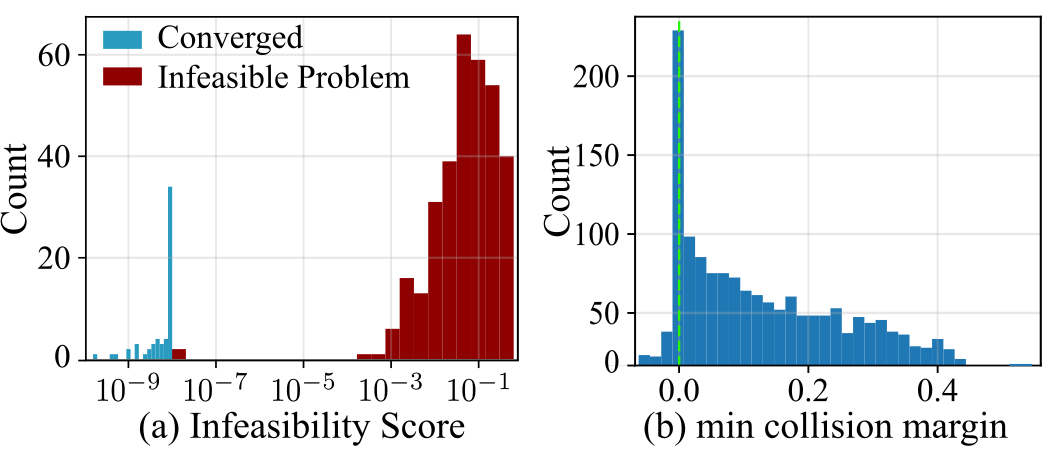
Fig 3: Figure 3 : Constraint diagnostics for the reduced formulation (ours). (a) Aggregate infeasibility score s infeas s_{\mathrm{infeas}} stratified by termination status (log-scale x-axis). (b) Minimum collision margin min k ( ‖ p 1 , k − p 2 , k ‖ 2 − d safe ) \min_{k}(\|p_{1,k}-p_{2,k}\|_{2}-d_{\mathrm{safe}}) ; values below zero indicate safety-distance violations.
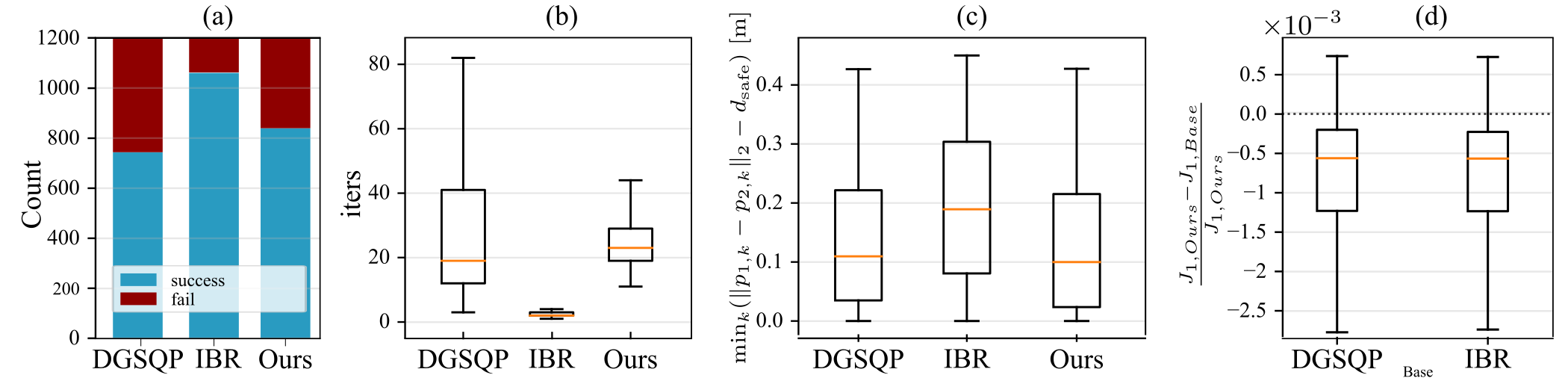
Fig 4: Figure 4 : Comparison to full-information baselines over N = 1200 N=1200 Monte Carlo instances. (a) Iterations on successful runs. (b) Minimum collision margin on successful runs. (c) Paired ego-cost differences Δ J 1 := J 1 ours − J 1 base \Delta J_{1}:=J_{1}^{\mathrm{ours}}-J_{1}^{\mathrm{base}} on instances where both solvers succeeded (negative is better for ours). (d) Outcome counts (success vs. non-success).
Ready to evaluate your AI agents?
Learn how ReputAgent helps teams build trustworthy AI through systematic evaluation.
Learn MoreYes, But...
The approach depends on the quality and coverage of offline interaction data: out-of-distribution opponent behavior can make the embedded response constraint invalid or infeasible. Experiments were open-loop on a kinematic model and assume the opponent’s dynamics class is known; closed-loop deployment will need conservative safety wrappers or online adaptation. The dominant failure modes were infeasibility detection and occasional small safety-margin violations under ex-post checks, so treat the response operator as safety-critical. Explainability.
The Details
Recast the two-player dynamic game so the ego agent enforces a best-response feasibility constraint for the opponent instead of solving or differentiating through the opponent’s optimization online. Practically, collect offline pairs of ego trajectories and corresponding opponent best responses (from logs or simulation), fit a response map, and embed the learned map as an equality constraint in the ego’s finite-horizon planner. Keeping the opponent trajectory as an explicit decision variable while forcing it to equal the learned response avoids derivative coupling and preserves the ego’s Nash-style stationarity conditions.
In experiments on a tight two-car racing benchmark (1200 randomized scenarios, 10-step horizons), the reduced formulation produced feasible interaction plans in most test cases and obtained ego costs comparable to full-information equilibrium solvers on instances where both methods succeeded. The method succeeds when the learned map accurately captures opponent behavior; its main failure modes are infeasibility and small safety-margin violations under ex-post evaluation. For deployment, treat the learned operator as a safety- and trust-critical artifact: gather rich interaction data, add out-of-distribution detection, and employ conservative safety filters or receding-horizon adaptation to guard against unseen opponent strategies. Hierarchical Multi-Agent Pattern Agent Service Mesh Pattern.
Avoid common pitfallsLearn what failures to watch for
Credibility Assessment:
Authors have low h-indices and no affiliation or venue prestige (arXiv only), indicating limited established credibility.