The Big Picture
Measure whether group behavior gives extra value beyond simply adding more compute: use a "collaboration gain" score (Γ) and a structured factor library to separate true teamwork from mere resource increases.
ON THIS PAGE
The Evidence
A single, task-aware metric called collaboration gain (Γ) can distinguish real cooperative benefits from performance gains caused only by added compute or agents. A two-step factor attribution process—first find performance improvements, then check Γ—lets teams confirm whether a change truly boosts collaboration. Organizing candidate variables into a factor library (task context vs. MAS construction, and within construction: control vs. information levels) turns blind trial-and-error into a reproducible testing recipe. factor attribution process
Data Highlights
13 core recommendations: adopt a collaboration-gain metric, run a factor attribution paradigm, and build a factor library.
2Γ > 1 is the binary threshold that signals genuine collaboration—values at or below 1 imply no teamwork advantage over an equivalent single-agent baseline.
32 external vs. internal domains in the factor library; internal factors split into 2 levels (control level for static architecture, information level for dynamic execution mechanisms).
What This Means
Engineers building systems where multiple AI agents coordinate—use the metric to prove that added agents actually help rather than just cost more. Technical leads and research teams can use the factor library and attribution recipe to prioritize experiments and avoid wasted compute on changes that only add resources. Researchers tracking collective AI can adopt the metric for clearer, comparable claims about emergence and synergy.
Not sure where to start?Get personalized recommendations
Key Figures
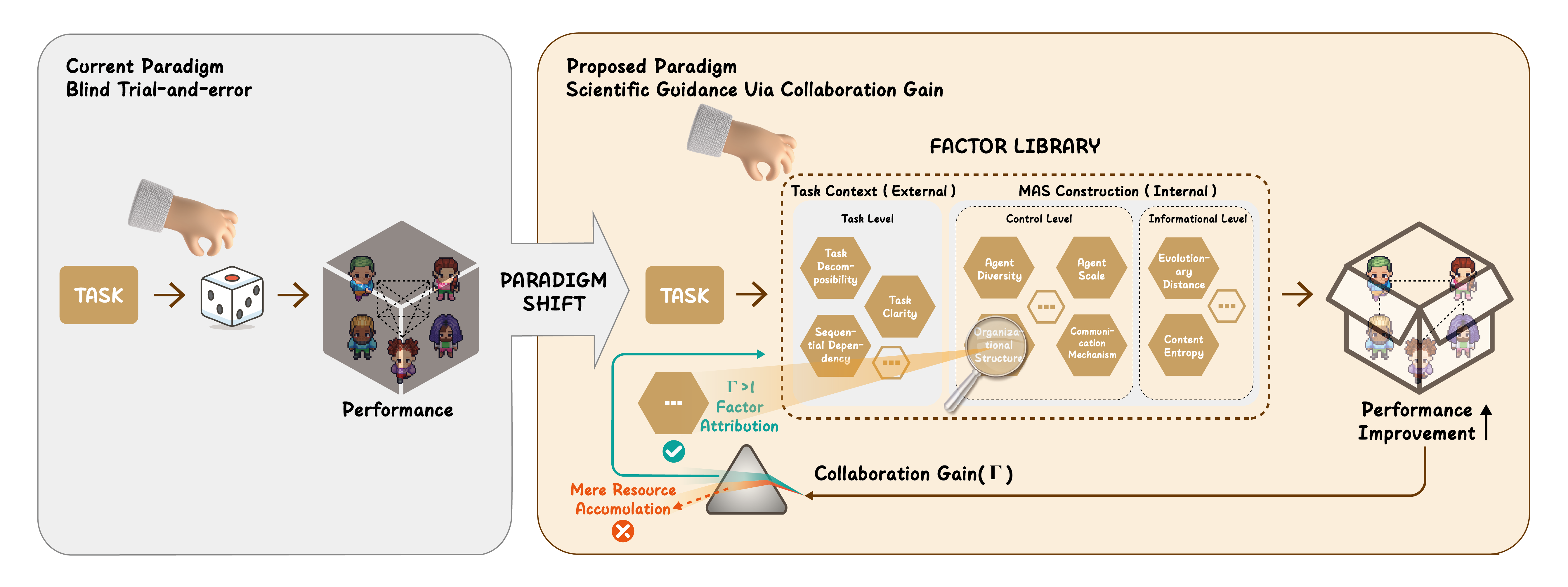
Fig 1: Figure 1 : The Paradigm Shift: From Blind Trial-and-Error to a Science Guidance. Left (Current): An opaque black box where performance gains are stochastic and unattributable. Right (Proposed): A white-box paradigm. Researchers select factors from the library to construct the MAS; observed performance is then passed through the Γ \Gamma (the prism), which filters out mere resource accumulation to isolate genuine collaboration gain. This analytic step inherently executes factor attribution.
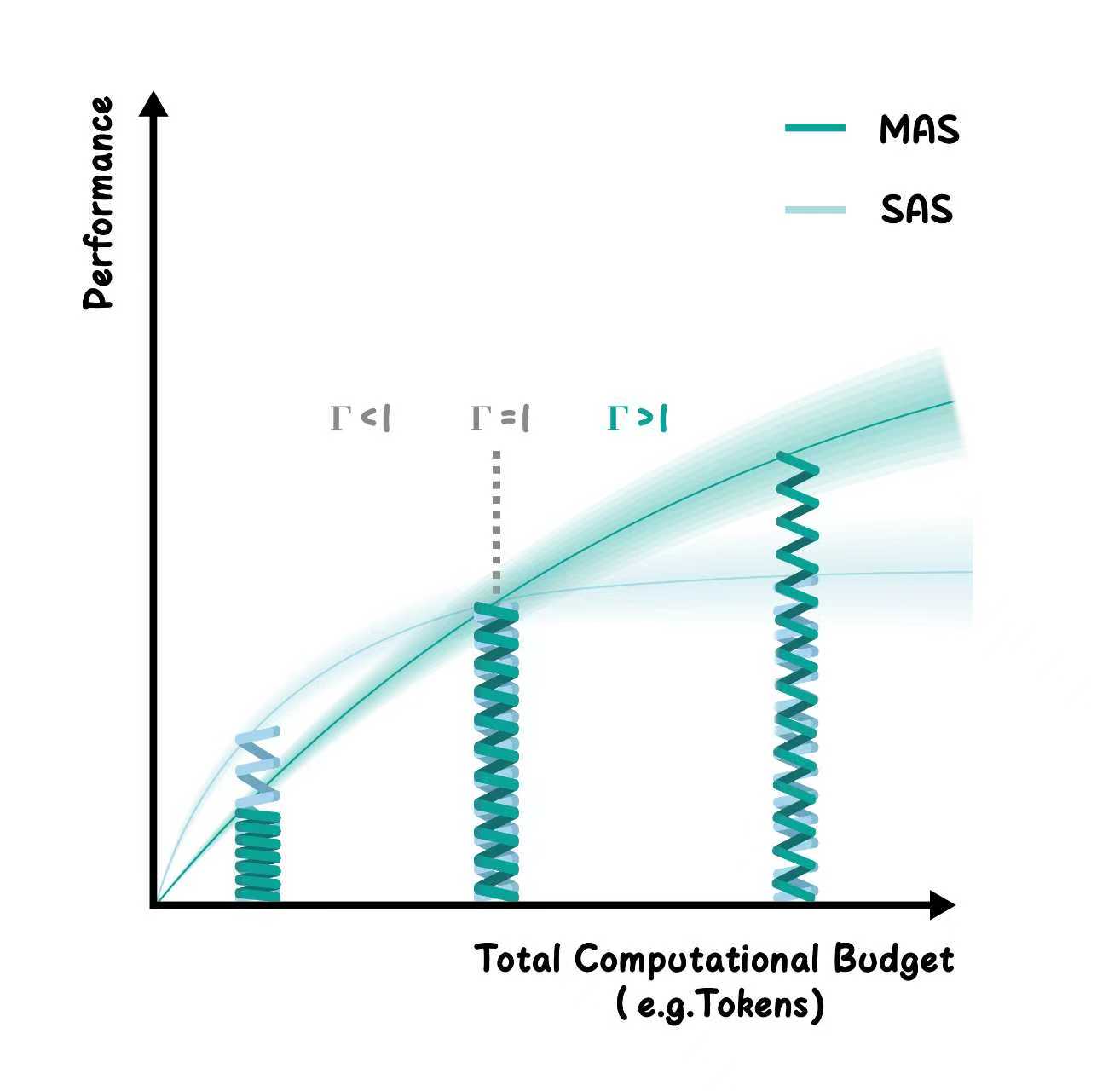
Fig 2: Figure 2 : Conceptual Illustration of Collaboration Gain ( Γ \Gamma ). The curves represent the performance of MAS and SAS under equivalent computational budgets to ensure comparability. When SAS performance equals or exceeds MAS, Γ ≲ 1 \Gamma\lesssim 1 , indicating mere resource accumulation; conversely, Γ > 1 \Gamma>1 signifies the genuine collaboration beyond the single-agent.
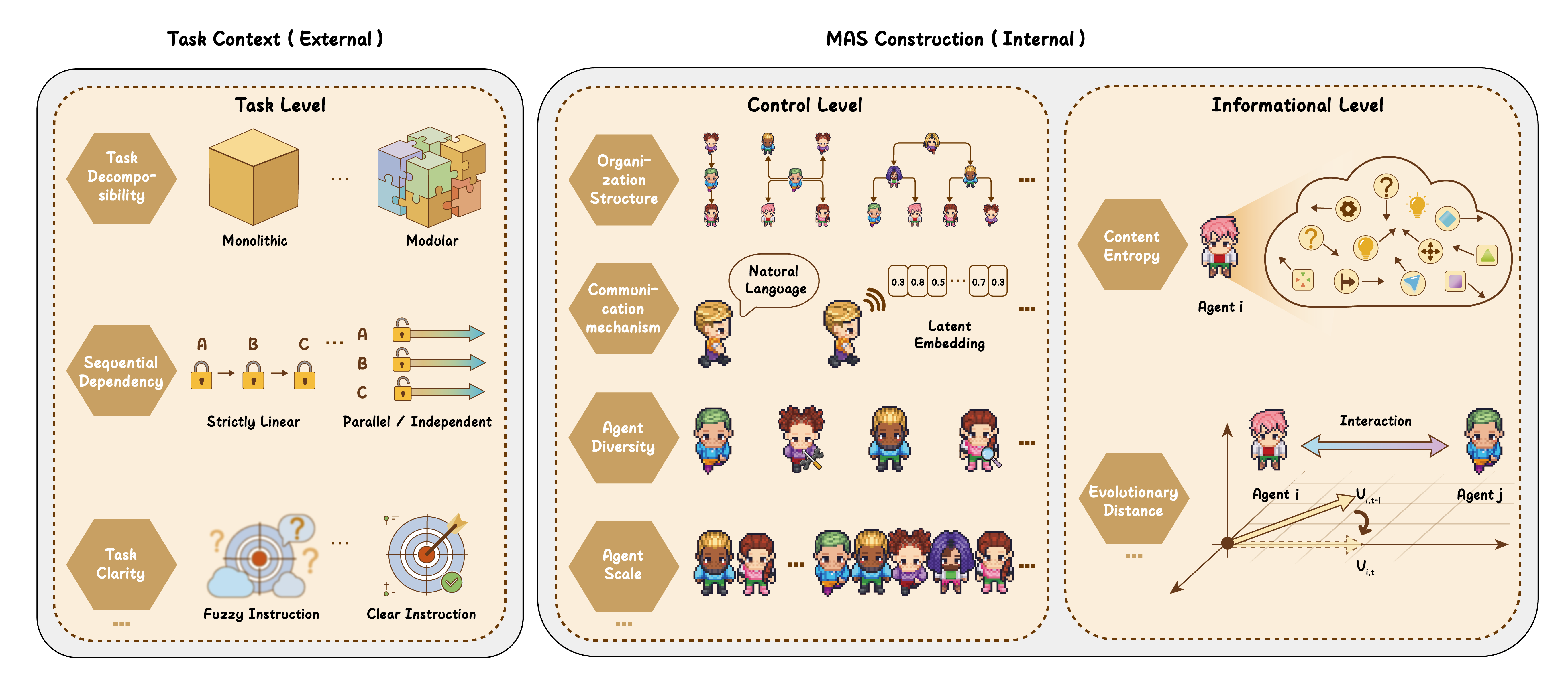
Fig 3: Figure 3 : The MAS Factor Library Taxonomy. Factors are organized into task context(external) and MAS construction( internal), with the internal dimension spanning static control level presets and dynamic information level to guide rigorous system design.

Fig 4: Figure 4 : The taxonomy of communication mechanisms in biological groups.
Ready to evaluate your AI agents?
Learn how ReputAgent helps teams build trustworthy AI through systematic evaluation.
Learn MoreYes, But...
The collaboration-gain score depends on how you define task success (the evaluation function) and how you measure resource equivalence, so results are only comparable when those choices are standardized. Running rigorous, resource-matched baselines increases experimental overhead and requires careful engineering to ensure fairness. The proposal is conceptual: it defines a testing framework and taxonomy but does not deliver large-scale empirical benchmarks demonstrating consistent numeric improvements across domains. evaluation function
Methodology & More
Measure synergy, not just scale. The central idea is the collaboration gain (Γ): the ratio of a multi-agent system’s performance to the best single-agent performance given the same total resource budget. If Γ > 1, the group achieved a genuine cooperative advantage; if Γ ≤ 1, the multi-agent setup added no teamwork value beyond consuming more compute. Because both the performance function and the resource metric are task-dependent, the approach requires defining task-appropriate evaluation functions (accuracy, coverage, etc.) and matching resource accounting (tokens, tool calls, runtime) between multi-agent and single-agent baselines. Turn guesswork into a recipe. Use a two-step factor attribution paradigm: (1) identify candidate factors that change performance (e.g., organization, communication rules, agent scale); (2) confirm whether any observed gains are collaboration-driven by checking Γ. To help guide which factors to test, build a structured factor library: separate task context (external constraints like decomposability or sequential dependency) from MAS construction (internal), and within internal factors split into control-level presets (static architecture) and information-level mechanisms (dynamic messaging, content properties). Together these pieces let teams systematically test what really makes agents work better as a group and avoid wasting resources on changes that only increase capacity. collaboration gain (Γ) total resource budget
Avoid common pitfallsLearn what failures to watch for
Credibility Assessment:
Contains several authors with moderate h-indices (several around 10–11 and multiple mid-range contributors); stronger author signal despite being an arXiv preprint.