The Big Picture
A fully open-source system can run multiple autonomous cars in the same simulated parking lot across separate computers, coordinating drop-off, parking, and retrieval without conflicts—provided hosts have enough memory and a centralized camera watches the lot.
ON THIS PAGE
The Evidence
Distributed coordination and perception running on separate machines produced synchronized, conflict-free parking behavior in both two-host and three-host tests. An overhead camera module running inside the simulator reliably published parking availability, but the vision model was sensitive to vehicle color and shape and required standardizing test vehicles. The current setup uses a single host to manage reservations (a single point of failure) and showed hardware limits: a host with less memory sometimes entered an emergency state and failed to complete tasks. consensus-based decision pattern
Data Highlights
1Validated across 2-host and 3-host distributed setups, with both configurations achieving synchronized, conflict-free parking assignments.
2Instability correlated with memory: the third host with 16 GB RAM showed intermittent failures, while hosts with 24 GB RAM operated stably.
3All parked vehicles were standardized to red sedans during vision tests to keep U-YOLO occupancy detection consistent, exposing sensitivity to color/shape variations.
What This Means
Engineers building multi-vehicle simulations or testing fleet coordination; this shows a practical, open-source way to run multiple full autonomy stacks together and test reservation/queuing logic. Technical leads planning hardware for distributed validation should note the memory and CPU requirements and the current reliance on a centralized camera and coordinator. Multi-Agent Event Management
Not sure where to start?Get personalized recommendations
Key Figures
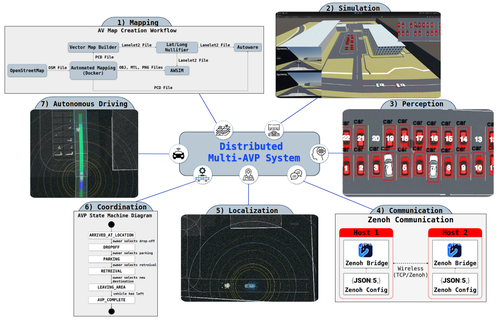
Fig 1: Figure 1: Proposed seven-workflow layered architecture for the DMV-AVP System, extending the five-workflow DMAVA with additional Perception and Coordination workflows.
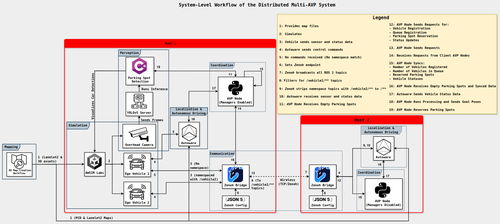
Fig 2: Figure 2: System-level workflow of the DMV-AVP System across two physical hosts.
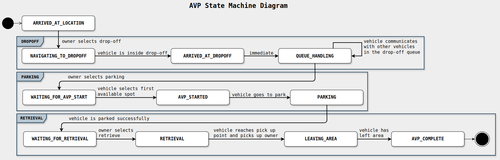
Fig 3: Figure 3: AVP state machine diagram illustrating the vehicle lifecycle from arrival to completion across Drop-off, Parking, and Retrieval phases.
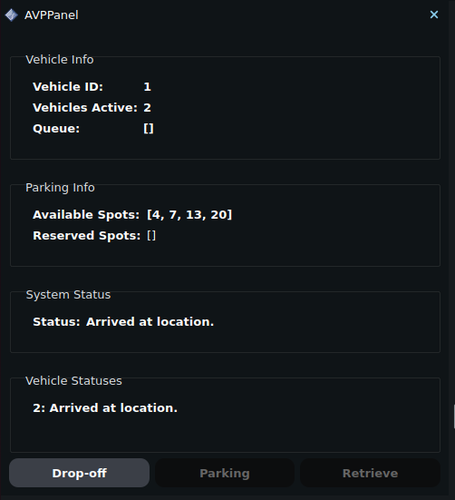
Fig 4: Figure 4: Custom AVP Panel in RViz displaying vehicle status, parking availability, and lifecycle controls for Drop-off, Parking, and Retrieval.
Ready to evaluate your AI agents?
Learn how ReputAgent helps teams build trustworthy AI through systematic evaluation.
Learn MoreKeep in Mind
Current coordination is centralized: managers run on a single host, creating a single point of failure and limiting fault tolerance. Vision-based parking detection worked in controlled simulation but was sensitive to vehicle color and shape, so expect degradation in visually diverse or real-world scenes without additional training. Some Autoware planners failed to route vehicles outside mapped lane regions, requiring manual repositioning—unsuitable for production retrieval workflows. Semantic Capability Matching Pattern
Methodology & More
Built on a prior distributed Autoware architecture, the system runs an instance of the full autonomy stack per vehicle across separate machines and uses a cross-host messaging layer to synchronize topics and states. An overhead simulator camera runs a YOLOv5-based detector inside the simulator to publish spot availability, and a coordination node handles queuing, reservations, and per-vehicle goals so multiple vehicles can enter a drop-off area, get assigned parking slots, and later be retrieved without conflicting assignments. The system was exercised in two- and three-host deployments using Autoware Universe inside AWSIM Labs and demonstrated deterministic synchronization and stable closed-loop control when hardware resources were sufficient. Guardrails Pattern consensus-based decision pattern LLM-as-Judge (Note: additional references to enable robustness and fault tolerance)
Avoid common pitfallsLearn what failures to watch for
Credibility Assessment:
No affiliations and low author h-indices; minimal reputation signals.