The Big Picture
Selective sharing of useful intermediate steps across parallel agent teams cuts redundant work and speeds up long tasks without sacrificing final answer quality.
ON THIS PAGE
The Evidence
A shared memory that stores concise summaries of intermediate results, combined with a lightweight learned controller that decides what to save, lets parallel agent teams reuse work instead of repeating it. That selective sharing reduces overall runtime on long, tool-heavy tasks while matching or improving final solution quality. Naively dumping every intermediate step into shared memory either adds noise or hurts efficiency, so learning when to admit a step is crucial. This approach aligns with the Agent Service Mesh Pattern and beyond, helping teams manage inter-agent data flows. It also warns against over-sharing, as excessive dumps can lead to issues described by Spiraling Hallucination Loops.
Data Highlights
1Evaluated on 165 GAIA tasks (53 level 1, 86 level 2, 26 level 3) and 181 AssistantBench tasks, showing broad coverage of long, multi-step problems.
2The memory controller was trained using only the 33-task development split of AssistantBench and then applied to other evaluations (no retraining on GAIA).
3The admission controller makes a single binary decision per intermediate step (store or discard), keeping memory growth explicitly controlled.
What This Means
Engineers building multi-agent orchestration systems who want faster end-to-end runs and lower compute cost should consider selective shared memory. Technical leaders running large-scale agent fleets or tool-heavy workflows can use the approach to cut redundant work without changing core agent logic. Researchers studying agent interaction or agent reliability can use the learned-admission framing to study which signals indicate reusable progress, and practitioners may find guidance in the LLM-as-Judge Pattern.
Not sure where to start?Get personalized recommendations
Key Figures
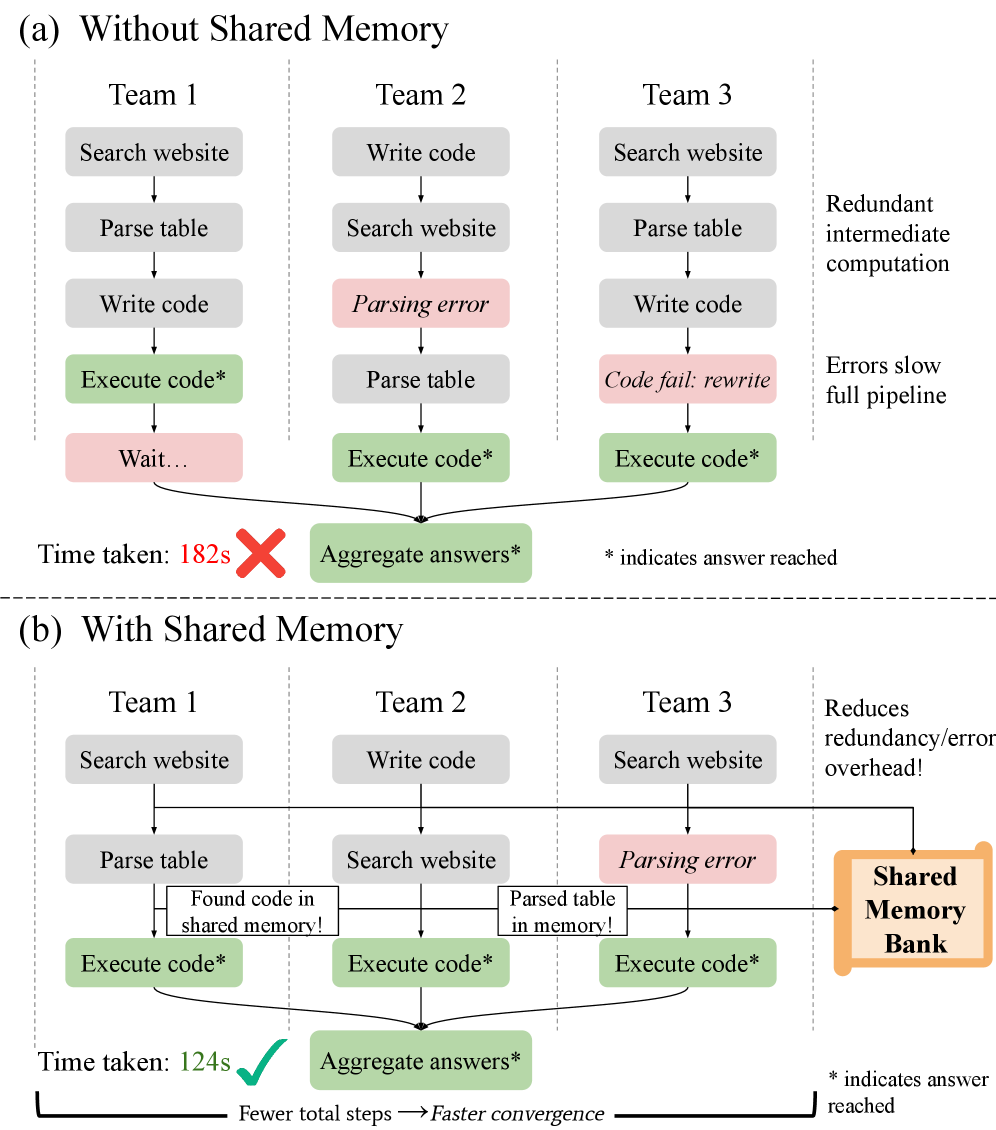
Fig 1: Figure 1 : Shared memory reduces redundant computation in parallel agentic execution. Comparison of parallel agent teams solving a long-horizon task without (top) and with (bottom) shared memory. (a) Without shared memory, teams independently repeat overlapping intermediate steps (e.g., web search, table parsing, code writing), and errors in one branch propagate additional retries, increasing overall latency. (b) With a shared memory bank, teams reuse previously discovered intermediate results, avoiding redundant work and reducing error overhead. As a result, the system converges in fewer total steps and lower wall-clock time.
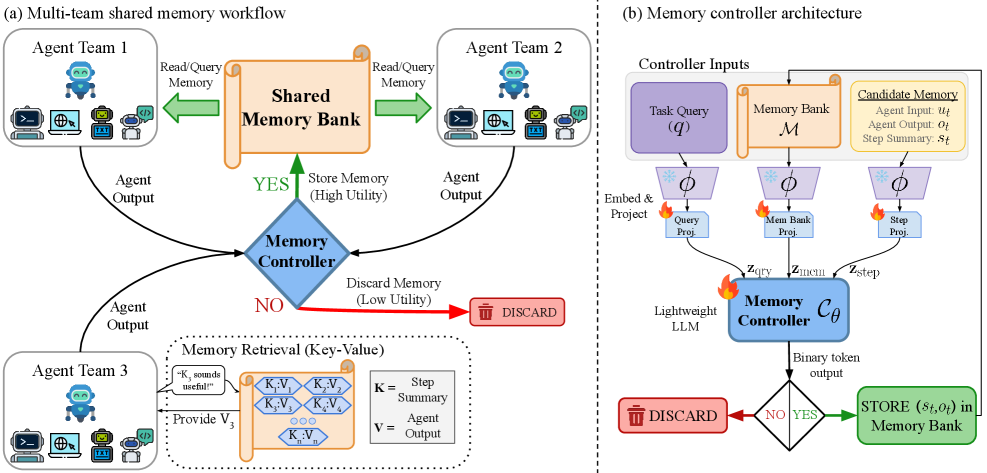
Fig 2: Figure 2 : Learning to Share: selective shared memory for parallel agentic systems. (a) Parallel agent teams execute independently while interacting with a central Shared Memory Bank . After each agent step, a learned Memory Controller evaluates the intermediate result and selectively admits high-utility information into shared memory as a key-value pair (step summary, agent output) or discards it. Teams may query stored keys to reuse previously discovered results to reduce redundant computation (shown only for team 3, but all teams follow the same memory retrieval). (b) The memory controller receives embeddings of the task query, existing memory keys, and the current step (agent input, output, and summary) for context. These are projected into a shared token space and processed by a lightweight controller LLM, which emits a single binary decision indicating whether the step should be stored. Selective admission maintains a high-quality shared memory while accelerating convergence.

Fig 3: Figure 3 : Cumulative distribution of wall-clock completion times on AssistantBench. Our LTS shared-memory approach shifts the runtime distribution left relative to memory-free M1-Parallel, indicating faster completion for a larger fraction of tasks. Selectively sharing intermediate results reduces redundant computation and lowers overall latency.
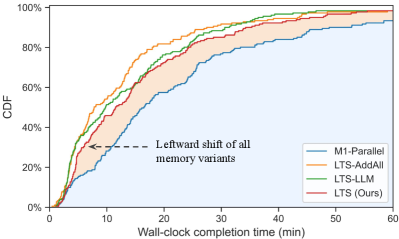
Fig 4: Figure S1 : Cumulative distribution of wall-clock completion times on AssistantBench for shared-memory variants. All shared-memory variants shift the runtime distribution left relative to memory-free M1-Parallel, indicating reduced wall-clock latency due to cross-team reuse of intermediate results. Alternate admission strategies achieve larger runtime gains but exhibit lower task accuracy.
Ready to evaluate your AI agents?
Learn how ReputAgent helps teams build trustworthy AI through systematic evaluation.
Learn MoreConsiderations
Exact runtime and accuracy improvements are reported as distributional shifts rather than single-point percentages in the paper, so expect variant-specific gains that depend on task mix and implementation details. The memory controller was trained on a small development split, so additional tuning may be needed for very different environments or toolsets. Shared memory introduces considerations around privacy, data sharing, and caching correctness that must be handled in production deployments. See also potential failure modes like RAG Poisoning.
Methodology & More
Parallel teams exploring multiple solution paths often redo the same intermediate steps—web lookups, parsing, or partial code—wasting time. A global memory bank that holds concise natural-language summaries as keys and raw outputs as values lets teams peek at past work and retrieve full artifacts only when needed. But storing everything clutters context and invites noise, so a lightweight controller is trained to accept only steps likely to help other teams. The controller is a compact language model that emits a single yes/no decision for each agent step. It’s trained with a stepwise reinforcement objective that rewards memory entries used by other teams and penalizes unbounded growth, so the system learns what is globally useful. Evaluated on two long-horizon benchmarks (GAIA and AssistantBench), the selective memory approach consistently shifts runtime distributions toward faster completion while maintaining or improving final-task results; naive memory dumping either increases variance or harms accuracy. The method is straightforward to add to existing parallel agent frameworks and is especially useful where repeated tool calls are costly or slow to reproduce, a pattern that resonates with the Hierarchical Multi-Agent Pattern.
Avoid common pitfallsLearn what failures to watch for
Credibility Assessment:
Mostly low h-index authors and no venue/affiliation information; not enough senior/established signals to rate higher.