The Big Picture
Large language model agents can find optimal ordering rules in simple supply chains, but they struggle to generalize; giving agents a searchable memory of prior successful runs makes them far more robust and lets them match reinforcement-learning performance without heavy retraining.
ON THIS PAGE
The Evidence
A plain decision prompt plus a basic safety-stock rule lets an AI agent team hit the optimal ordering policy in a simple, uniform-demand scenario. The same prompt fails in other, more varied supply-chain setups. Letting agents retrieve and reuse similar past experiences (stored as historical logs from reinforcement-learning runs) makes behavior consistent across diverse scenarios and brings performance up to the level of learned reinforcement-learning baselines. Increasing the model’s internal “reasoning effort” did not reliably improve results, so memory-based adaptation mattered more than extra compute per decision.
Not sure where to start?Get personalized recommendations
Data Highlights
1Reached the true optimal ordering policy (zero optimality gap) in the constant-uniform scenario using a stepwise prompt plus safety-stock guidance.
2AIM-RM used K = 6 nearest-neighbor retrievals with a similarity threshold τ = 2 and, when initialized with historical reinforcement-learning logs, matched reinforcement-learning baselines across the 5 evaluation episodes.
3The increasing and decreasing demand scenarios required selling 54 units over the episode, creating a supply requirement that exposed where non-adaptive agents failed.
What This Means
Engineers building AI agents for supply-chain planning — because a lightweight memory layer can make LLM-based agents more reliable without expensive retraining. Technical leaders evaluating agent orchestration and automation — because Hierarchical Multi-Agent Pattern memory-augmented agents can match learned policies while reducing the training and simulation cost. Researchers exploring practical agent systems — because the study shows a clear path (and limits) for retrieval-based adaptation in multi-agent settings.
Key Figures
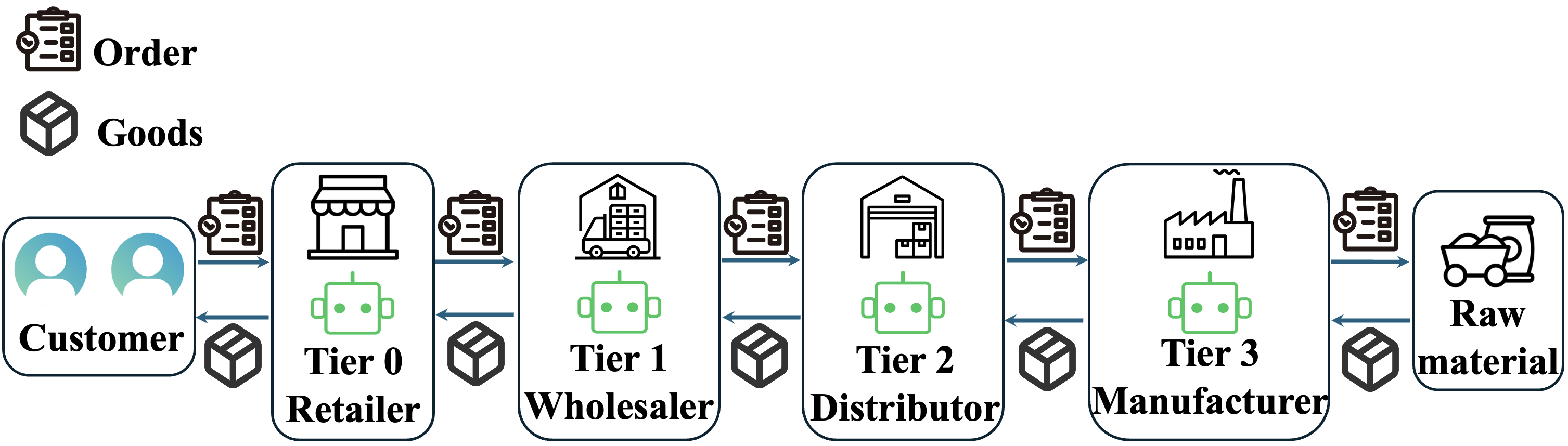
Fig 1: Figure 1. Multi agent system for inventory management in a supply chain. At each tier, the agent places orders with the upstream agent and receives goods after a delivery lead time.
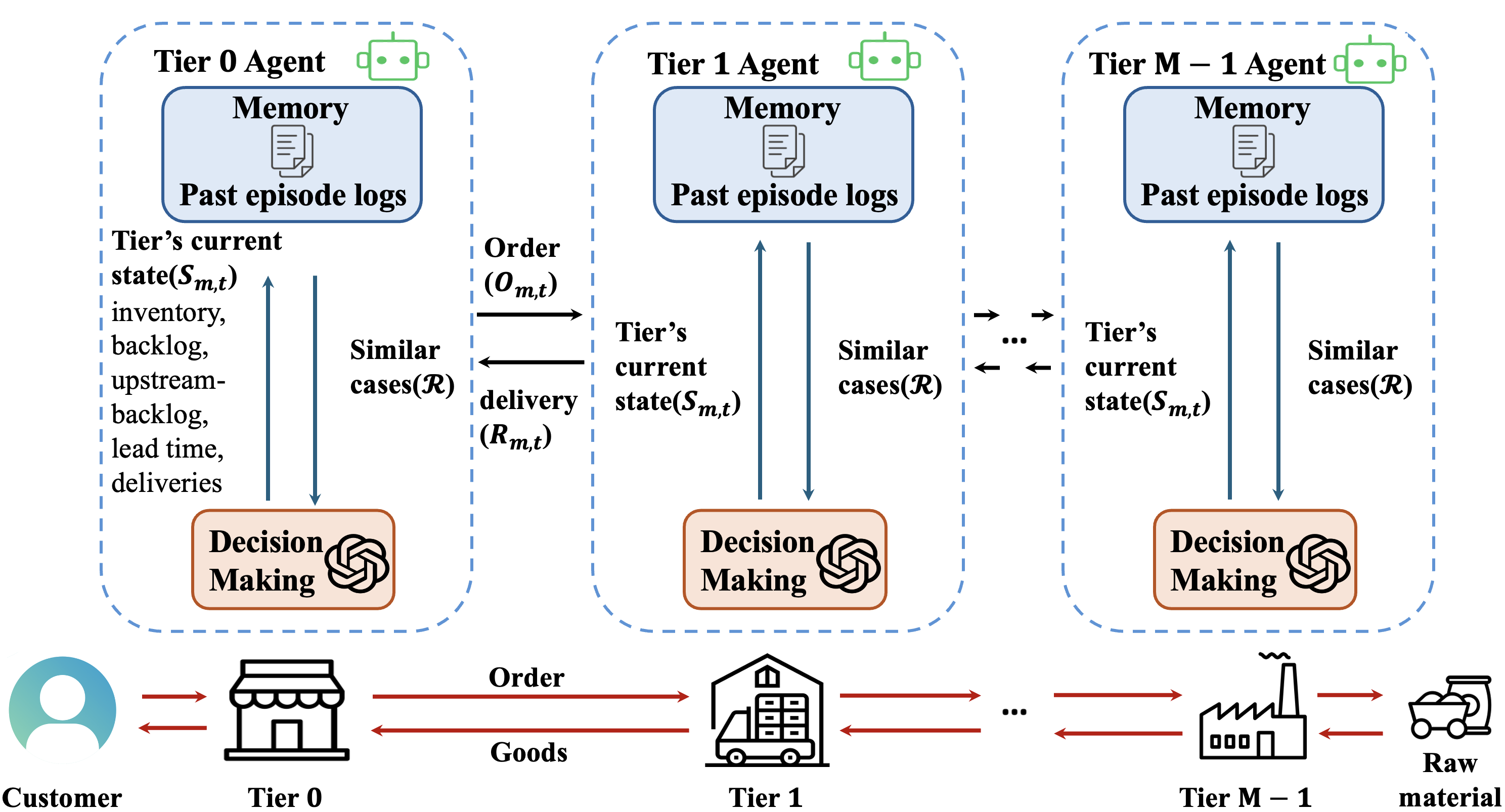
Fig 2: Figure 2. Framework of the interaction between agents and the supply chain environment. Starting with the downstream agent, the agent at each tier observes its state and places an order with the upstream agent in a round. Our proposed agent retrieves historical experience data through similarity matching and then uses them when placing an order.
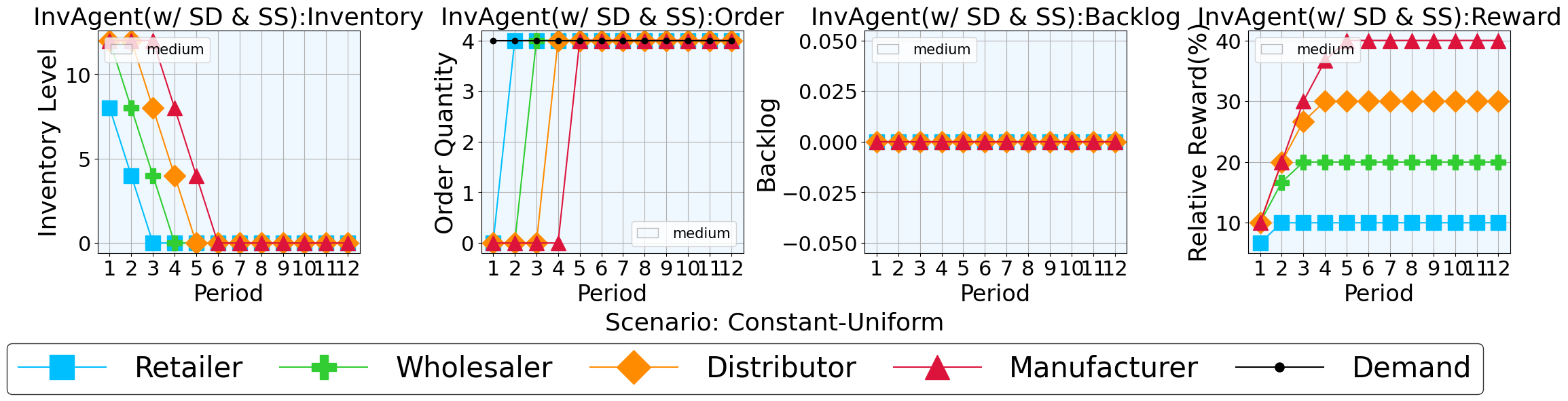
Fig 3: Figure 3. Results of InvAgent (w/ step desc and safety stock strategy) with medium reasoning effort. These four graphs present, from left to right, the inventory, backlog, order quantities, and relative reward ( r / 𝖮𝗉𝗍 ) (r/{\sf Opt}) within an episode. The “demand” legend corresponds to customer demand, which is plotted in the graph for order quantity.
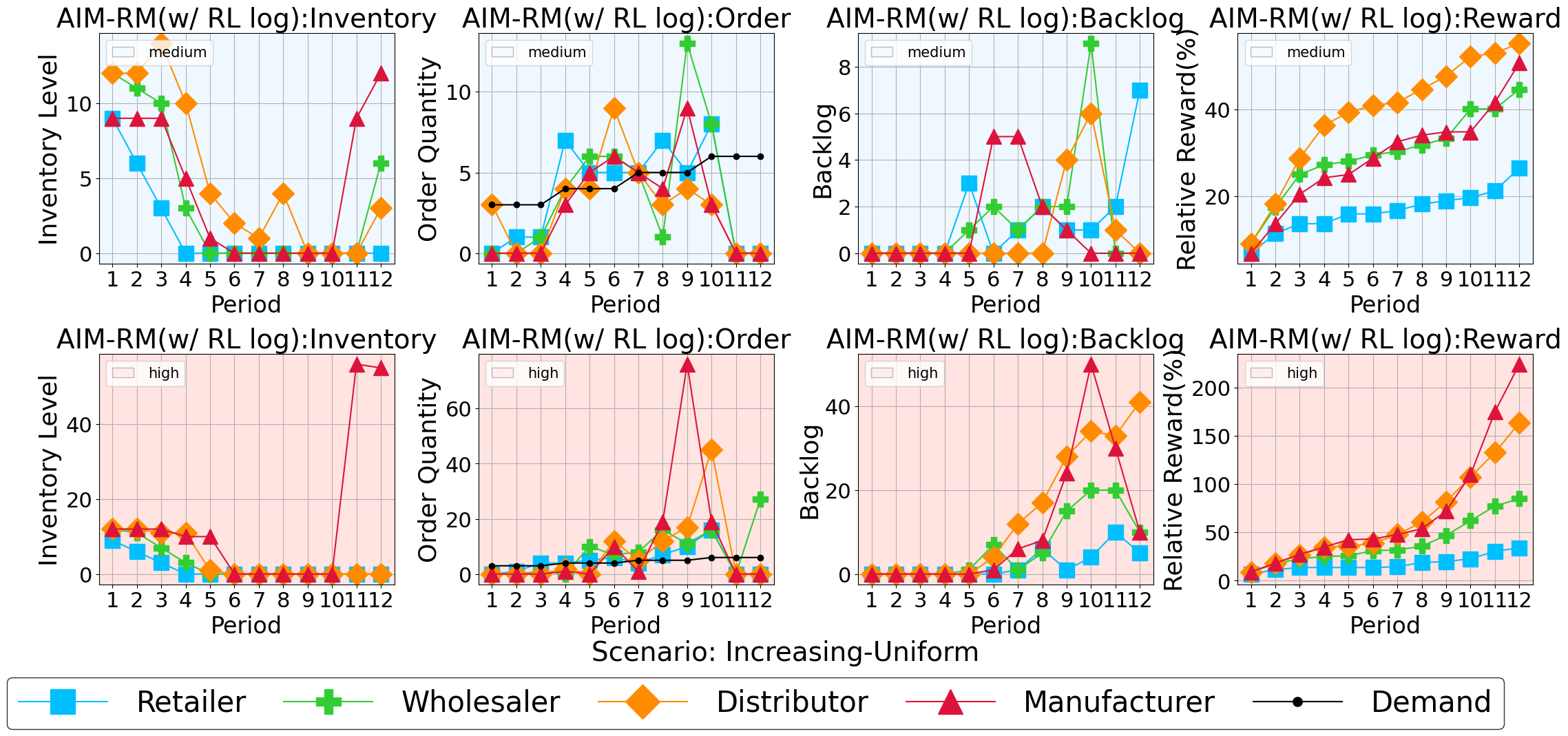
Fig 4: Figure 4. Results for the inventory level, backlog, order quantities, and cumulative reward within an episode. The graphs in the first line represent the results of AIM-RM (w/ RL log) with medium reasoning effort, and those in the second line represent the same model with a high reasoning effort.
Ready to evaluate your AI agents?
Learn how ReputAgent helps teams build trustworthy AI through systematic evaluation.
Learn MoreConsiderations
Experiments used deterministic demand to limit API costs, so results may differ under realistic random demand. Similarity matching used a fixed Euclidean metric and threshold (τ = 2); alternative metrics or learned similarity could change performance. The language model sometimes produced orders without clearly reflecting retrieved cases, indicating occasional mismatch between retrieved memory and the model’s reasoning path. See State Inconsistency for related failure modes.
Methodology & More
They framed multi-tier inventory control as a multi-echelon supply-chain problem where one agent controls each tier and acts each period (replenish, observe demand, decide orders, ship, and compute profit/loss). Baseline agents used a decision prompt that walks the model through those steps; one variant also included a standard safety-stock strategy. The experimental setup covered five scenarios (uniform vs diverse tier parameters and constant/increasing/decreasing deterministic demand patterns) and compared prompt-only agents, heuristic policies, and reinforcement-learning baselines. To boost adaptability, the proposed AIM-RM adds a searchable memory: agents store past episodes (including results from reinforcement-learning runs) and, at decision time, retrieve the K = 6 most similar cases (similarity threshold τ = 2) and are instructed how to use them. Across five evaluation episodes, the prompt+strategy agent reached the true optimal policy only in the simplest (constant-uniform) case. By contrast, AIM-RM initialized with RL logs improved robustness across diverse scenarios and produced total rewards comparable to multi-agent reinforcement-learning, without the heavy sample cost of retraining. The study also found that cranking up the model’s internal “reasoning effort” did not consistently improve outcomes, so retrieval of past relevant experience was the key benefit. memory-based adaptation Implications: adding an experience-retrieval layer is a practical way to make language-model-based agent teams adapt to new supply-chain situations, offering a middle ground between brittle prompt engineering and expensive reinforcement learning. Follow-up work should test stochastic demand, learn or tune similarity metrics, and consider adding structured self-reflection logs so agents can summarize what worked and turn that into reusable rules.
Avoid common pitfallsLearn what failures to watch for
Credibility Assessment:
All authors have very low h-indices and no listed affiliations; arXiv preprint with no citation history suggests limited established reputation.