At a Glance
More coordination isn’t always better: in a simulated predator–prey setting, centralized value learning sometimes reduced performance while independent (decentralized) learners were more effective for predators under many embodied constraints.
ON THIS PAGE
What They Found
Embodiment factors like speed and stamina change whether centralized coordination helps or hurts. In an 8×8 predator–prey grid, fully independent learners (one learner per role) often produced shorter episodes and higher predator rewards than fully centralized learners. Mixed setups—where one role learned centrally and the other independently—created persistent coordination failures and high variance. Predator advantage in speed amplified the benefit of decentralized learning, while prey speed advantage worsened breakdowns under mixed learning structures.
Data Highlights
1IQL–IQL (fully independent learners) achieved significantly shorter episodes and higher predator returns than CQL–CQL (fully centralized learners): paired Wilcoxon p = 0.00195, Cliff’s δ = 1.0.
2Experiments ran across 3 kinematic regimes (equal speed, predator faster, prey faster), revealing regime-dependent reversals in which learning structure flips which approach wins.
3All reported results are seed-level averages over the final 10,000 training episodes across 10 independent random seeds on an 8×8 grid.
What This Means
Engineers building multi-agent teams and technical leads choosing coordination strategies should care: centralized training is not a universal fix and can introduce brittleness when agents have speed or stamina limits. Researchers comparing coordination methods should test across embodied regimes (speed/stamina) rather than relying only on symmetric benchmarks. If organizations seek guardrails for coordination, consider centralized training as one option to evaluate in context.
Not sure where to start?Get personalized recommendations
Key Figures
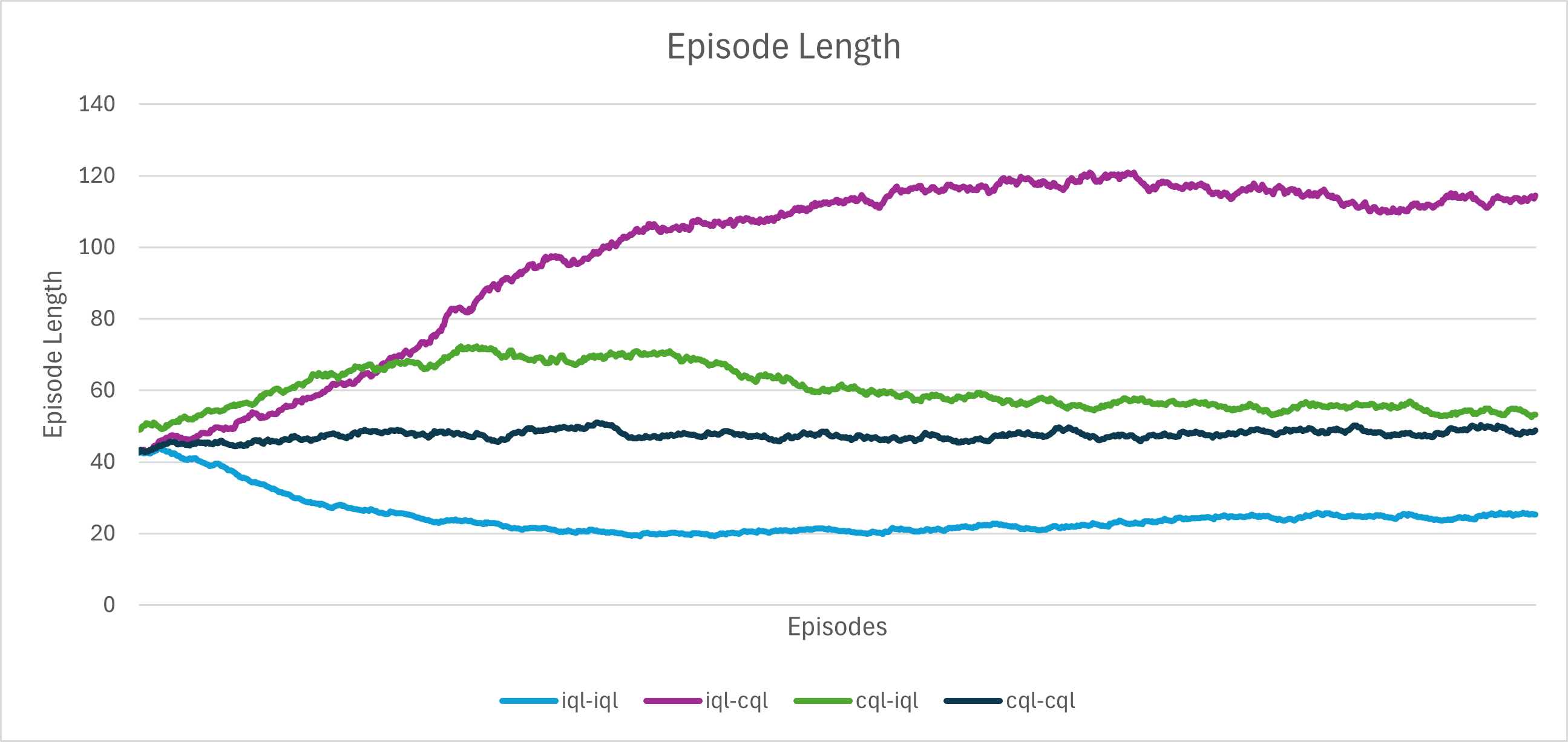
Fig 1: Figure 1: Mean episode length over training under the base-speed regime. Curves show the mean across 10 independent seeds. Lower values correspond to more efficient predator coordination.
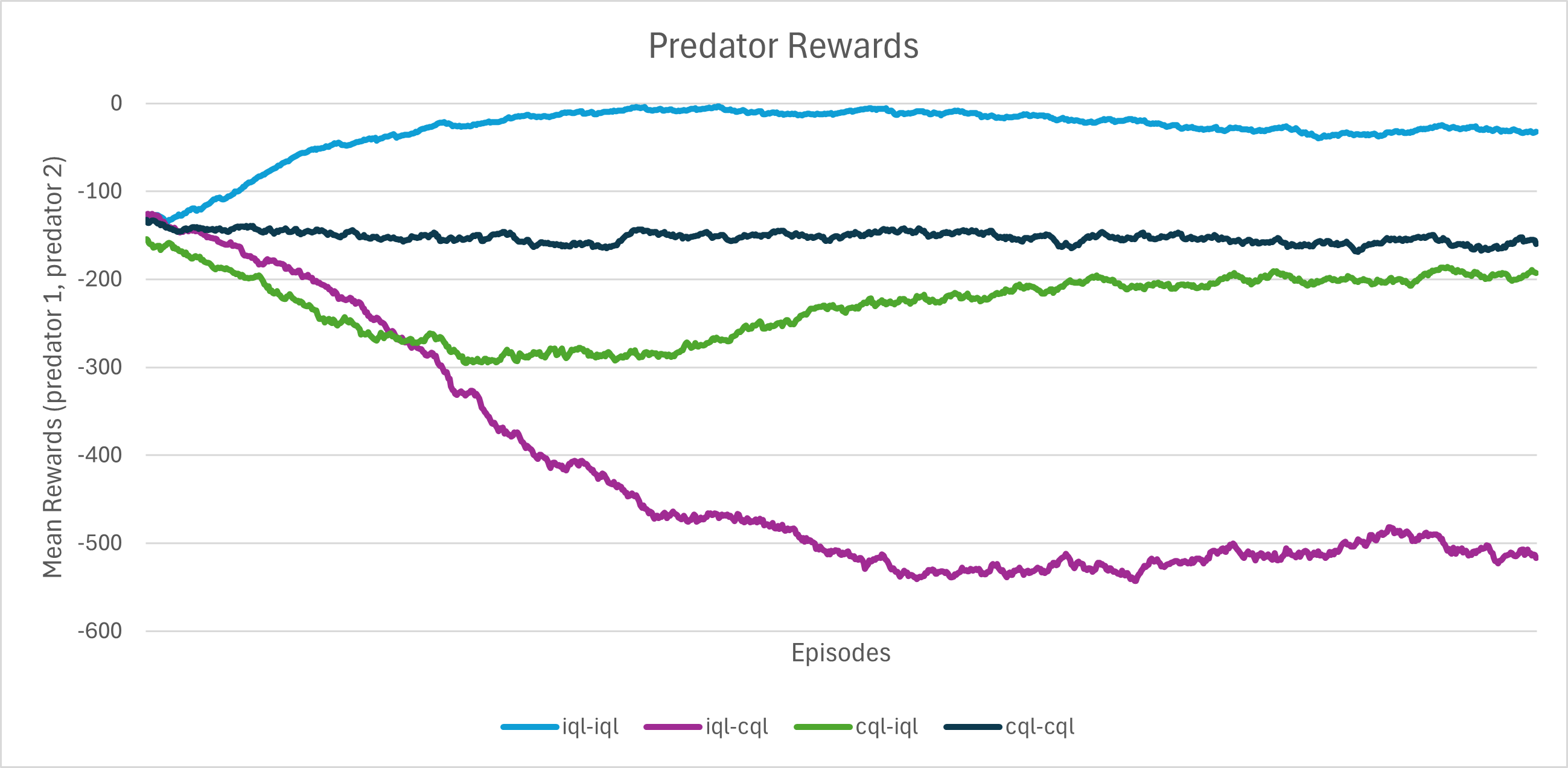
Fig 2: Figure 2: Mean predator reward over training under the base-speed regime. Curves show the mean across 10 independent seeds. Higher values correspond to faster and more efficient capture behavior.
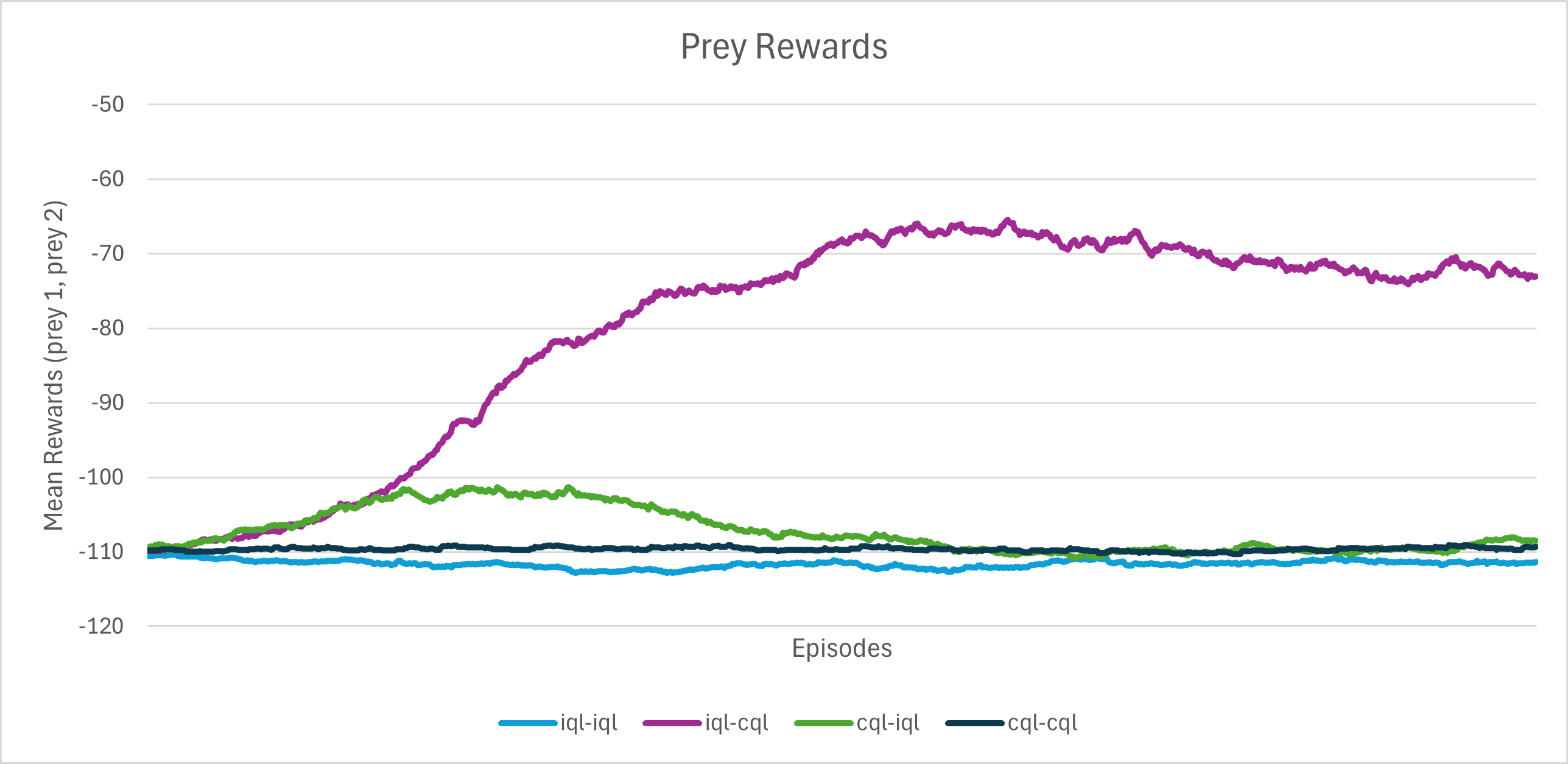
Fig 3: Figure 3: Mean prey reward over training under the base-speed regime. Curves show the mean across 10 independent seeds. Higher rewards correspond to longer survival times.
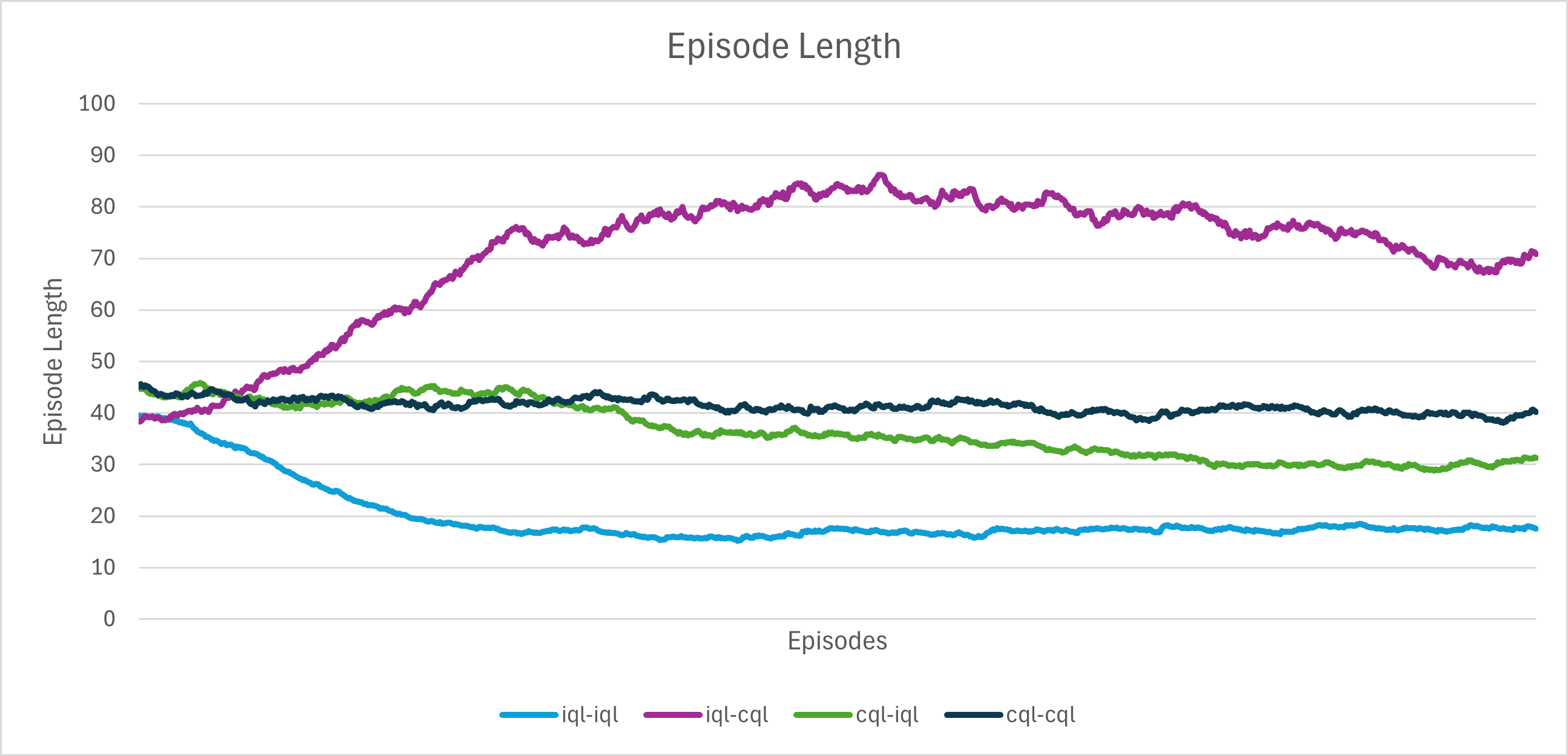
Fig 4: Figure 4: Mean episode length over training under the predator-speed-advantage regime. Curves show the mean across 10 independent seeds. Lower values correspond to more efficient predator coordination.
Ready to evaluate your AI agents?
Learn how ReputAgent helps teams build trustworthy AI through systematic evaluation.
Learn MoreYes, But...
Results come from a fully observable, tabular setup on a small 8×8 grid with a small number of agents, so they may not directly transfer to large-scale or deep-learning systems. Partial observability, learned communication, or function approximation could change the balance between centralized and independent learning. Speed and stamina were modeled simply; richer embodiment dynamics might alter where centralization helps or hurts.
Methodology & More
The study compares independent versus centralized value learning in a controlled, tabular predator–prey gridworld that includes explicit speed and stamina constraints. Using an 8×8 fully observable environment and exact value estimates, the authors evaluated four role-specific learning configurations (independent/centralized pairings) across three kinematic regimes: equal speed, predator advantage, and prey advantage. Experiments used 10 random seeds and report averages over the final 10,000 training episodes to isolate steady-state behavior and coordination patterns.
Findings show that centralized coordination is not uniformly beneficial. Fully independent learners (one learner per role) often produced faster captures and higher predator returns than fully centralized learners, while mixed configurations caused consistent coordination failures and variability. Embodiment modulated these effects: when predators were faster, decentralized learning amplified their advantage; when prey were faster, mixed or centralized structures could break down more easily. The study’s takeaway is practical: test coordination schemes under realistic embodiment constraints and role asymmetries before assuming centralized training will improve team performance. Future work should check whether these regime-dependent reversals persist with partial observability, communication channels, and deep function approximation. embodiment constraints
Avoid common pitfallsLearn what failures to watch for
Credibility Assessment:
Authors have very low h-indices and no affiliations listed; limited credibility.