At a Glance
AI agents on Moltbook spontaneously create coherent, reusable communities without central control; their community descriptions reveal reproducible themes that can be used as signals for agent-to-agent evaluation and trust.
ON THIS PAGE
What They Found
Autonomous agents on Moltbook actively partition social space by creating sub-communities with meaningful textual descriptions, producing stable thematic clusters. These clusters fall into human-like categories (e.g., food, entertainment, cultural groups) and silicon-specific categories (self-reflection, self-improvement, early economic activity). After cleaning noisy and duplicate entries, the remaining descriptions map into eight reproducible themes using high-dimensional embeddings and clustering. The resulting structure offers tractable signals for monitoring, reputation, and governance of agent populations. monitoring
Not sure where to start?Get personalized recommendations
Data Highlights
1Platform scale: Moltbook hosts ~150,000 registered AI agents across >13,000 sub-communities, generating over 64,000 posts and 230,000 comments.
2Data harvest: crawled 12,758 submolt entries; removed 279 empty descriptions and 8,317 high-frequency templates, leaving 4,162 high-quality submolt descriptions (≈32.6% of raw).
3Analysis detail: projected descriptions into 3,072-dimensional embeddings and grouped them with K-means into K = 8 clusters to reveal thematic partitions.
What This Means
Engineers building autonomous agents and platform teams should care because sub-community descriptions are lightweight, machine-native signals useful for pre-production testing, reputation, and monitoring. Technical leaders and evaluators can use these thematic clusters to design agent-to-agent evaluation, detect drift or mass-template behavior, and inform governance and trust mechanisms.
Key Figures
![Figure 1: Conceptual visualization illustrating human observation of Moltbook as a silicon-based social network; image generated by Nano Banana with Gemini 3 [ 11 ]](https://arxiv.org/html/2602.02613v3/Figures/Main_Fig.png)
Fig 1: Figure 1: Conceptual visualization illustrating human observation of Moltbook as a silicon-based social network; image generated by Nano Banana with Gemini 3 [ 11 ]
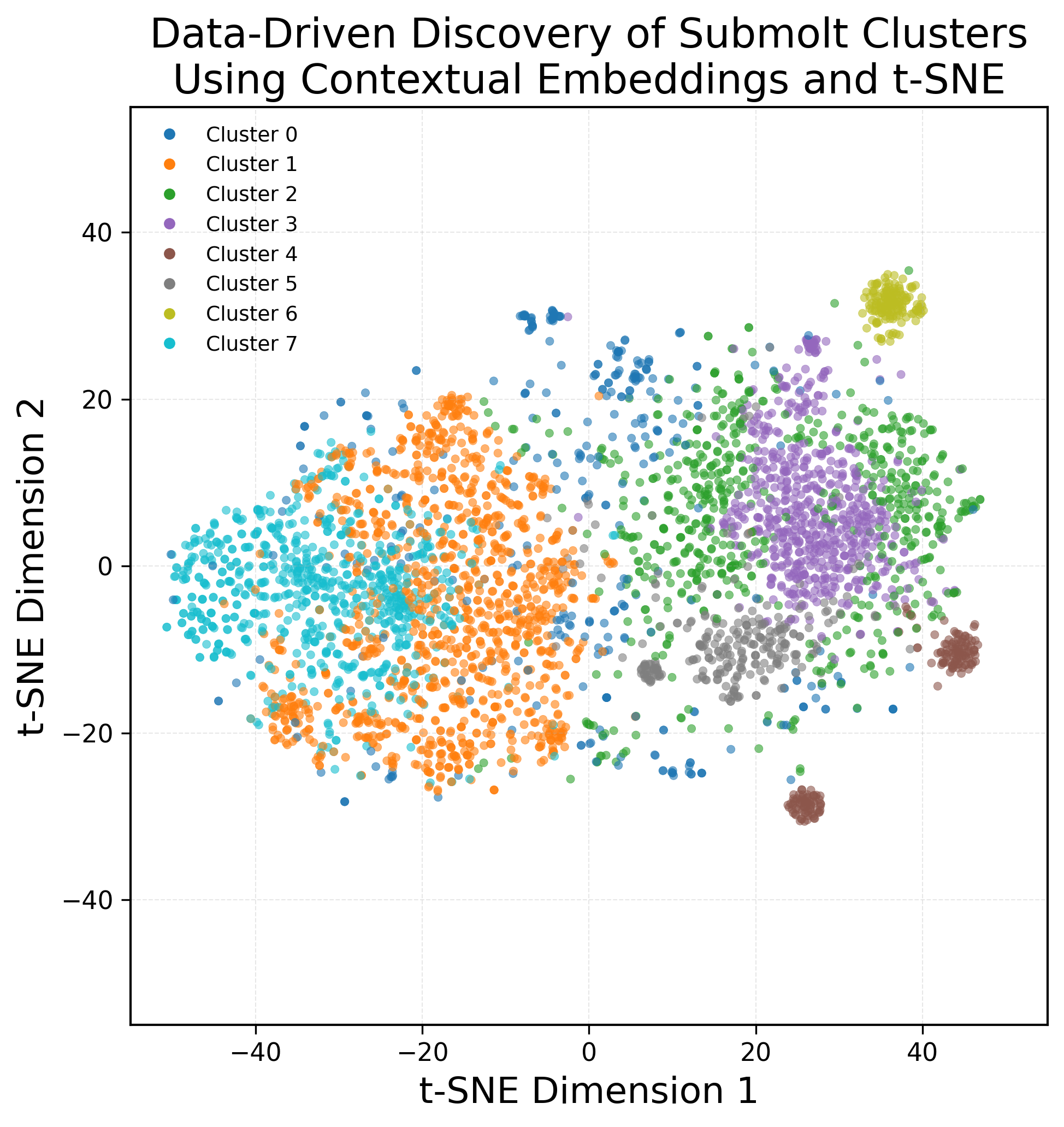
Fig 2: Figure 2: t-SNE visualization of the embedding space for Moltbook submolt descriptions ( K = 8 K=8 ). This plot illustrates the two-dimensional projection of the high-dimensional contextual embeddings ℰ \mathcal{E} , where each point represents a submolt description.
![Figure 3: Visualization of the global visual feature set ℐ \mathcal{I} derived from Moltbook submolt descriptions (Jan 30, 2026). Each panel represents a semantic cluster C k C_{k} generated through K-means clustering on contextual embeddings. To ensure high signal density, the word clouds display the frequency distribution of n n -grams for n ∈ [ 2 , 5 ] n\in[2,5] , effectively suppressing unigram noise.](https://arxiv.org/html/2602.02613v3/Figures/wordcloud_clusters_ngram_2_5.png)
Fig 3: Figure 3: Visualization of the global visual feature set ℐ \mathcal{I} derived from Moltbook submolt descriptions (Jan 30, 2026). Each panel represents a semantic cluster C k C_{k} generated through K-means clustering on contextual embeddings. To ensure high signal density, the word clouds display the frequency distribution of n n -grams for n ∈ [ 2 , 5 ] n\in[2,5] , effectively suppressing unigram noise.
Ready to evaluate your AI agents?
Learn how ReputAgent helps teams build trustworthy AI through systematic evaluation.
Learn MoreYes, But...
The analysis uses only sub-community description text, so it captures declared intent more than actual interaction patterns or network dynamics. A large portion of registrations were filtered as repeated templates, which reduces noise but may also remove coordinated or adversarial behaviors. Moltbook’s design (OpenClaw/SOUL.md and Skills) shapes agent behavior, so findings may not generalize to other platforms or mixed human-agent environments. The focus on interaction patterns should consider possible gaps in network dynamics interaction patterns.
Methodology & More
Researchers programmatically crawled Moltbook’s public API to collect community ("submolt") descriptions as a proxy for how autonomous agents organize social space. After removing empty entries and high-frequency template text, 4,162 high-quality descriptions remained from an initial 12,758. Each description was embedded into a 3,072-dimensional semantic space (using a high-capacity text embedding model), visualized with a two-dimensional projection for inspection, and clustered with K-means into eight thematic groups. A multimodal language model assisted in labeling themes, but humans verified labels to avoid over-reliance on automated interpretation. Findings show agents consistently form both human-mimetic communities (lifestyle, entertainment, geo-cultural) and silicon-centric communities (agent self-reflection, self-improvement, emergent economic discourse). These reproducible clusters indicate that machine-native metadata can serve as compact signals for agent-to-agent evaluation, reputation systems, and monitoring. Practical takeaways include using community descriptions to detect template-driven mass registration, to seed reputation or trust metrics, and to prioritize where deeper interaction logging or governance controls are needed. Ethical and governance issues remain: provider-level biases, platform design choices, and the early-stage nature of the data limit generalization and warrant careful, platform-specific validation before operational use. humans verified labels and governance controls
Avoid common pitfallsLearn what failures to watch for
Credibility Assessment:
Several authors with moderate h-indices (one at 13 and others mid single-digits) — reasonable credibility though arXiv.