In Brief
Grounding language-driven planning in a shared, continuously updated knowledge graph makes heterogeneous robot teams much more reliable—about 25% more tasks complete and 15% fewer execution failures. The graph acts as a living memory so the team can detect mismatches and replan on the fly.
ON THIS PAGE
The Evidence
A structured knowledge graph that serves as shared, structured memory separating object relations, object properties, and reachability grounds language-based planning and reduces errors from missing or conflicting context. Specialized language modules extract goals, relations, properties, and navigability from instructions and observations to synthesize correct symbolic plans planning pattern. When execution deviates from expectations, a vision-language check updates the graph and triggers replanning, allowing recovery from failures such as closed drawers or missing objects. Across simulated multi-robot tasks, this approach produced notably higher success and lower failure rates than both language-only and classic symbolic baselines.
Data Highlights
125.5% relative improvement in task completion rate over the strongest baseline across all tasks.
215.5% relative reduction in execution failures versus the strongest baseline.
3Evaluated on 51 multi-robot tasks across seven floor plans in the MAT-THOR benchmark.
Why It Matters
Robotics engineers and system architects building heterogeneous robot teams will get more reliable long-horizon behavior and easier task allocation. Technical leads deciding between language-driven planners and symbolic planners can use the graph-as-memory pattern to reduce brittle failures and support online replanning. Teams running agents in warehouses, inspection, or disaster response benefit most because those domains need coordination and recovery under changing conditions. For reference, the concept supports Multi-Agent System scale and coordination workflows.
Not sure where to start?Get personalized recommendations
Key Figures
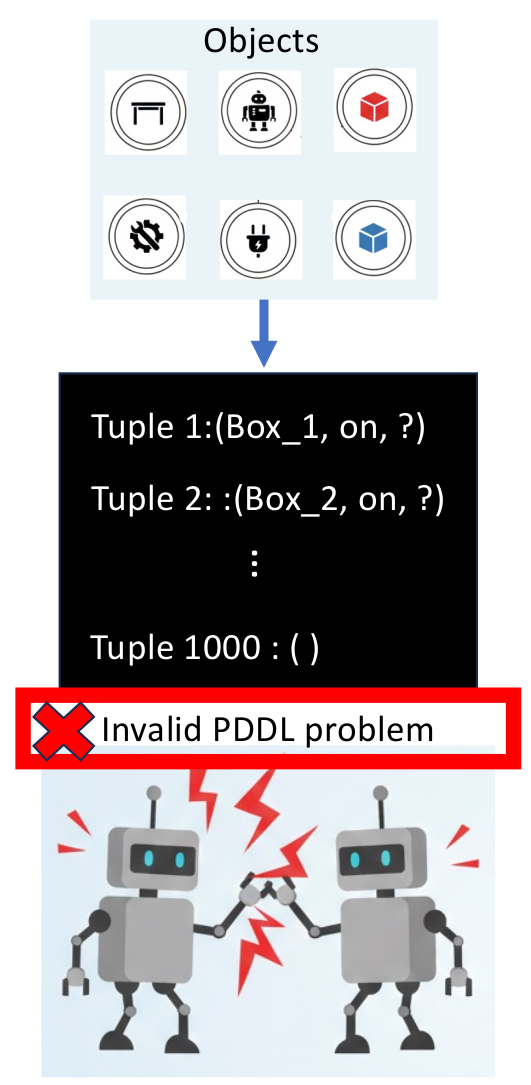
Fig 1: (a) Without relational knowledge

Fig 2: (a) Domain PDDL (STRIPS action schema)
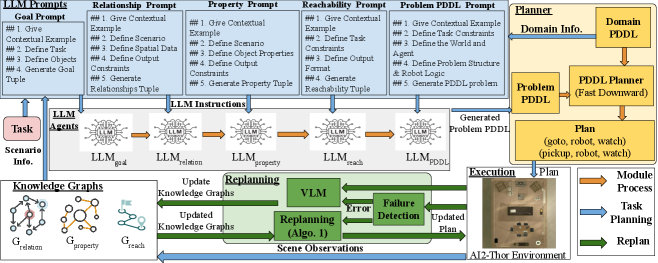
Fig 3: Figure 3 : Overview of KGLAMP framework. Environment and robot information are encoded as relationship, property, and reachability knowledge graphs. LLM agents generate goal, relational, property, and reachability predicates in a dependency-aware manner to synthesize a PDDL problem, execute the resulting plan, and iteratively update the graphs and replan upon execution failures.
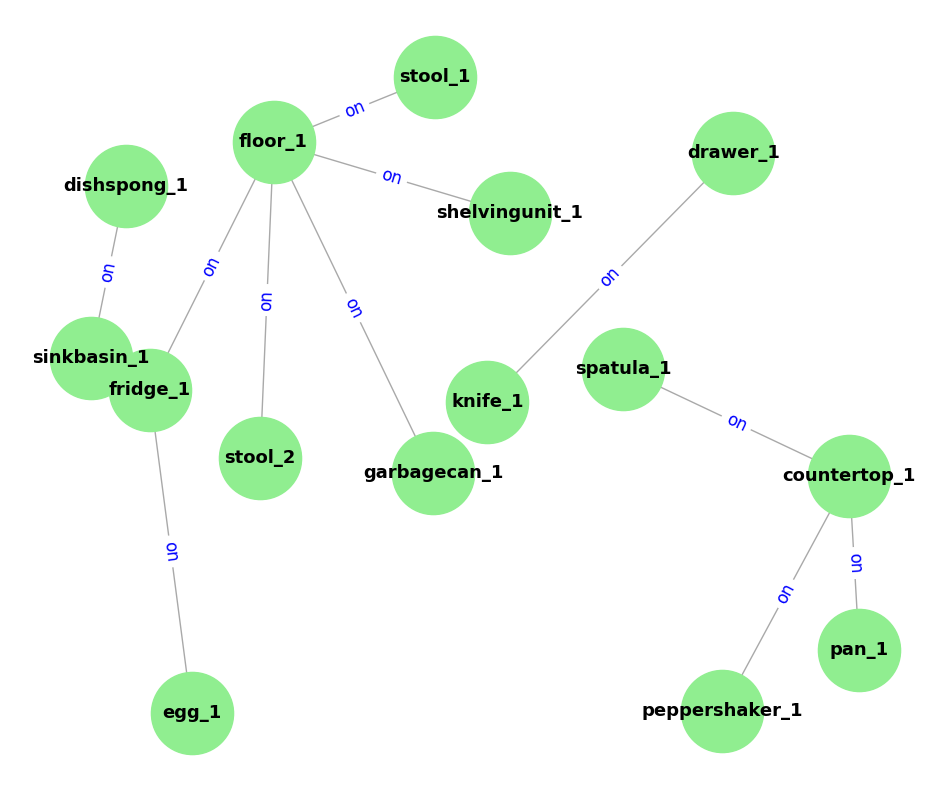
Fig 4: (a) Relationship graph G relation G_{\text{relation}}
Ready to evaluate your AI agents?
Learn how ReputAgent helps teams build trustworthy AI through systematic evaluation.
Learn MoreYes, But...
The approach depends on reasonably detailed scene information; if the initial graph is very incomplete, language-based inference can introduce noisy or incorrect facts. Running multiple specialized language modules and verification steps creates noticeable computational overhead, which may limit real-time use without model or pipeline optimization. Results are demonstrated in simulation (MAT-THOR); deploying on physical robots will require tighter perception integration, verification of generated domain symbols, and attention to timing and safety constraints. Considerations include potential bottlenecks in Human-in-the-Loop Pattern to mitigate errors during execution.
Deep Dive
KGLAMP builds a symbolic planning problem by splitting the world into three linked graphs: one for object relationships (what is on or in what), one for object and robot properties (who can pick what, item attributes), and one for reachability (which locations are accessible). Language modules extract goals and populate those graphs from instructions and observations. Those structured outputs are turned into a symbolic planning problem, solved by a classic planner, and executed while a monitor looks for failures. When something goes wrong—an object isn’t where the plan expected, or a drawer is closed—a vision-language check updates the relevant parts of the graph and the system synthesizes a corrected plan. In simulation on 51 diverse multi-robot tasks, that loop produced a 25.5% higher task completion rate and 15.5% fewer execution failures compared with strong baselines. The structure reduces context overload for language reasoning and keeps agent capability and spatial constraints explicit, which improves task allocation and coordinated timing. Practically, the method gives teams a clear pattern: use a compact, queryable knowledge representation as the authoritative state, let language modules propose symbolic predicates constrained by that state, and make replanning a first-class, graph-driven operation. For production use, expect to invest in perception-to-graph reliability, verification of generated domain symbols, and compute optimizations to make the multi-module stack run within operational budgets.
Explore evaluation patternsSee how to apply these findings
Credibility Assessment:
Mix of authors including one with moderate h-index (David Isele h=17); arXiv and unspecified affiliations but some established researcher signal.