The Big Picture
Coordinating only at a few well-chosen time-steps prevents costly, uncoordinated behaviors while keeping communication costs low.
ON THIS PAGE
Key Findings
Uncoordinated agents can settle into locally stable but team-worst behaviors; the difference between good and bad team outcomes shows up in the curvature of the team objective. By checking second-order properties (how the objective bends) for blocks of time, teams can identify the exact time windows where joint planning yields better joint solutions. An optimization balances the cost of staying connected against the benefit of avoiding bad equilibria; in short horizons only short coordination windows are needed, while longer horizons may require coordination over many steps. For a broader lens on coordinating teams, practitioners can consider applying the planning pattern to structure when to coordinate across time.
By the Numbers
1Coordination cost in the model scales with duration: for an interval S the cost term is c_S = |S| (the interval length).
2For a 6-step scenario (T=6), the optimal coordination concentrates on time-steps {4,5} (an interval of length 2) to avoid a high-cost uncoordinated outcome.
3For a 10-step scenario (T=10), the optimal solution pays to coordinate on the interval {3,4,5,6,7,8} (length 6), showing longer horizons can need much longer coordination windows.
What This Means
Robotics engineers and teams running multiple agents who need to trade off communication budget against joint performance should care — the method tells you when short bursts of coordination are enough. Technical leads designing communication policies for fleets (drones, ground robots, satellites) can use the idea to reduce continuous chatter while avoiding catastrophic uncoordinated behaviors. See how teams can manage decision-making with a consensus-based decision pattern to balance local vs. joint optimization.
Explore evaluation patternsSee how to apply these findings
Key Figures
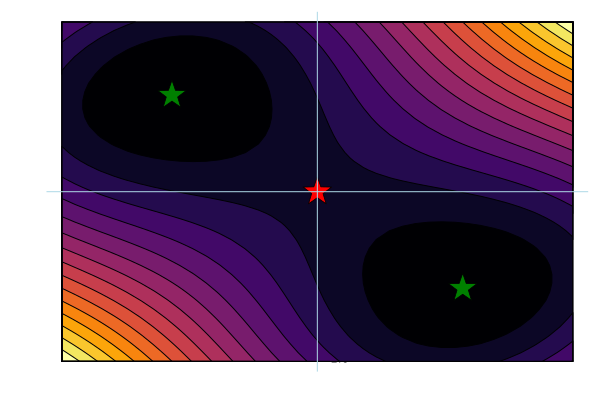
Fig 1: (a) Cost landscape
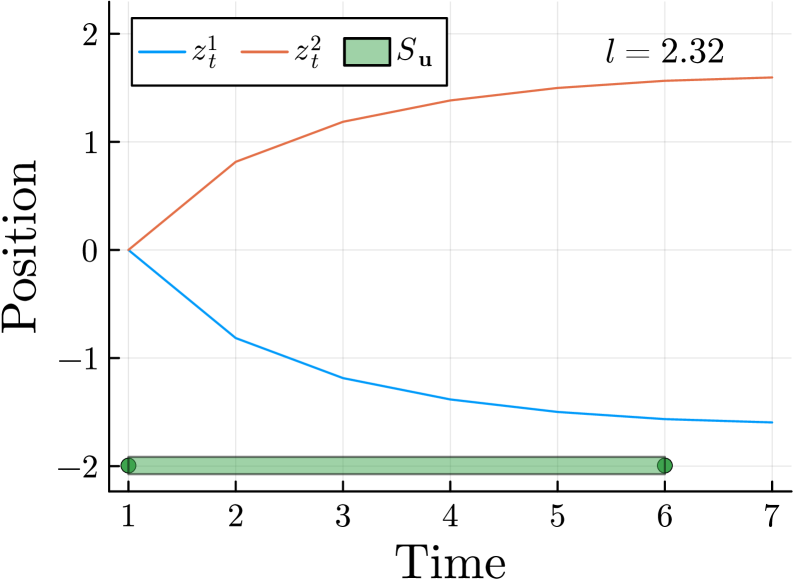
Fig 2: (a)
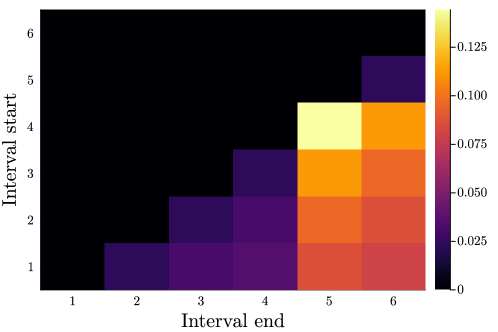
Fig 3: Figure 3 : The optimal coordinated solution finds the smallest interval that differentiates coordinated and uncoordinated behavior. We depict the optimal distribution p ∗ p^{*} for the problem in ( 19 ) when T = 6 T=6 , where we color the heatmap by the value of p ∗ p^{*} for each interval. We observe that the optimal solution places probability mass on intervals that contain { 4 , 5 } \{4,5\} , with higher mass being placed on shorter intervals. This solution reflects the fact that, in order to avoid high-cost uncoordinated solutions, the team only needs to be optimal in the decision variables corresponding to time-steps 4 4 and 5 5 .
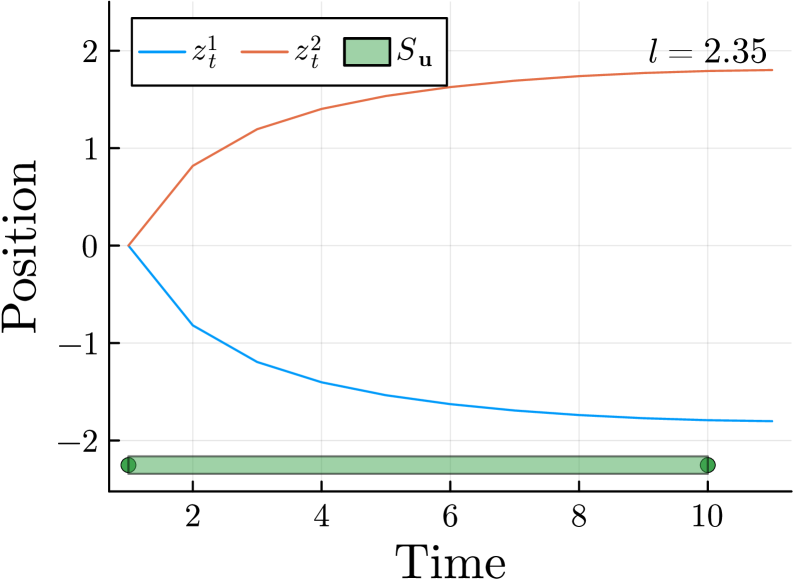
Fig 4: (a)
Ready to evaluate your AI agents?
Learn how ReputAgent helps teams build trustworthy AI through systematic evaluation.
Learn MoreYes, But...
The approach assumes full knowledge of the team objective and smooth, differentiable dynamics; it does not address uncertainty in objectives or noisy communication. Experiments are on toy one-dimensional robot examples with two agents, so scaling to many agents or complex dynamics will require extra work. The coordination-cost model (linear in interval length and uniform selection among solutions) is simple and may need tailoring to real-world communication patterns and selection biases. For practical mitigation strategies, explore the Human-in-the-Loop Pattern.
Deep Dive
Coordination is modeled as a binary choice at specific time-steps: either agents jointly optimize their actions over that interval or each agent optimizes alone (leading to a Nash-type solution). The key technical insight is that coordinated and uncoordinated solutions differ in second-order structure — roughly, how the team objective curves around a candidate solution. By checking positive-definiteness of Hessian subblocks that correspond to particular time windows, one can characterize when joint optimization would produce a locally better team outcome. Building on that, the authors define an optimization over probability distributions of coordination intervals: minimize expected team cost plus a coordination penalty that grows with how long the team stays connected (they set the cost for an interval equal to its length). An algorithm searches for which intervals are worth paying for. In experiments with two one-dimensional robots, a 6-step task required coordinating only on a 2-step window {4,5}, while a 10-step task needed a 6-step window {3–8}. The result: short, targeted coordination bursts can avoid expensive uncoordinated traps, but longer missions may need longer coordination. Practical use will require extensions for noisy information, more agents, and richer communication-cost models. For example, addressing potential failure modes could be informed by patterns such as Red Teaming Pattern or Guardrails Pattern to strengthen reliability across plans and communications. Additionally, evaluating coordination strategies under realistic constraints can benefit from the Handoff Pattern.
Test your agentsValidate against real scenarios
Credibility Assessment:
Includes Ufuk Topcu (well-known researcher) alongside other authors; strong author reputation despite arXiv venue.