At a Glance
Train a single language model to internalize multi-agent debate behavior and you get team-level reasoning with much lower run-time cost and better robustness.
ON THIS PAGE
Core Insights
Training one model on the internal debate traces of many agents gives it the ability to generate, critique, and refine solutions in a single pass. Three distillation strategies — supervising on consensus with reasoning traces, augmenting with diverse reasoning chains, and using a process-aware reward model — each improve a single model’s reasoning. A strong process reward model matters more than just student model size: even small models gain when guided by high-capacity process evaluators. The distilled models also generalize to unseen benchmarks and to preliminary multimodal settings.
Test your agentsValidate against real scenarios
Data Highlights
1120 distillation experiments across model families and datasets were run to evaluate methods and scaling.
2Ensembles of 5 debating teacher agents were used to generate the training trajectories used for distillation.
3Model sizes ranged from 0.6 billion to 32 billion parameters; distillation from 32B teachers benefited students down to 0.6B when guided by a high-capacity process reward model.
What This Means
Engineers deploying reasoning-heavy models in resource-sensitive settings (on-device, low-cost inference) can get team-level reasoning without the multi-agent run-time cost. ML researchers and technical leads exploring how to transfer complex workflows into compact models can use these distillation patterns to improve small or multimodal models. on-device, low-cost inference
Key Figures
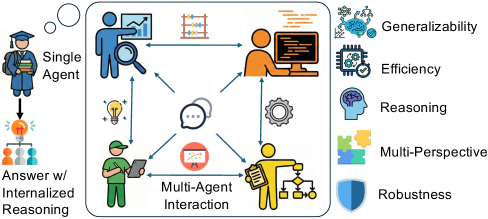
Fig 1: Figure 1 : AgentArk distills the reasoning capability of multi-agent systems into one single agent, such that this single unit can imitate the thinking process with boosted performance.
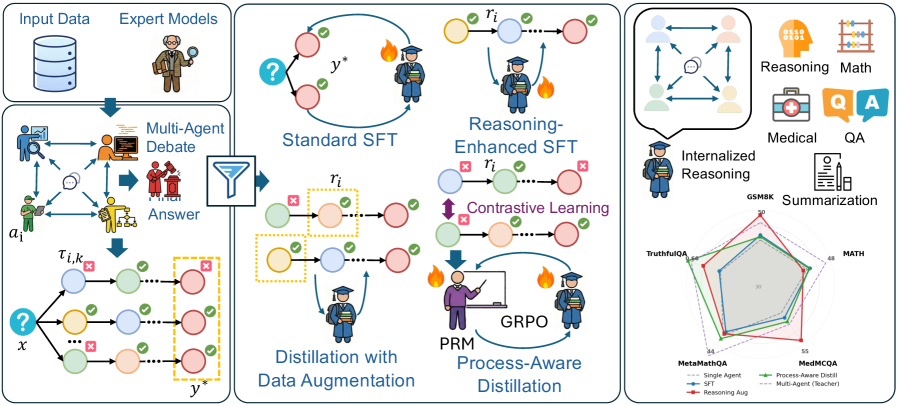
Fig 2: Figure 2 : Overview of AgentArk. The pipeline proceeds through three stages: (1) Data Generation Through Multi-Agent Debate to produce diverse reasoning trajectories; (2) Knowledge Extraction to filters for high-quality corrective traces; and (3) Distillation utilizing Standard SFT, Reasoning-enhanced SFT, Distillation with Data Augmentation, and Process-Aware Distillation (PRM + GRPO). The resulting student model achieves optimized, low-latency reasoning that generalizes across diverse task domains.
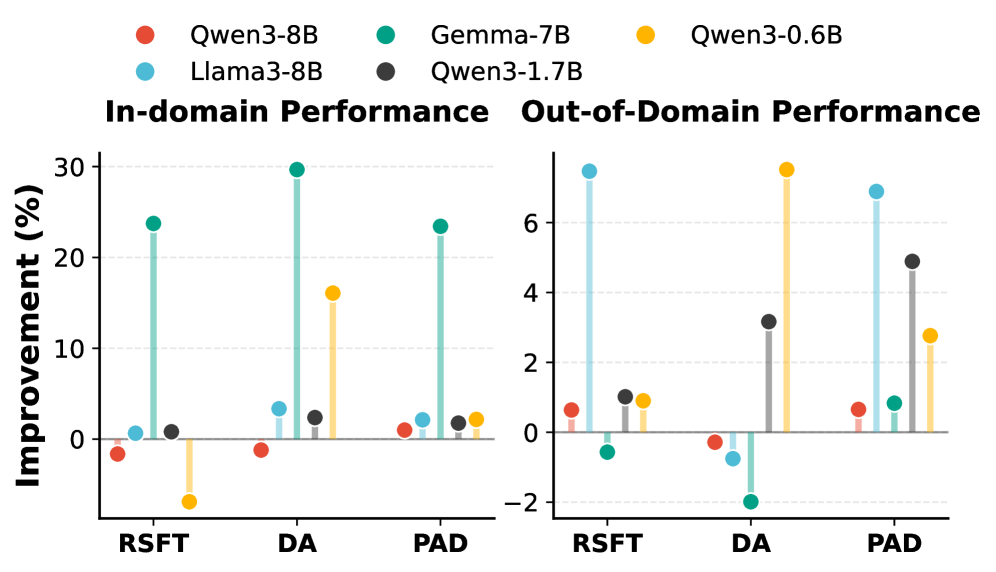
Fig 3: (a) Performance on in-domain (left) and OOD (right) datasets
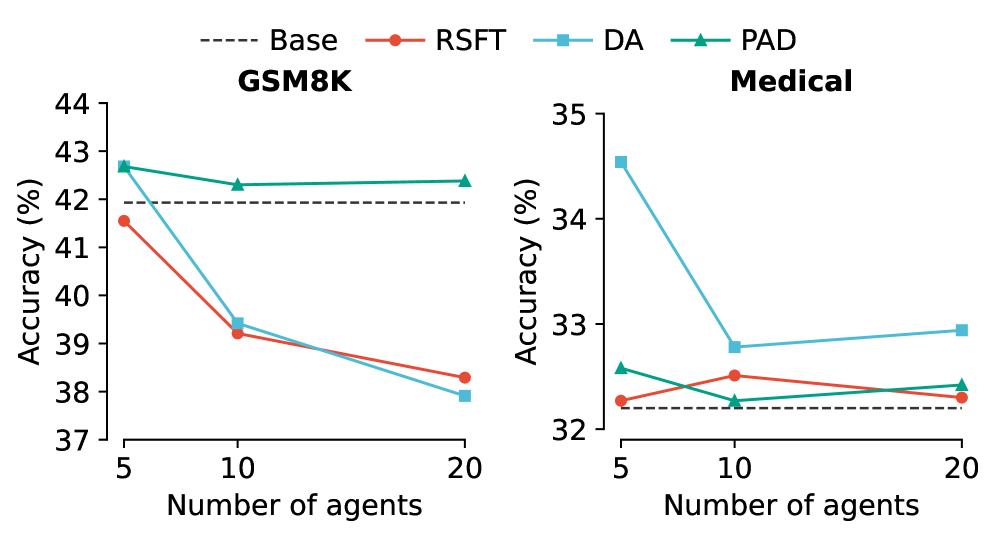
Fig 4: (a) 0.6B on test GSM8K
Ready to evaluate your AI agents?
Learn how ReputAgent helps teams build trustworthy AI through systematic evaluation.
Learn MoreConsiderations
Results come from a subset of reasoning benchmarks and a debate-style multi-agent setup, so gains may vary on other tasks or interaction schemes. The best results rely on a high-capacity process reward model, which can be costly to train. Distilled students can inherit undesirable teacher behaviors (bias, persuasive but incorrect rationales), so audit and safety checks remain necessary before deployment.
Deep Dive
AgentArk turns multi-agent debate-style reasoning into training data that teaches a single model to carry out the same critique-and-revise thinking in one forward pass. The pipeline first runs many teacher agents in debate to produce diverse reasoning trajectories, then filters and extracts high-quality corrective traces, and finally trains student models using three complementary distillation strategies: (1) supervise on final consensus while feeding in reasoning traces so the student learns how to reach those answers; (2) augment training with diverse reasoning chains so the student sees many valid solution paths; and (3) apply process-aware distillation using a process reward model and policy optimization so the student internalizes the stepwise critique-and-revision dynamics.
Not sure where to start?Get personalized recommendations
Credibility Assessment:
Authors include some with moderate h-indices (e.g., Weijie Xu h=13) though affiliations unspecified; minor citation count.