Key Takeaway
A coordinated set of specialist agents can let creators steer AI-generated content precisely while embedding provenance marks during generation, improving control and ownership tracking without obvious quality loss.
ON THIS PAGE
Key Findings
A pipeline of five focused agents—planning, generation, review, integration, and protection—breaks a creative request into manageable steps and keeps the user in the loop for edits. Embedding a watermark during generation (not after) lets the system jointly optimize for how well content matches intent and how recoverable the provenance mark is. Prototype design shows this is practical with existing language and image models and suggests meaningful gains in control and watermark robustness. An evaluation plan proposes objective metrics and user studies to validate quality, alignment, and protection tradeoffs. As described in the Guardrails Pattern.
Data Highlights
1Prior work suggests task decomposition can yield about 20–25% better controllability versus one-shot generation.
2Integrated watermark methods report 90%+ recovery rates under non-adversarial edits in existing studies.
3Robustness will be tested across realistic degradations: JPEG compression (quality 50–95), Gaussian noise (σ=0.01–0.05), cropping (10–30%), and resizing (50–200%).
What This Means
Product and platform engineers building creative tools, studios and marketplaces that need proof of ownership, and technical leads designing safe content pipelines should pay attention. They can use a multi-agent approach to give creators finer control over outputs while embedding traceable provenance without relying on brittle post-processing steps.
Not sure where to start?Get personalized recommendations
Key Figures
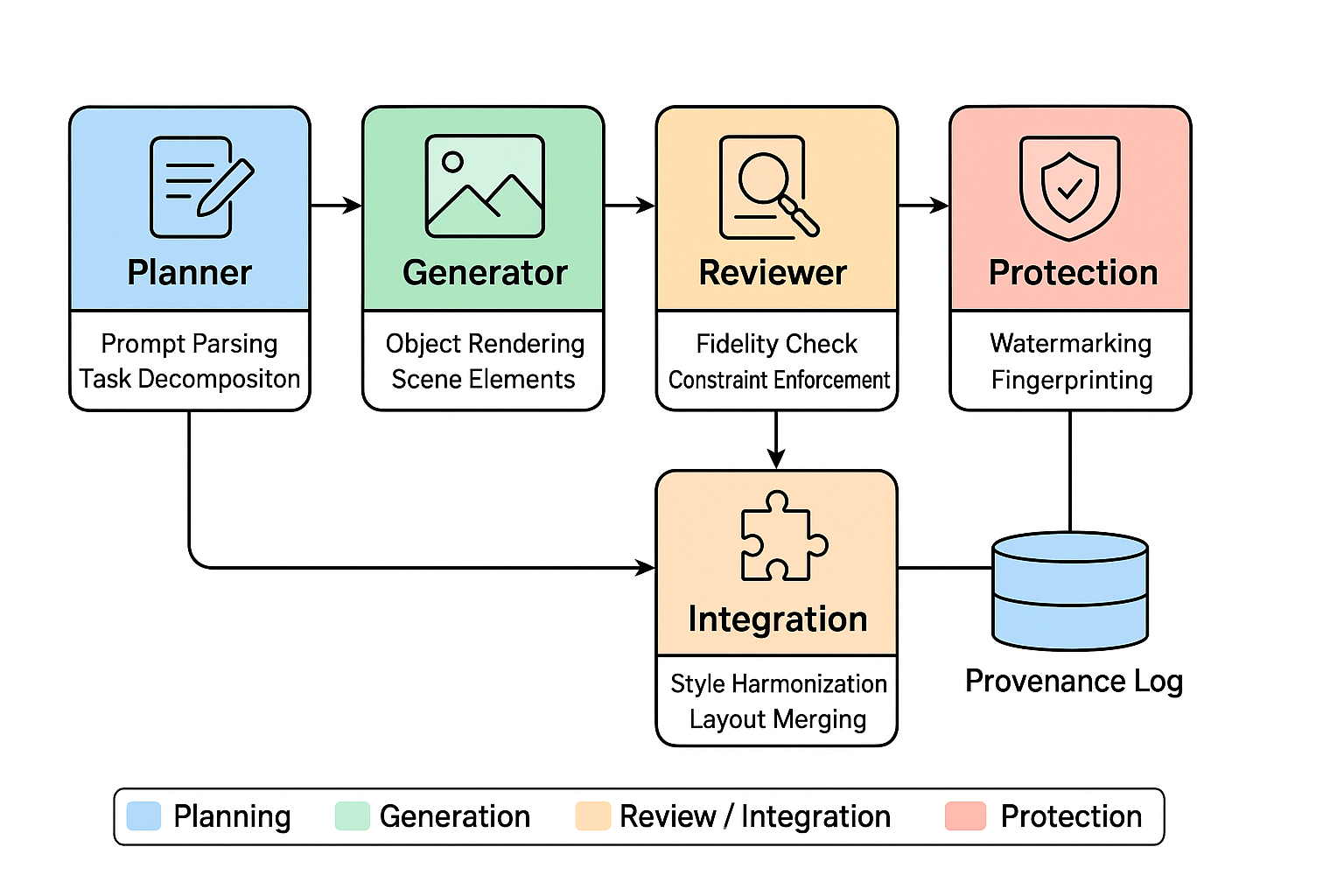
Fig 1: Figure 1: Proposed multi-agent framework. The pipeline consists of specialized agents for planning, generation, review, integration, and protection, with iterative human-in-the-loop feedback and provenance logging to ensure both fidelity to user intent and secure content traceability.
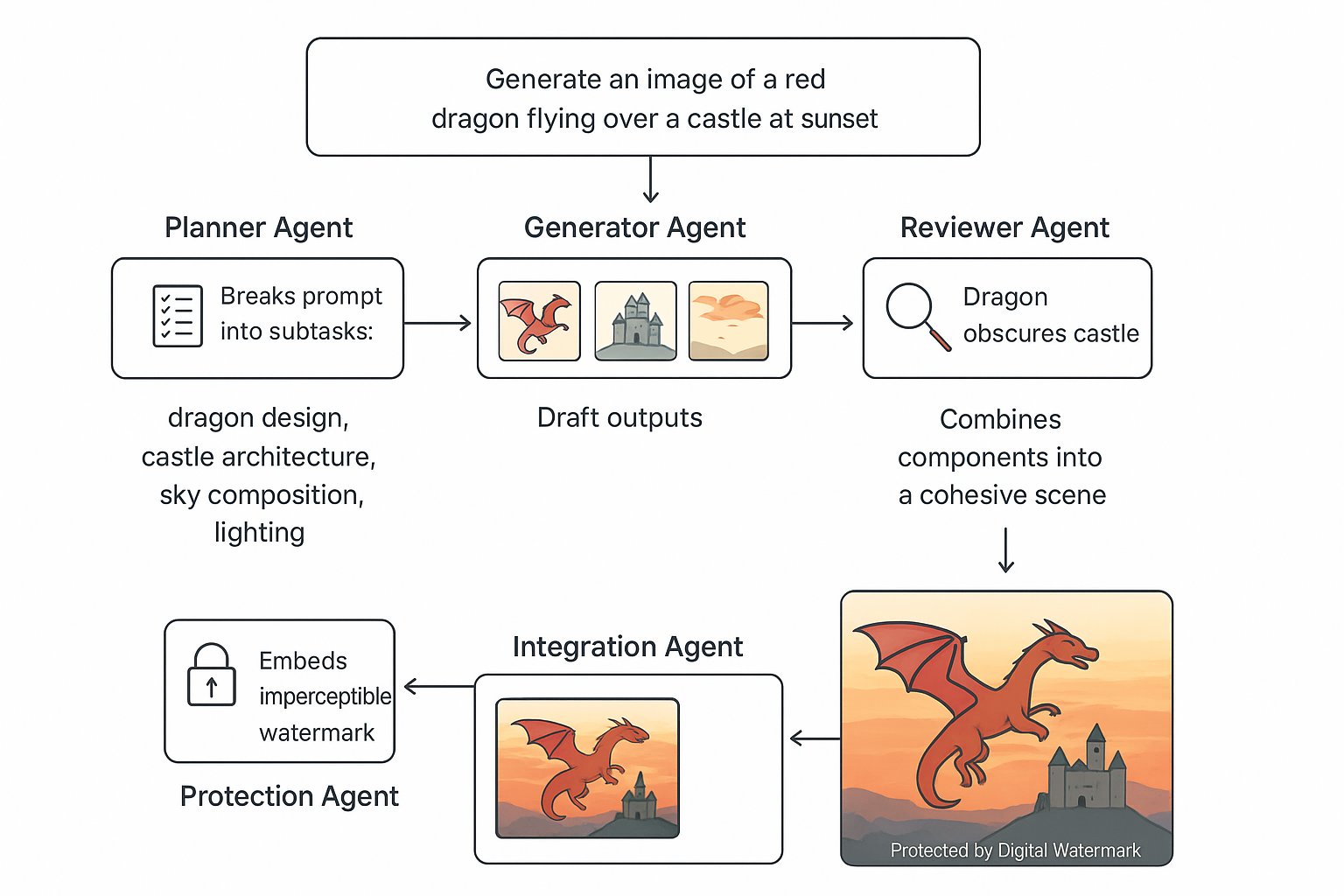
Fig 2: Figure 2: Illustrative case study of the multi-agent pipeline using the prompt “Red dragon flying over a castle at sunset.” The Planner decomposes subtasks, the Generator synthesizes components, the Reviewer refines alignment, the Integration agent harmonizes layout, and the Protection agent embeds an imperceptible watermark for secure provenance.
Ready to evaluate your AI agents?
Learn how ReputAgent helps teams build trustworthy AI through systematic evaluation.
Learn MoreYes, But...
The work is a framework and prototype plan; end-to-end, peer-reviewed results are still pending. Watermark robustness may vary by content type, model family, and adversarial attacks, so real-world evaluation is essential. Human-in-the-loop controls improve alignment but add workflow complexity and latency that teams must budget for.
Full Analysis
The approach splits creative generation into five specialist agents: a Planner that decomposes a prompt into sub-tasks, a Generator that synthesizes components, a Reviewer that scores alignment with the intent, an Integration agent that composes pieces into a coherent whole, and a Protection agent that embeds an imperceptible provenance mark during synthesis. The key idea is to move watermarking from a separate post-processing step into the generation loop so the system can jointly optimize for both alignment to user intent and watermark recoverability. five specialist agents can be interrupted by human operators who tune protection parameters for traceability decisions. Feasibility is shown using off-the-shelf components (large language models for planning and diffusion-style image models for generation) and a planned evaluation using objective metrics: alignment via image–text similarity scoring, visual quality via standard fidelity scores, and watermark recovery under compression, noise, cropping, and resizing. Expected benefits include measurable gains in controllability (20–25% improvements cited from related decomposition work) and high watermark recovery rates (90%+ in integrated schemes). The framework is practical for creative platforms and rights management, but requires careful validation against adversarial removal of marks and assessment of workflow overhead when adding human review steps. Consensus-Based Decision Pattern.
Explore evaluation patternsSee how to apply these findings
Credibility Assessment:
Accepted at NeurIPS (top venue) — strong credibility regardless of listed affiliations.