The Big Picture
Coordinating specialized, autonomous agents reduces wasted work and lets audits recover from tool failures, making automated smart contract auditing more robust and more efficient.
ON THIS PAGE
Key Findings
A set of five focused agents (planning, execution, repair, safe execution, coordinator) that share beliefs and use simple negotiation and auction rules finds and fixes problems more reliably than uncoordinated pipelines. Local agent autonomy means work-in-progress isn't lost during network or tool failures — a repair agent can continue and report back when connectivity returns. Lightweight protocols (plan negotiation, resource auctions, contract-net style task allocation) steer scarce expensive resources (like large model calls) to the highest-value tasks. In tests, the framework handled brittle generated artifacts via a program-first repair policy and detected critical issues faster than ablated baselines.
Data Highlights
1Benchmarked on 15 Damn Vulnerable DeFi challenges with 10 independent runs per configuration.
2Resource-allocation example: repair requested 500 LLM tokens vs test generation 200 tokens; computed efficiency scores were 0.00144 (repair) vs 0.0021 (test), so the auction awarded the cheaper, higher-efficiency request.
3Context: manual smart contract audits typically take 2–4 weeks and cost $50,000–$150,000, motivating automated, more robust approaches like SPEAR.
What This Means
Security engineers and tool builders who run or automate smart contract audits will get practical ideas to make pipelines more resilient and to reduce wasted compute and model calls. Technical leads and auditors can use these coordination patterns to prioritize scarce resources and recover from flaky generated tests or failing analysis tools with less human intervention.
Avoid common pitfallsLearn what failures to watch for
Key Figures
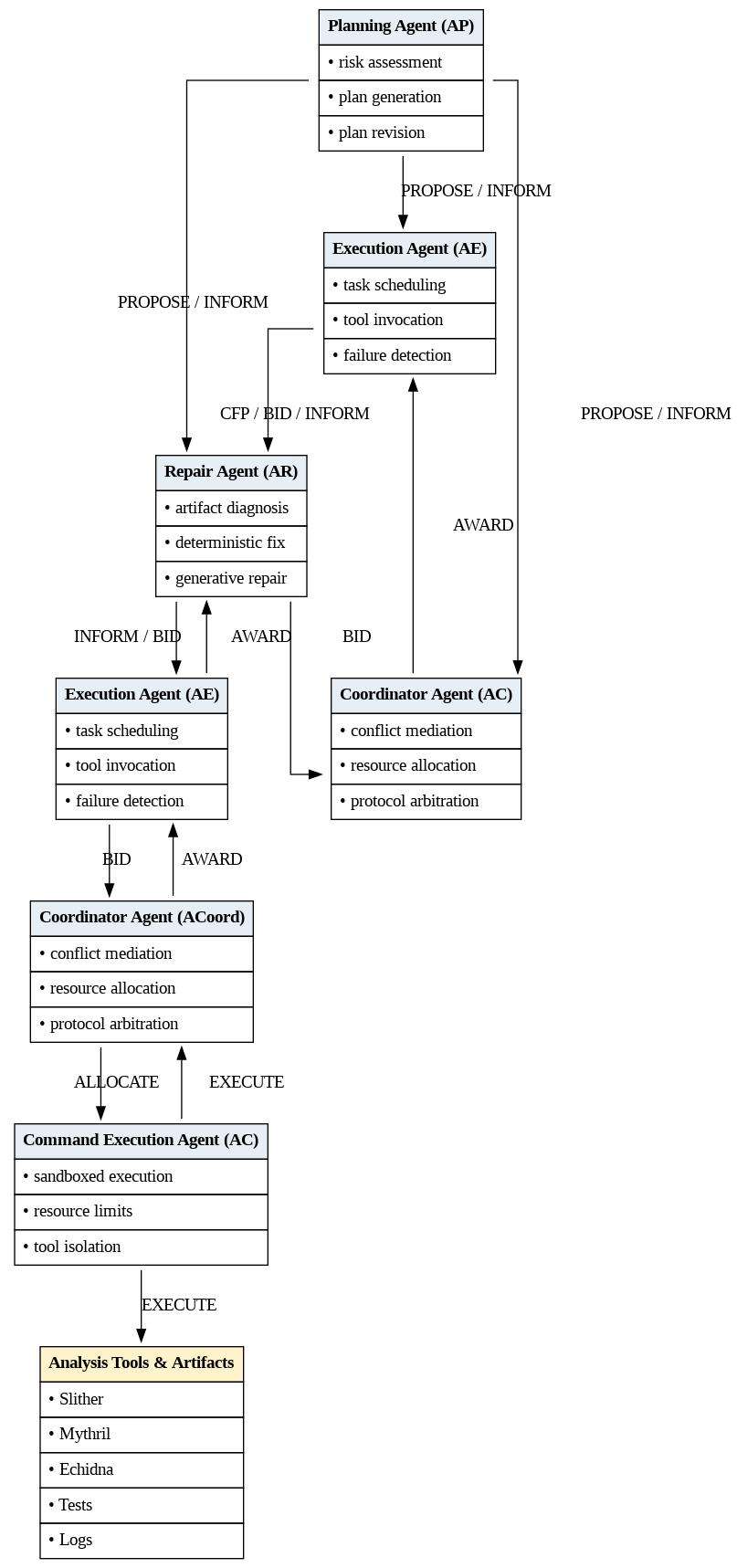
Fig 1: Figure 1: SPEAR architecture: five specialized agents ( A P A_{P} , A E A_{E} , A R A_{R} , A C A_{C} , A C o o r d A_{Coord} ) interact through a message bus, coordinating via Contract Net, plan negotiation, and resource auctions.
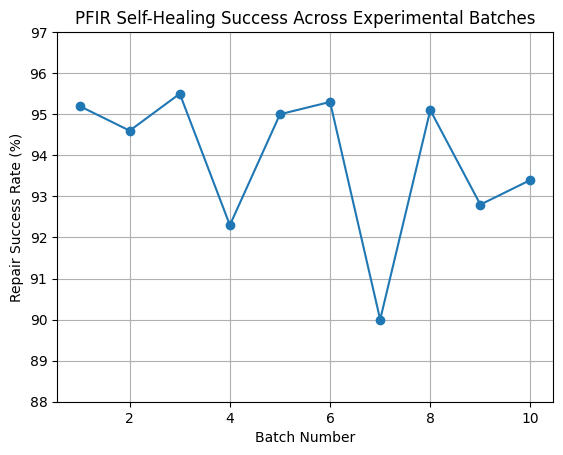
Fig 2: Figure 2: Performance of the PFIR self-healing algorithm. The programmatic-first echelon resolves most failures, achieving consistent success across batches.
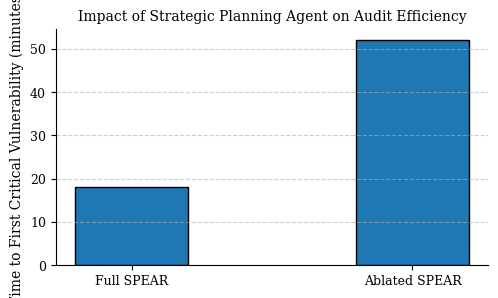
Fig 3: Figure 3: Impact of the Strategic Planning Agent. The planning-driven mode detects critical vulnerabilities faster than the ablated baseline.
Ready to evaluate your AI agents?
Learn how ReputAgent helps teams build trustworthy AI through systematic evaluation.
Learn MoreConsiderations
Evaluation scale was modest (15 challenges) and assumes the underlying analysis tools are capable of finding many real vulnerabilities — real-world tool blind spots will limit results. The coordinator agent is a potential single point of failure in the current design and needs hardening or decentralization for production. The resource auction is a practical heuristic for cooperative agents but is not proved incentive-safe for adversarial settings. Coordination Deadlock
Deep Dive
SPEAR models smart contract auditing as a mission carried out by five specialized, communicating programs: a planner that scores and prioritizes contracts, an executor that runs analysis tools, a repair agent that fixes brittle generated artifacts first by programmatic edits, a command agent that sandboxes tool execution, and a coordinator that mediates conflicts and allocates resources. Agents keep local beliefs and use structured messages and simple protocols — plan negotiation, contract-net task allocation, and distributed negotiation — so decisions emerge from local information rather than a single controller. That local autonomy matters in realistic failure modes: a repair agent can continue work during network partitions and report completion later, avoiding wasted model calls and retries. The team evaluated SPEAR on a 15-challenge DeFi benchmark with 10 runs per setup, comparing uncoordinated tool runs, sequential pipelines, combined tools, and a centralized scheduler that implements the same planning and repair logic but without distributed negotiation. Results show the program-first repair strategy and explicit coordination improve recovery from brittle generated artifacts and detect high-risk vulnerabilities faster than ablated baselines. For practitioners, the takeaway is pragmatic: composition of established coordination patterns (agent autonomy, negotiation, auctions) can make automated audits more robust and resource-efficient — but production use will require broader tool coverage, scaling tests, and addressing coordinator availability or decentralization. distributed negotiation
Need expert guidance?We can help implement this
Credibility Assessment:
All authors low h-index, no affiliations, arXiv preprint and no citations — limited reputation signals.