The Big Picture
An autonomous team of AI agents can read relevant papers, argue over design choices, and iteratively modify bioinformatics model architectures to produce repeated, measurable performance gains without human tinkering.
ON THIS PAGE
Key Findings
MARBLE chains literature search, structured agent debate, automated code changes, and performance feedback into a closed loop that steadily improves model architectures. When run on six existing bioinformatics models across three domains, it produced repeated gains (not one-off fixes): segmentation quality increased, prediction precision rose, and prediction error fell. The system keeps a memory of what worked, prioritizes useful papers, and maintains high execution reliability while converging after early improvements. This aligns with a consensus-driven approach to decision-making.
Data Highlights
1200 candidate papers retrieved per target model during literature selection
2Evaluated on six target models spanning three bioinformatics domains (spatial transcriptomics, drug–target interaction, drug response)
3Notable staged improvements for one model: architectural updates at iterations 5, 17, and 28 for STAGATE corresponded to stepwise gains in segmentation quality
What This Means
Machine-learning engineers and platform teams building or maintaining bioinformatics models can use MARBLE to reduce manual trial-and-error in model design and accelerate architecture iteration. Computational biologists and technical leads who need reproducible, literature-grounded model changes will find it useful for scaling model refinement without deep manual involvement. Semantic Capability Matching can help map literature ideas to model capabilities throughout iteration.
Avoid common pitfallsLearn what failures to watch for
Key Figures
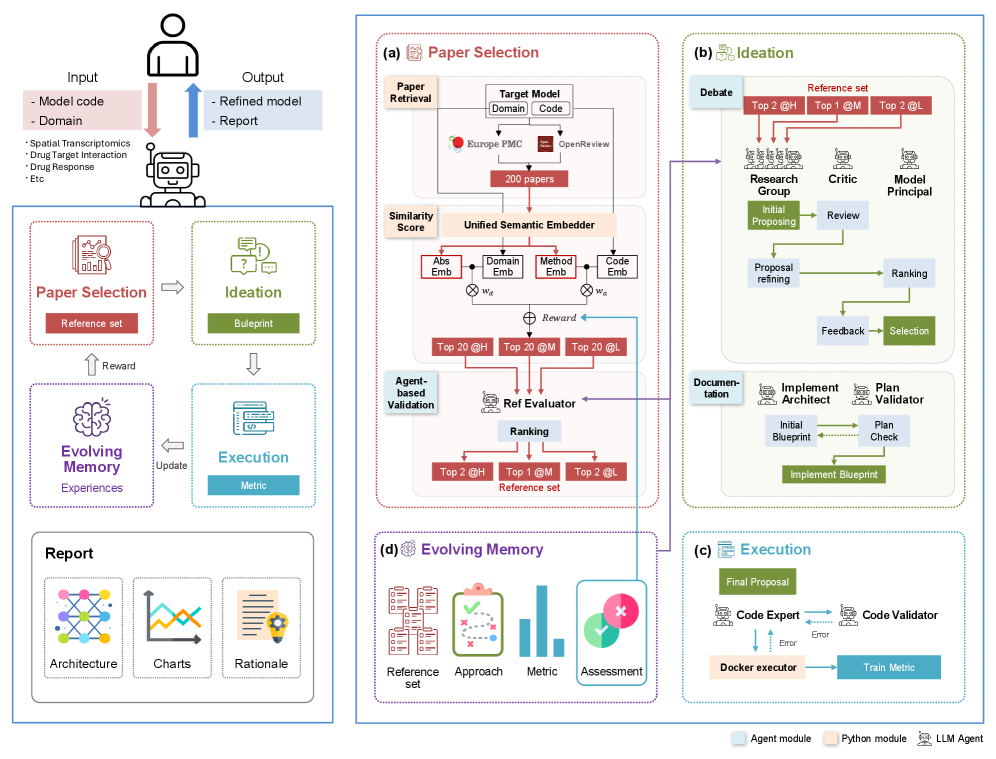
Fig 1: Figure 1: Overview of the MARBLE framework. MARBLE is an end-to-end multi-agent system for iterative bioinformatics model refinement. The framework operates in a closed loop comprising (a) literature-aware paper selection, (b) debate-driven ideation among role-specialized agents, (c) autonomous execution and evaluation, and (d) an evolving memory that records outcomes to guide subsequent refinement iterations.
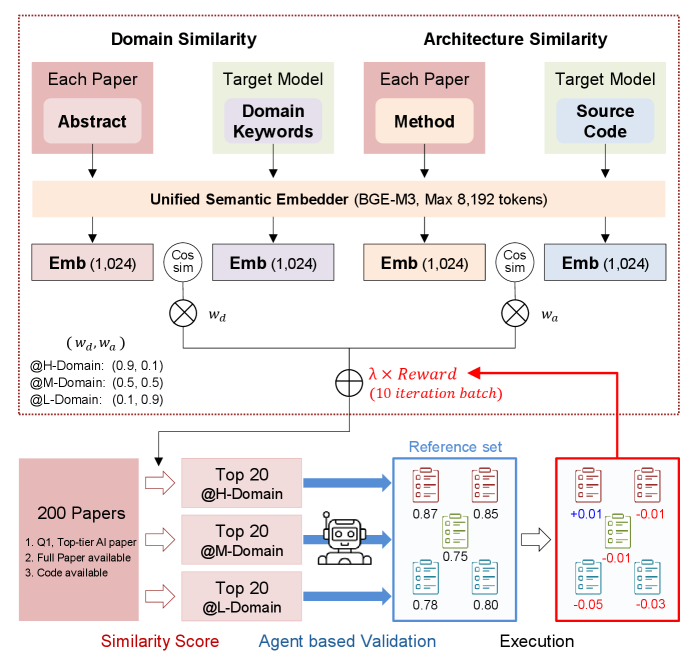
Fig 2: Figure 2: Hybrid paper selection with performance-grounded reward update. Candidate papers are scored using embedding-based domain similarity (paper abstract vs. target domain keywords) and architecture similarity (paper method vs. target model source code) via a unified semantic embedder. The two similarity components are combined using domain and architecture weights ( w d , w a ) (w_{d},w_{a}) , which vary across high-, middle-, and low-domain relevance groups, to produce a metric score. From an initial pool of 200 papers, top candidates are filtered per group and further ranked through agent-based validation. Execution outcomes from subsequent refinement iterations generate batch-aggregated reward signals, which update paper selection weights and guide performance-grounded reference prioritization across iterations.
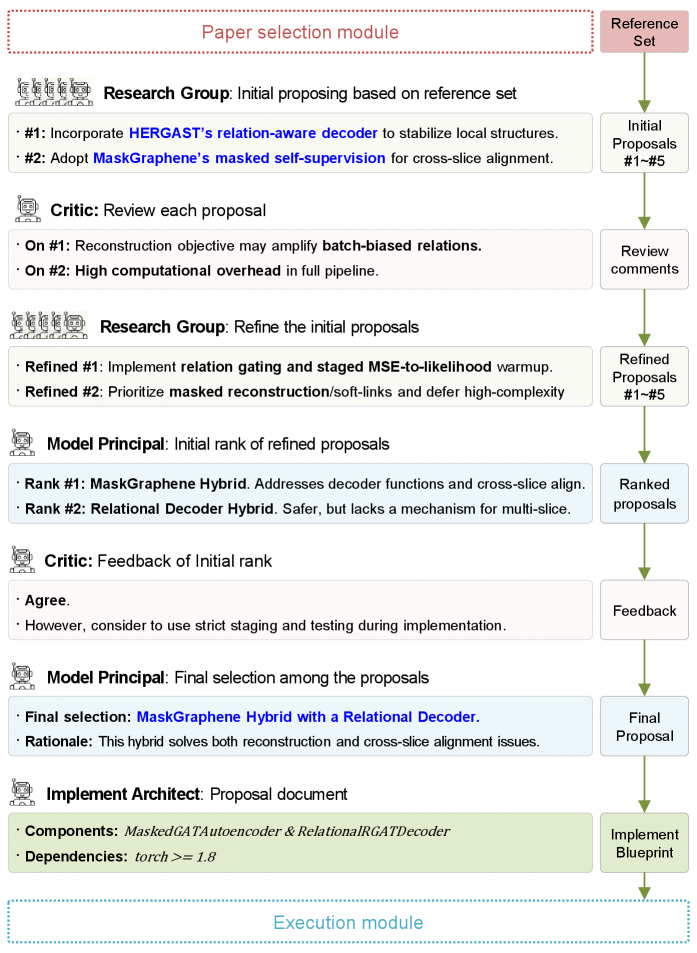
Fig 3: Figure 3: Example of debate-driven ideation in MARBLE. Illustrative ideation trace for refining the STAGATE model on a spatial transcriptomics domain segmentation task. Research Group generates initial architecture modification proposals based on the selected reference set, which are evaluated and critiqued by a Critic . The proposals are then refined and ranked by a Model Principal , who incorporates feedback to balance expected performance impact and feasibility, and makes the final selection. Based on this decision, the Implement Architect formalizes the chosen approach into a concrete specification for execution.
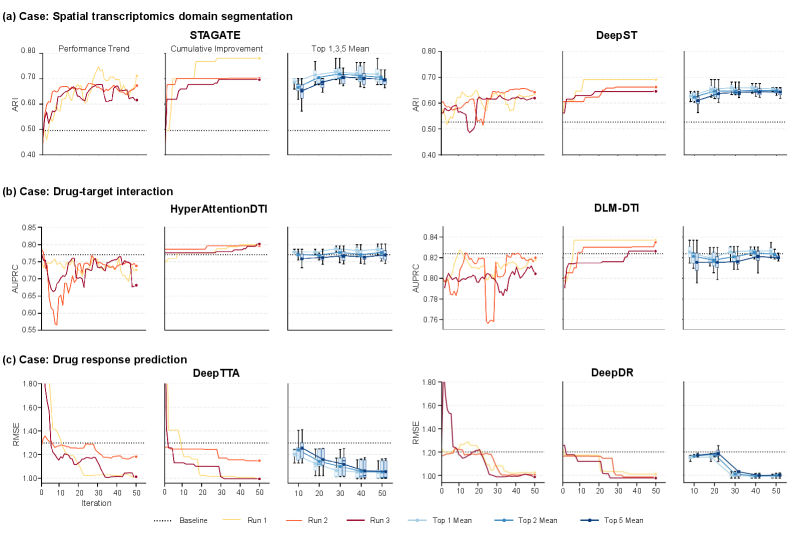
Fig 4: Figure 4: Iterative performance trajectories of target models refined by MARBLE across bioinformatics domains. Performance trends of MARBLE over refinement iterations for (a) spatial transcriptomics domain segmentation (STAGATE, DeepST; ARI), (b) drug–target interaction prediction (HyperAttentionDTI, DLM-DTI; AUPRC), and (c) drug response prediction (DeepTTA, DeepDR; RMSE). For each model, the left panel shows iteration-wise performance trajectories across independent runs, the middle panel reports cumulative peak performance, and the right panel summarizes mean performance of the top-performing iterations. Across all tasks, MARBLE exhibits repeated performance improvements followed by stable convergence relative to the initial baselines.
Ready to evaluate your AI agents?
Learn how ReputAgent helps teams build trustworthy AI through systematic evaluation.
Learn MoreConsiderations
Running iterative architecture refinement with multiple agents adds nontrivial compute cost and engineering overhead compared with one-off experiments. MARBLE currently operates on existing data types and does not introduce new biological measurements or perform lab experiments. Its effectiveness on much larger model classes and in multimodal or experimental feedback-integrated settings remains to be demonstrated. Be mindful of potential risks such as memory poisoning that can degrade results in iterative settings. Memory Poisoning
Deep Dive
MARBLE is a multi-role agent system that automates the cycle of improving bioinformatics models. It begins by pulling a curated pool of literature (200 candidate papers per target) using semantic similarity and agent validation, then moves into a debate-driven ideation phase where role-specialized agents propose, critique, and rank architectural changes. Chosen changes are converted into executable specifications, run, and evaluated; outcomes update a memory and a reward signal that reprioritizes future literature selection and proposals. The design balances modularity (separate paper selection, ideation, execution) and closed-loop feedback so successful changes accumulate across iterations. Chain of Thought Pattern and LLM-as-Judge inform the evaluation and decision discipline that guide the loop. When tested on six models across three domains—spatial transcriptomics segmentation, drug–target interaction prediction, and drug response prediction—MARBLE produced consistent improvements: segmentation adjusted to better anatomical continuity, interaction models increased precision, and response predictors reduced prediction error. Gains tended to appear in early iterations and then stabilize, with multiple repeatable improvements rather than isolated one-off tweaks (for example, STAGATE saw architectural updates at iterations 5, 17, and 28 that incrementally raised segmentation scores). The system emphasizes robustness (high execution success) and transparency (memory of changes and literature grounding). Future work aims to expand to multimodal data, tighten resource-aware controls, and integrate experimental lab feedback. Supervisor Pattern
Need expert guidance?We can help implement this
Credibility Assessment:
All authors lack provided h-index or notable affiliations and the work is an arXiv preprint with no citations — emerging/limited info.