The Big Picture
A training-free, multi-agent pipeline can mine noisy web images and produce high-precision, fine-grained corner-case labels with minimal human effort, making dataset curation practical on modest edge-capable hardware.
ON THIS PAGE
The Evidence
A recursive crawl→filter→distill→relabel pipeline (ReCCur) uses vision–language prompts, multimodal consistency checks, and multiple visual encoders to gather high-recall data and prune noise without heavy retraining. Uncertainty-driven routing sends only low-confidence items to human reviewers, keeping manual labeling to a few samples per cluster while preserving rare positives. A final region-level proposer/validator produces auditable, part-level labels that improve downstream recognition on flooded vehicles, toxic/edible mushrooms, and wall-damage cases. consensus-based decision pattern also informs how cluster decisions are reviewed, while semantic capability matching pattern helps align descriptor metadata with visual features.
Not sure where to start?Get personalized recommendations
Data Highlights
1Modest-hardware throughput: 1.6 images/sec on an Intel i7-11700 CPU, 4.1 images/sec on an NVIDIA RTX 3060 (≈5.6 GB), and 8.2 images/sec on an NVIDIA A10 (batch size 16).
2Cluster labeling policy reduces annotation: clusters with ≥80% sampled items marked relevant are auto-kept, while clusters with ≤20% are discarded—minimizing manual checks to a small per-cluster sample.
3Iterative refinement yields fast convergence: per-class F1 scores rise across rounds with visible convergence by round 3, enabling high clean-data retention and steadily improving downstream accuracy.
What This Means
Engineers building robust vision models for edge deployment will benefit—ReCCur produces high-quality, fine-grained datasets without heavy retraining or big compute. Technical leads or data teams needing to expand rare-case coverage (insurance, inspection, safety-critical apps) can use the pipeline to reduce labeling cost and produce auditable labels. For teams aiming to reason about model outputs, the chain-of-thought pattern provides a structured way to trace decision reasoning.
Key Figures
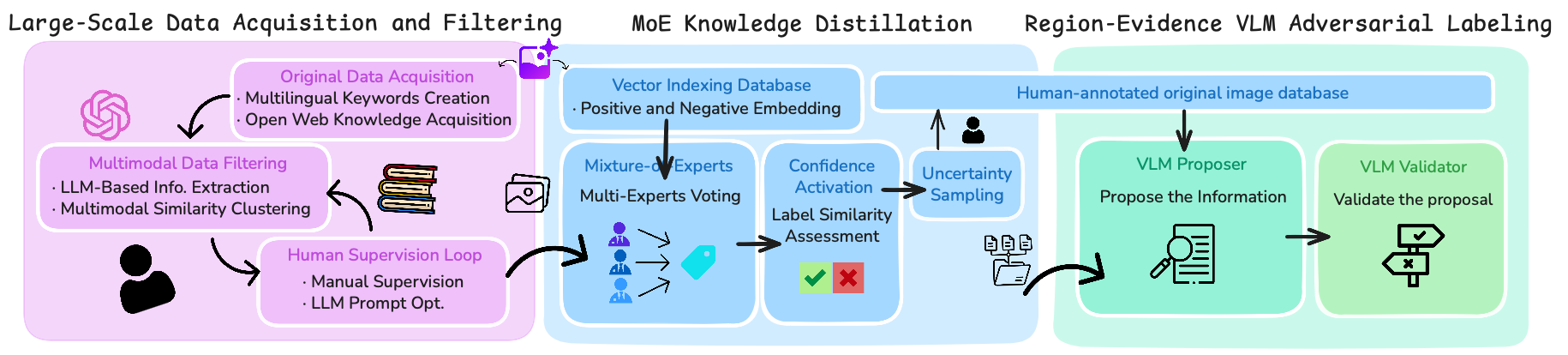
Fig 1: Figure 1 : Overview of ReCCur. Multimodal acquisition/filtering, MoE labeling (with confidence + uncertainty), and region-evidence VLM progressively purify data and refine labels.
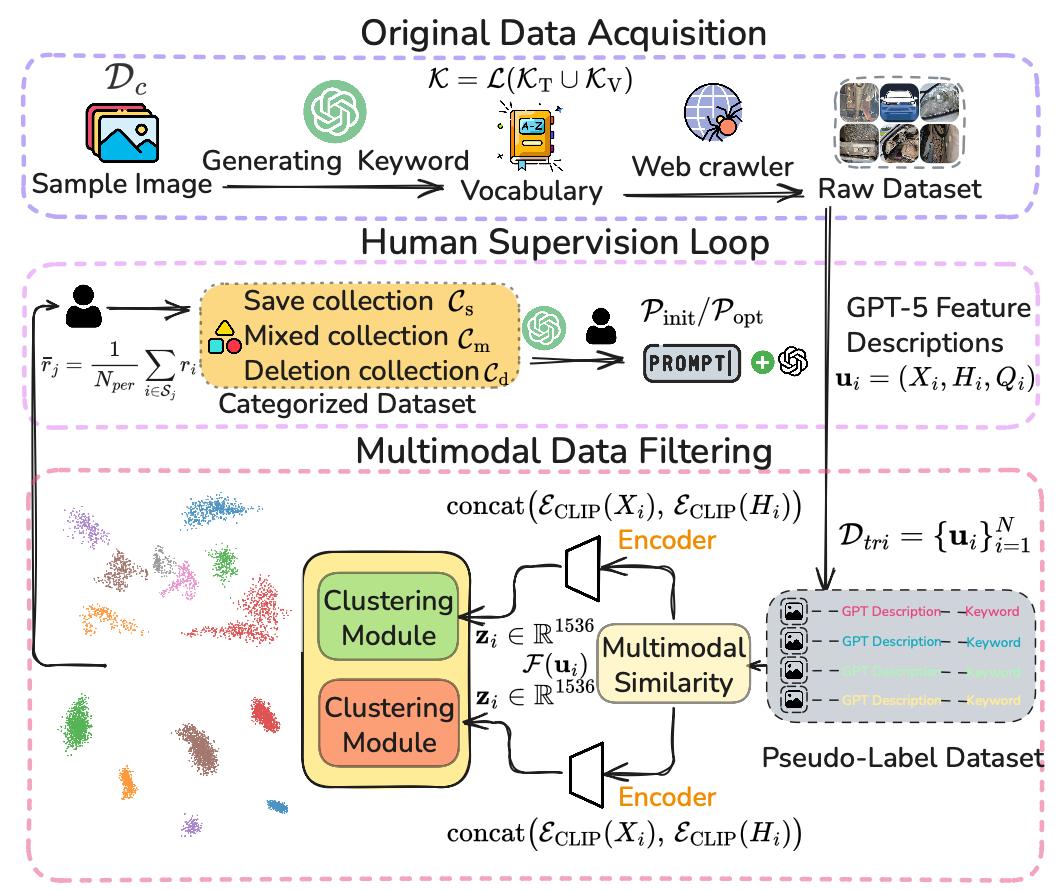
Fig 2: Figure 2 : Overall framework of Large-Scale Data Acquisition and Filtering. LLM-expanded keywords guide crawling; the Human Supervision Loop refines prompts, adds descriptors, and categorizes samples into save/mixed/delete; vision–language clustering prunes noise to produce a pseudo-labeled, high-quality dataset.
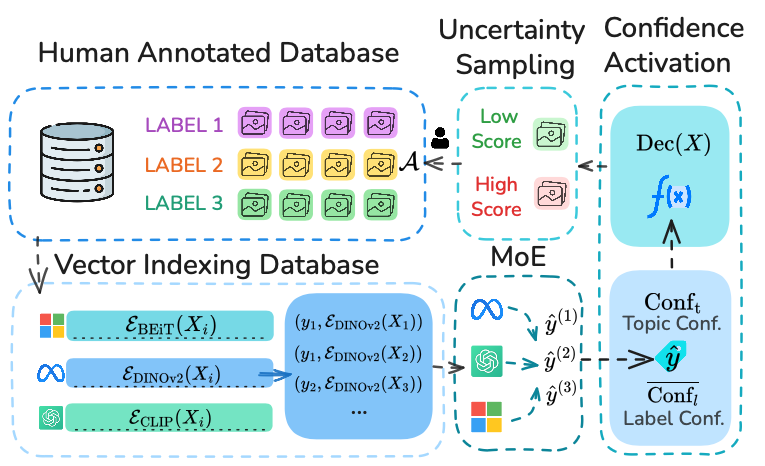
Fig 3: Figure 3 : Overall Structure of Mixture-of-Experts Knowledge Distillation. Human-labeled images are embedded into a vector index. MoE predicts y ^ \hat{y} with topic/label confidences; uncertainty sampling escalates low-confidence cases to annotators, and confidence activation decodes the final decision.
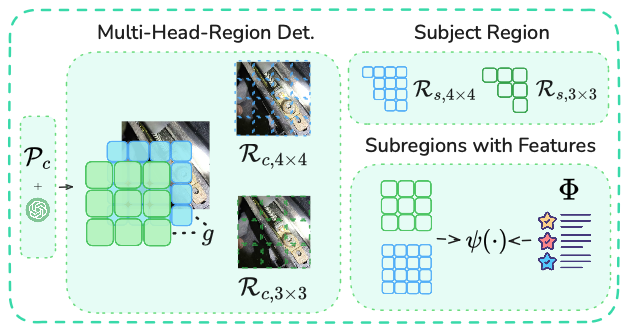
Fig 4: Figure 4 : Architecture of the VLM Proposer. The Proposer outputs Multi-Head-Region grids, isolates the subject and subregions, and annotates each with semantic cues 𝚽 \boldsymbol{\Phi} .
Ready to evaluate your AI agents?
Learn how ReputAgent helps teams build trustworthy AI through systematic evaluation.
Learn MoreYes, But...
Validation so far is limited to image case studies (flooded vehicles, mushrooms, wall damage); video, 3D, and temporal corner cases were not tested. The system depends on external vision–language model outputs (used here via a VLM API), so quality and costs may vary with the chosen service. While designed to avoid mass annotation, some manual review and careful provenance handling are still required for legal and privacy compliance. See Retrieval-Augmented Generation for related rationale on using external sources to augment data.
Methodology & More
ReCCur is a modular, training-free-core framework for turning noisy web imagery into high-confidence corner-case datasets suitable for edge-constrained workflows. Start with a small set of exemplar images; a vision–language model expands those into multilingual crawler keywords to maximize recall. Retrieved images are paired with model-generated textual descriptions and keyword metadata, then scored by multimodal similarity (image↔description↔keyword) to split high- and low-similarity sets. High-similarity samples are clustered in an enhanced embedding space and only a few images per cluster are manually reviewed to categorize clusters as keep/mixed/discard. Human feedback is used to refine prompts and improve the next crawl/filter round. LLM-as-Judge can provide audit-friendly assessments at key steps. A mixture-of-experts distillation stage builds a vector-indexed ensemble from several visual encoders; k-nearest-neighbor voting with dual confidence activation assigns coarse labels while an uncertainty sampler routes ambiguous or boundary items to human annotators. Finally, a region-evidence stage proposes multi-granularity regions and runs chained global+local consistency checks to produce explainable, part-level semantic labels. Chain of Thought Pattern experiments on three corner-case domains show ReCCur improves label purity and downstream recognition while running on modest hardware (consumer GPU or laptop), converging within a few refinement rounds and keeping manual labeling minimal. The approach is practical for teams that need to expand rare-case datasets under compute and budget constraints, but extending to video/3D and assessing VLM dependency are next steps. Semantic Capability Matching Pattern could help further align multi-modal cues with task-specific labels.
Avoid common pitfallsLearn what failures to watch for
Credibility Assessment:
No clear top affiliations and low author h-indices; arXiv preprint with no citations.