The Big Picture
A synthetic benchmark plus an agent memory evaluator let you measure whether a conversational agent can handle multiple overlapping goals, remember long-term context, and resume paused tasks—outperforming LLM-only judges on goal detection and status tracking while using fewer resources.
ON THIS PAGE
The Evidence
A synthetic dataset (ATOD) and a unified evaluation framework (ATOD-Eval) capture realistic multi-goal, interleaved, and long-horizon dialogue behaviors that prior benchmarks miss. A dual memory evaluator—combining a structured goal database and a semantic vector store—tracks goal lifecycles turn-by-turn and produces dependency-aware metrics for success and efficiency. In experiments the memory-based evaluator beats zero-shot LLM judges and prior memory methods on goal detection and status tracking, remains stable as dialogues grow complex, and uses less per-turn compute and tokens. The setup also provides fine-grained metrics (like dependency-aware completion and turns-to-complete) that let teams diagnose where agents fail in multi-goal workflows.
Data Highlights
1Goal detection accuracy is near-perfect at early stages (>98% F1) and remains high throughout dialogues.
2In complex, interleaved dialogues the proposed evaluator degrades only modestly (≈≤8 percentage points) compared to medium settings, showing stronger robustness than baselines.
3Per-turn resource use is substantially lower than LLM-only judging: roughly 30% fewer tokens per turn and noticeably lower mean update time in the evaluated settings.
What This Means
Engineers building conversational agents who need to validate multi-task behavior and long-term memory: use ATOD to stress-test interleaved goals and asynchronous flows. Technical leads and product managers evaluating agents for real-world workflows can use ATOD-Eval’s dependency-aware metrics to compare candidate systems on meaningful operational signals. Researchers studying agent memory and evaluation get a standardized benchmark and metrics for reproducible comparison.
Not sure where to start?Get personalized recommendations
Key Figures
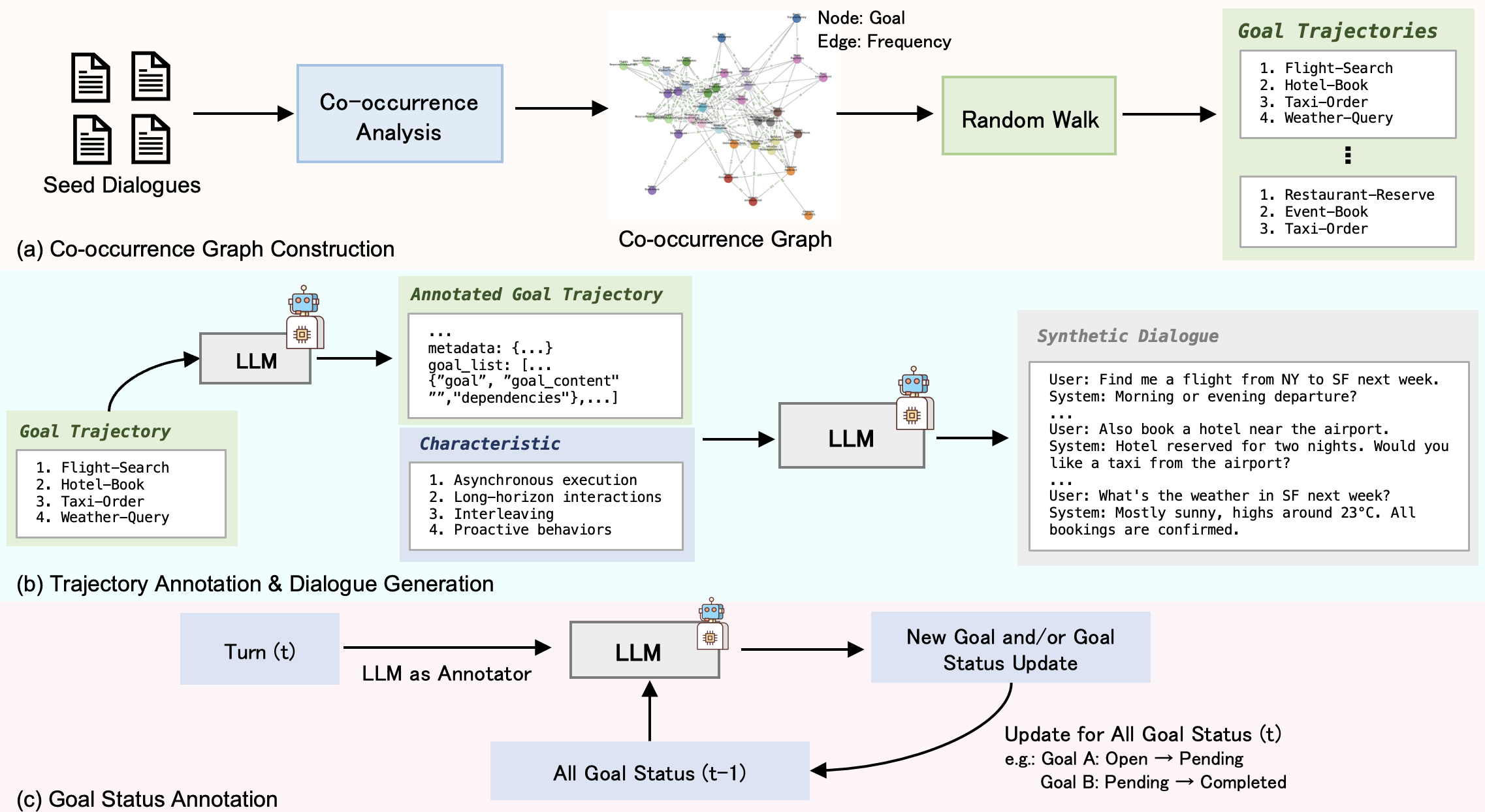
Fig 1: Figure 1: ATOD dataset curation pipeline. (a) Co-occurrence Graph & Trajectory Sampling (§ 4.1 ): Construct a goal co-occurrence graph from seed dialogues and sample diverse multi-goal trajectories via random walks; (b) Trajectory Annotation & Dialogue Generation (§ 4.2 –§ 4.3 ): An LLM annotates slot values, inter-goal dependencies, and complexity, then generates agentic multi-turn dialogues conditioned on the trajectories; (c) Goal Status Annotation (§ 4.4 ): At each turn, an LLM labels active goals and updates lifecycle states, enabling fine-grained tracking of dialogue progress.
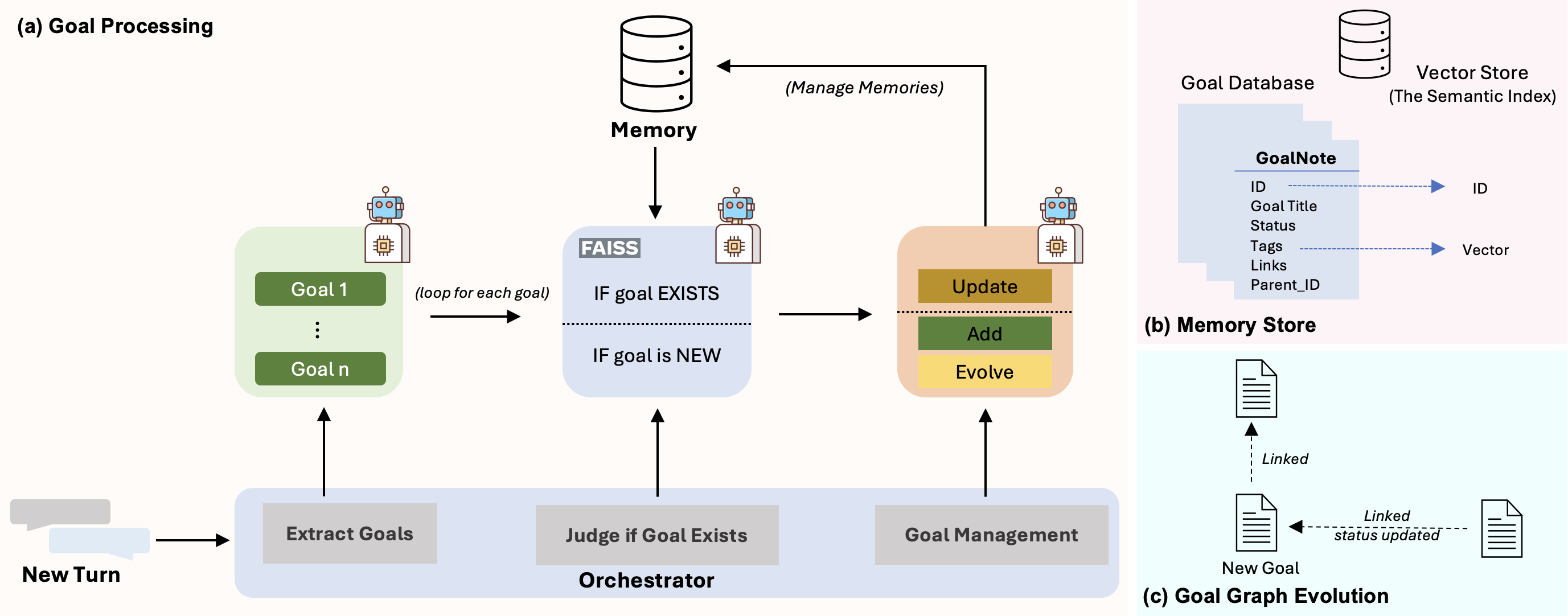
Fig 2: Figure 2: Architecture of the agentic memory system. (a) Turn-level pipeline for goal extraction, existence checking, updating/inserting, and proactive auditing. (b) Dual memory store with symbolic metadata and semantic embeddings. (c) Dependency graph evolution when inserting new goals, with explicit links and status transitions.
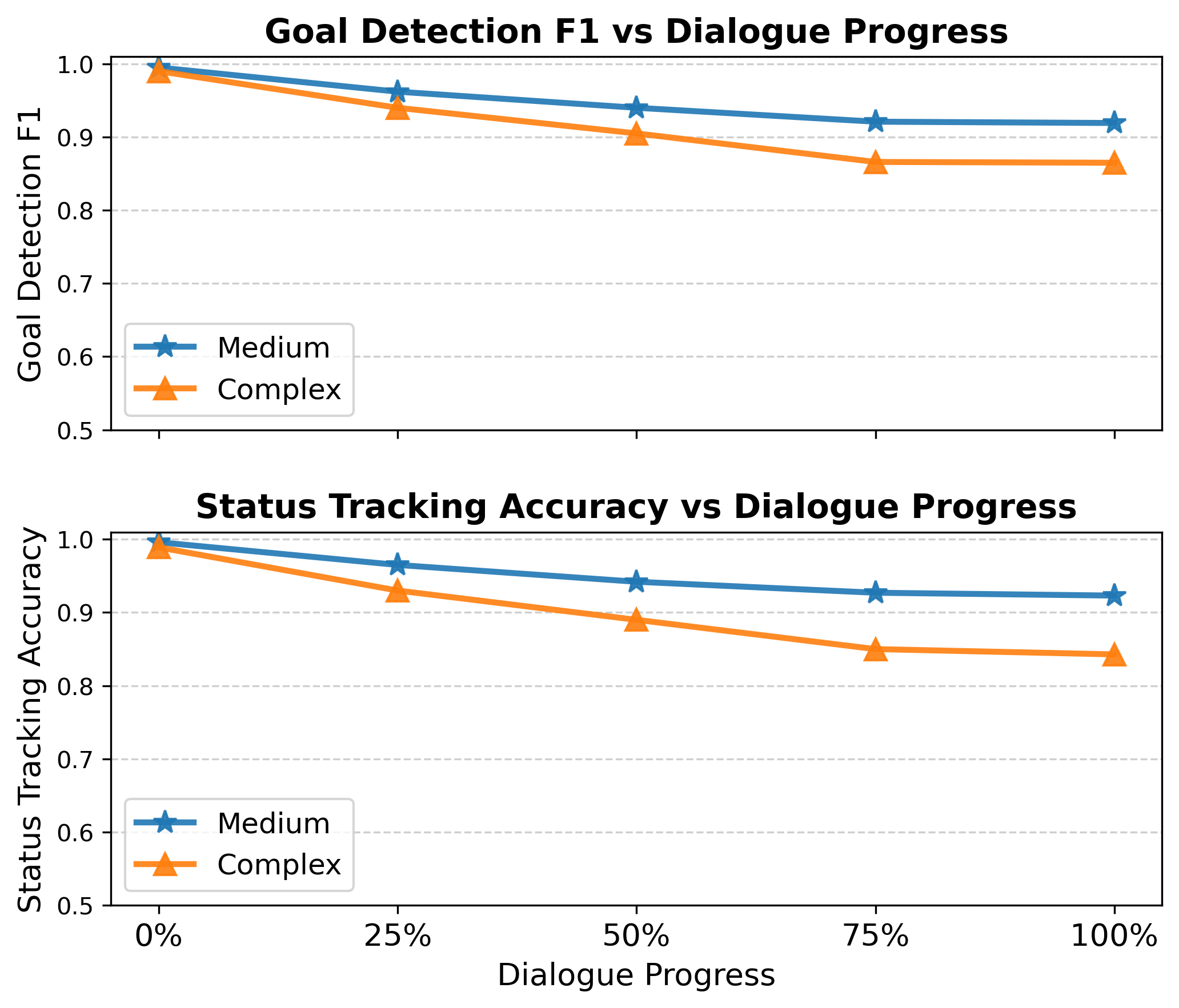
Fig 3: Figure 3: Goal detection F1 (top) and status tracking accuracy (bottom) vs. normalized dialogue progress (0–100%) under Medium and Complex settings.
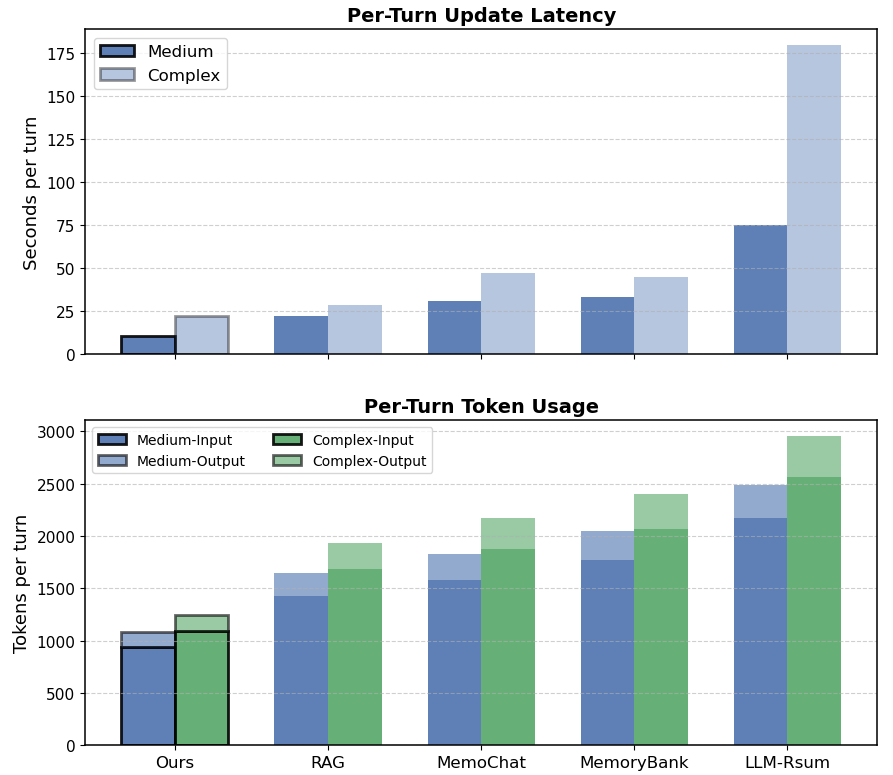
Fig 4: Figure 4: Per-turn update latency (top) and token usage (bottom) across methods. Latency is reported as mean per-turn time with range bars; token usage reports mean input and output tokens per turn under Medium and Complex settings.
Ready to evaluate your AI agents?
Learn how ReputAgent helps teams build trustworthy AI through systematic evaluation.
Learn MoreYes, But...
The dataset is synthetic (LLM-generated from a public seed), so real user traits like demographics, long-term preferences, and noisy user behavior are not represented. Evaluation focuses on text-only dialogues; multimodal interactions (images, voice features beyond text) are outside the current scope. Reported gains are for the benchmark and evaluator described—real-world systems may face additional deployment challenges such as integration with external APIs, user modeling, and policy constraints. To manage complexity and ensure safety, teams can consider guardrails patterns when designing evaluators.
Methodology & More
ATOD generates richly annotated, synthetic dialogues that explicitly include multiple concurrent goals, suspended/resumed workflows, goal dependencies, and delayed (pending) tasks. To build realistic multi-goal scenarios, the pipeline samples goal sets from a co-occurrence graph derived from existing dialogues, then uses a controlled language model pipeline to annotate slot values, inter-goal links, and turn-level goal status. Each dialogue turn is labeled with active goals and lifecycle states to enable fine-grained tracking.
ATOD-Eval adds an agentic memory evaluator that stores goals in two places: a structured symbolic database for exact status and history, and a semantic vector index for flexible retrieval. Key metrics include a dependency-aware goal completion rate (which only scores goals whose prerequisites are met) and turns-to-completion. When compared to zero-shot LLM judges and prior memory-augmented evaluators, the proposed memory-based system achieves higher goal detection and status-tracking accuracy, maintains stability as dialogues progress, and reduces per-turn token and compute costs. The benchmark and metrics give teams actionable failure signals (e.g., missed dependencies, slow recoveries, or abandoned goals) to guide engineering and model improvements. Retrieval-Augmented Generation
Avoid common pitfallsLearn what failures to watch for
Credibility Assessment:
University affiliation (UIUC) and Gokhan Tur with h-index ~22 — solid, established researcher signals.