The Big Picture
A lightweight, non-aggregating matchmaker that only sees privacy-safe profiles can learn which peer-to-peer model pairings help most, boosting shared-model performance (≈50% in some settings) while avoiding a central model aggregator.
ON THIS PAGE
The Evidence
A central profiler that never touches raw data or model weights can learn pairing strategies from simple feedback and direct agents to exchange knowledge securely. Using prediction distillation and parameter-efficient fine-tuning, matched peers improve each other far more than random peerings or isolated training. On a challenging code-generation setup the learned matchmaking gave large gains and stable convergence where a strong centralized distillation baseline failed. securely
Not sure where to start?Get personalized recommendations
Data Highlights
148.5% relative improvement in Pass@1 over random peer pairing for 32 clients in a high-heterogeneity setting
237.1% relative improvement for 8 clients in high-heterogeneity; gains shrink to 3.1% in low-heterogeneity scenarios
3Matcher learning converged: cumulative regret stabilized after ~60 communication rounds, enabling steady gains toward an oracle upper bound
What This Means
Engineers building collaborative, privacy-sensitive model updates across teams or organizations will benefit because the approach improves model quality without moving data or centralizing models. Technical leaders and researchers evaluating multi-agent systems can use the matchmaker idea to get predictable, measurable collaboration gains while reducing the attack surface of a central aggregator. The idea supports privacy-preserving model updates.
Key Figures
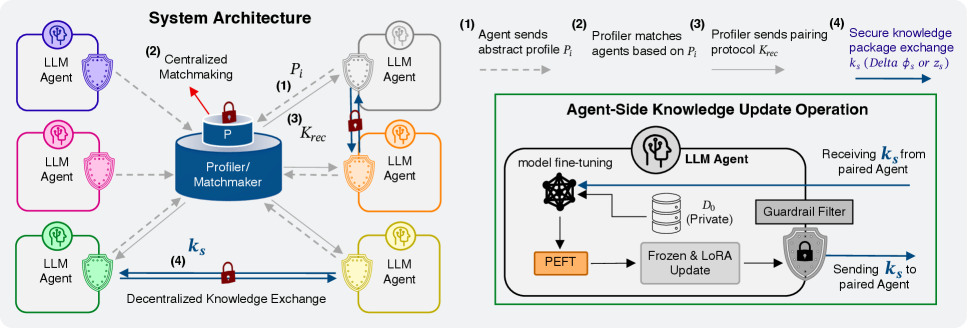
Fig 1: Figure 1: The KNEXA-FL architecture for orchestrated decentralization. Agents send abstract profiles ( 𝐩 i \mathbf{p}_{i} ) to a non-aggregating Central Profiler/Matchmaker (CPM), which provides pairing directives ( K r e c K_{rec} ). Paired agents then conduct direct, secure P2P knowledge exchange ( k s k_{s} ). The agent-side view (right) details local PEFT fine-tuning and the privacy-enforcing Guardrail Filter.
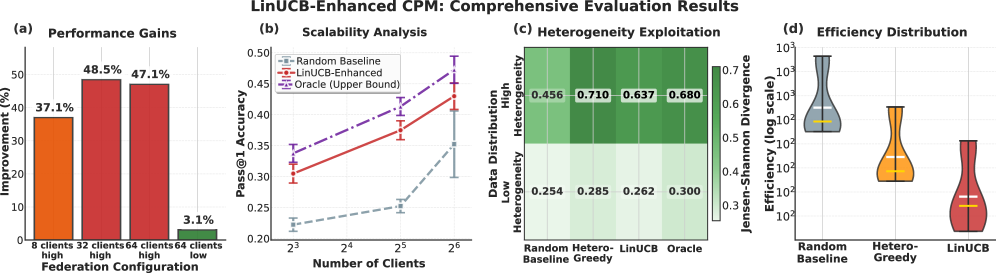
Fig 2: Figure 2: LinUCB-enhanced CPM comprehensive evaluation in a synthetic federation. (a) Performance Gains: The relative improvement over random pairing peaks at 48.5% for 32 clients in a high-heterogeneity setting and remains substantial (37.1%) even for 8 clients. Gains are modest (3.1%) in low-heterogeneity scenarios, confirming the CPM’s primary value is in exploiting diversity. (b) Scalability Analysis: Pass@1 accuracy demonstrates our LinUCB approach consistently outperforms the random baseline across all federation sizes (8 to 64 clients) and robustly tracks towards the oracle upper bound. (c) Heterogeneity Exploitation: The Jensen-Shannon (JS) divergence of selected pairs reveals the CPM’s learned strategy. While a naive Hetero-Greedy baseline maximizes JS divergence (0.710), our approach learns a superior trade-off, maintaining high divergence ( ≈ \approx 0.64) while selecting for synergistic compatibility. (d) Efficiency Distribution: The computational efficiency, measured in rewards processed per second, remains highly practical, confirming that the CPM’s intelligence does not introduce prohibitive overhead. Error bars and shaded regions represent 95% confidence intervals over five independent runs.
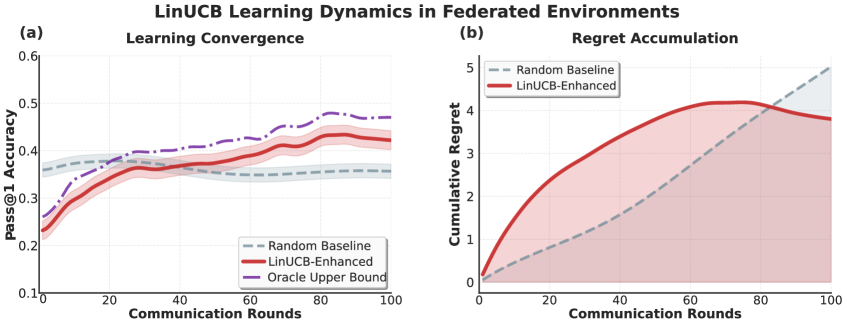
Fig 3: Figure 3: LinUCB-based CPM learning dynamics over 100 communication rounds in synthetic federated environments. (a) Learning Convergence: Pass@1 accuracy trajectories demonstrate the LinUCB algorithm’s ability to learn optimal pairing strategies over time. The LinUCB-enhanced approach (red) shows steady improvement and convergence toward the oracle upper bound (purple dashed), while the random baseline (gray dashed) plateaus at suboptimal performance. The shaded regions represent 95% confidence intervals. (b) Regret Accumulation: Cumulative regret quantifies the performance gap between each method and the oracle policy. LinUCB’s regret stabilizes after approximately 60 rounds, indicating convergence to a near-optimal policy, while the random baseline’s regret grows linearly. The plateauing of LinUCB’s regret curve confirms the algorithm’s successful exploitation of learned pairing patterns. These synthetic experiments validate the theoretical foundations of our contextual bandit approach and demonstrate why intelligent matchmaking is crucial for maximizing collaborative gains in heterogeneous federated learning environments.
Ready to evaluate your AI agents?
Learn how ReputAgent helps teams build trustworthy AI through systematic evaluation.
Learn MoreYes, But...
Results are demonstrated on code-generation tasks and a synthetic heterogeneity setup; gains may differ on other tasks or real-world client distributions. The current matchmaker uses a linear bandit model that may miss more complex compatibility patterns; richer models were suggested but not evaluated. Strong privacy guarantees like formal differential privacy or zero-knowledge proofs are not integrated yet, and the system assumes honest, cooperating peers and secure channels. privacy safeguards
Methodology & More
KNEXA-FL sets up a middle path between insecure central aggregation and blind peer-to-peer averaging by adding a non-aggregating matchmaker (the Central Profiler/Matchmaker) that only receives compact, privacy-preserving agent profiles. Each agent keeps its base model frozen and trains a small, parameter-efficient adapter (for example, LoRA) on private data. The matchmaker treats pairing as an online learning task: it proposes peer pairs, observes a simple reward signal from their knowledge exchange, and updates its policy. Knowledge exchange happens directly between agents via prediction distillation (one agent generates outputs on a shared unlabeled set and the other learns from those outputs) and updates only the lightweight adapter, not the full model weights. Central Profiler/Matchmaker as a pattern of coordination. Empirical tests merged two code benchmarks into a 464-problem corpus with non-uniform client splits to simulate realistic diversity. The learned matchmaker (implemented with a linear contextual bandit) consistently outperformed random or heuristic pairings, especially when clients were diverse: up to ~48.5% relative Pass@1 improvement for 32 clients and robust gains for other sizes. Learning converged in ~60 rounds and avoided the catastrophic collapse seen in a strong centralized distillation baseline. Practical implications: organizations can get much of the benefit of collaboration without a centralized aggregator, but real deployments should consider scaling, more expressive matchmaking models, and formal privacy safeguards.
Avoid common pitfallsLearn what failures to watch for
Credibility Assessment:
Authors have low h-indices and no strong institutional signals; arXiv venue only.