The Big Picture
Combining AI protocol generation with a digital-twin simulation loop produces robot-ready lab protocols and prevents physical failures; splitting reasoning across specialized agents is more reliable for complex experiments than a single all-purpose model.
ON THIS PAGE
The Evidence
An AI-driven pipeline called PRISM turns plain-English experimental goals into structured liquid-handling steps, then uses a simulated digital twin to catch and fix physical and sequencing errors before any robot runs the experiment. Simple constrained prompts work well for short, routine workflows, while open-ended prompts require more reasoning and benefit from the multi-agent setup. Simulation uncovered real execution risks—like trying to insert a plate with a closed lid or wrong orientation—and iterative refinement eliminated those issues; a PCR protocol produced by the system ran successfully on real hardware.
Not sure where to start?Get personalized recommendations
Data Highlights
15 large language models were evaluated (GPT-5, two Claude variants, and two Gemini variants).
2Protocol refinement used up to 3 automated correction iterations; attempts that didn’t converge within 3 rounds were marked non-convergent.
3GPT-5 produced a perfect initial PCR protocol on the benchmark (100% correct in initial-generation comparison).
What This Means
Engineers building automated laboratories and teams packaging AI-generated protocols for robotic platforms will benefit most—PRISM reduces wasted runs, avoids hardware damage, and speeds deployment by catching errors in simulation. Lab managers and technical leads evaluating autonomous workflows can use the multi-agent + simulator pattern to get safer, auditable protocol generation before real execution.
Key Figures

Fig 1: Fig. 1: Overview of the PRISM framework for protocol generation and execution. The system consists of three main stages: Protocol Planning, where user intent is converted into structured steps; Protocol Generation, where structured English instructions are transformed into robot-aware actions and iteratively refined through validation cycles in Omniverse before execution; and Real-World Execution, where the full pipeline is validated using the Luna qPCR protocol in our autonomous laboratory.

Fig 2: Fig. 2: Comparison of protocol complexity for Luna qPCR and PhenoVue Cell Painting assays. (A) Structured liquid-handling step format that all generated protocols must follow. (B) Number of atomic steps required per well/reaction for each assay, coloured by operation type. Cell Painting requires substantially more reagent additions and wash cycles than qPCR, and is highly order-dependent (e.g., stain–wash cycles must be performed sequentially), whereas reagent addition order does not matter in qPCR. (C) Schematic step-by-step workflows for qPCR (top) and Cell Painting (bottom), highlighting the increased length, repetition, and ordering constraints of the Cell Painting protocol.
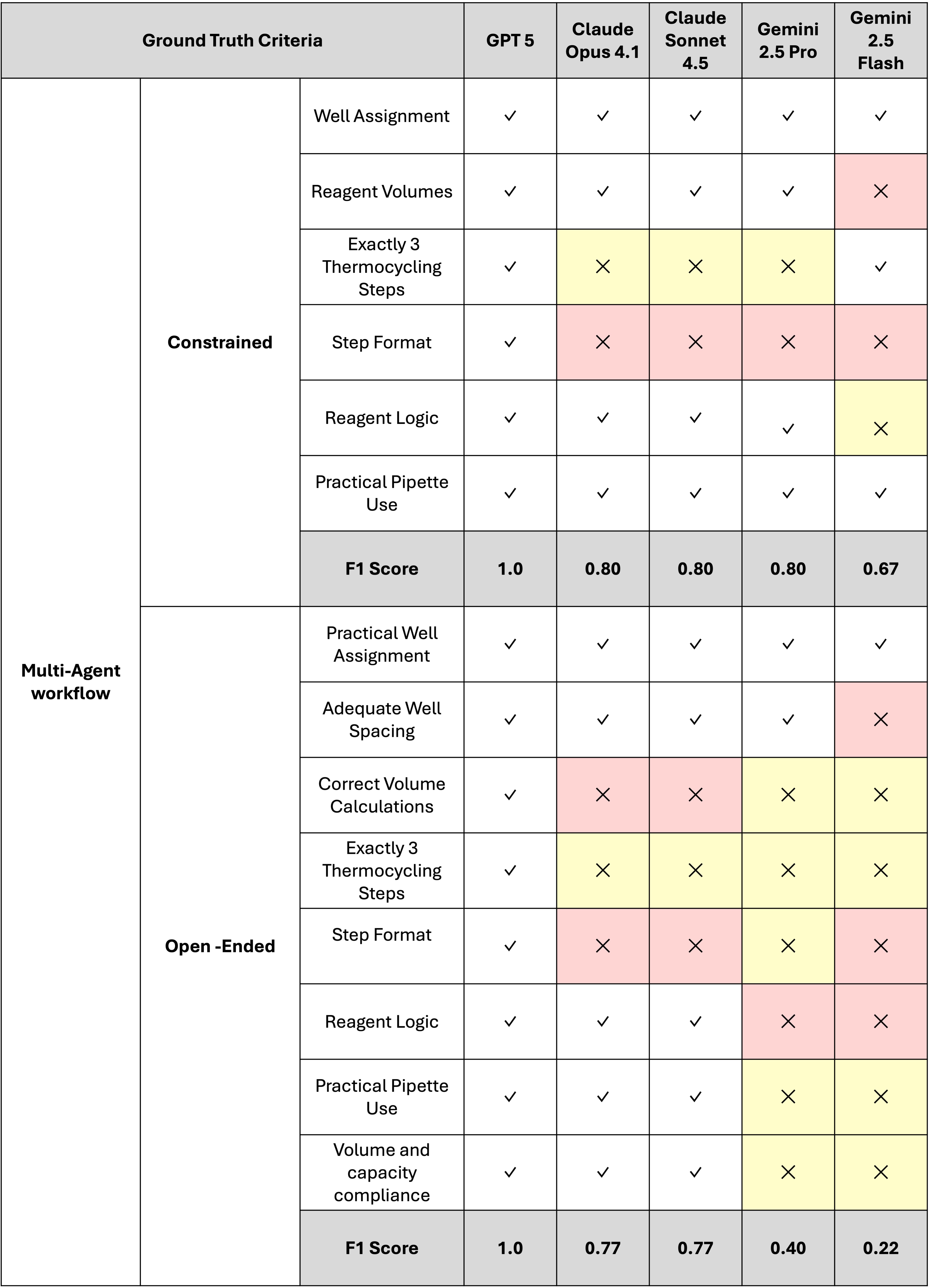
Fig 3: (a) Multi-agent

Fig 4: Fig. 4: Visualization-focused pattern-generation tasks used to evaluate PRISM. (A) A 3 × 3 3\times 3 coloured square in the upper-left corner. (B) A diagonal pattern beginning at the lower-left corner (H1). (C) An alternating-row fill pattern. (D) A rainbow checkerboard combining a red–yellow–blue gradient with a parity-based fill rule.
Ready to evaluate your AI agents?
Learn how ReputAgent helps teams build trustworthy AI through systematic evaluation.
Learn MoreKeep in Mind
Results are demonstrated on a limited set of workflows (PCR was executed end-to-end; a complex Cell Painting assay was validated in simulation but not run physically). Simulation reduced many failure modes but subtle geometric or device-specific constraints can still slip through (e.g., plate orientation issues). Performance depends on the underlying language models and the fidelity of the digital twin; different models and lab hardware may require additional tuning and validation. The term language models can be linked to the Foundation Model concept in broader discussions.
Methodology & More
PRISM automates the path from a scientist’s plain-English intent to robot-executable lab instructions by combining large language models with a digital-twin simulation and an iterative refinement loop. Planning can be handled either by a single reasoning model or by a prompts were tested to ensure safety and reliability, or by a multi-agent ensemble that splits the task into retrieval, planning, critique, and validation roles. Structured outputs are translated into robot-aware YAML and checked in a 3D simulation environment; detected issues feed back to the generator for up to three refinement cycles. Key findings show that constrained prompts and short, low-dependency workflows (like PCR) are well handled even by single-agent setups, while complex, order-sensitive assays (like Cell Painting) benefit from the multi-agent decomposition where specialized agents catch distinct error classes. The simulator caught real execution errors—such as attempts to insert a plate while a lid was closed or incorrect plate orientations—that text-only reasoning missed. The system produced a PCR protocol that passed simulation checks and was successfully executed on an automated platform with expected fluorescence readouts. Code and prompts are available on the project repository to support further testing and adaptation. Implications: pairing AI generation with a high-fidelity simulator is a practical way to make AI-written lab protocols safer and more trustworthy. For deployment, teams should plan for per-lab validation, invest in accurate digital twins for their instruments, and prefer role-separated agent designs for complex protocols to improve error localization and correction.
Avoid common pitfallsLearn what failures to watch for
Credibility Assessment:
Includes recognizable researchers (e.g., Ian Foster) and experienced team members; stronger author reputation despite arXiv venue.