The Big Picture
Selective, learned messaging plus compact discrete codes lets agent teams maintain or improve task success while sending far fewer bits — big wins in bandwidth- and energy-constrained deployments.
ON THIS PAGE
The Evidence
Learning when to speak and what to send dramatically improves coordination under tight communication limits. A learned gate decides the high-value moments to communicate, and discrete message codes (vector quantization) compress those messages to a handful of bits. In a search-and-rescue grid test, success rose from 13.8% with no communication to 38.8% with the method, while transmitted bits per episode dropped substantially. Across bandwidth budgets the method dominates baselines, preserving most of the pre-quantized information (about 85–95%).
Data Highlights
1181.8% relative improvement in success rate: 38.8% with gated discrete messages vs 13.8% with no communication
271.4% reduction in communication per episode: ~800 bits vs 2,800 bits for full communication
3Pareto area-under-curve 0.198 vs 0.142 for the next-best method, and higher success at 87% of shared bandwidth points
What This Means
Engineers building robot teams, autonomous vehicle coordination systems, and distributed sensor networks will benefit because the approach saves bandwidth and energy while improving task success. Research teams working on multi-agent coordination can adopt the gating + discrete encoding pattern to get stronger, bandwidth-aware baselines for real-world deployments. The approach aligns with planning pattern for bandwidth-aware system design.
Not sure where to start?Get personalized recommendations
Key Figures

Fig 1: Figure 1: Performance comparison showing success rates across communication methods. Our GVQ approach achieves 38.75% success rate, representing 181.8% improvement over no-communication baseline (13.75%) with statistical significance p < 0.001 p<0.001 . Error bars show 95% bootstrap confidence intervals across 8 random seeds.
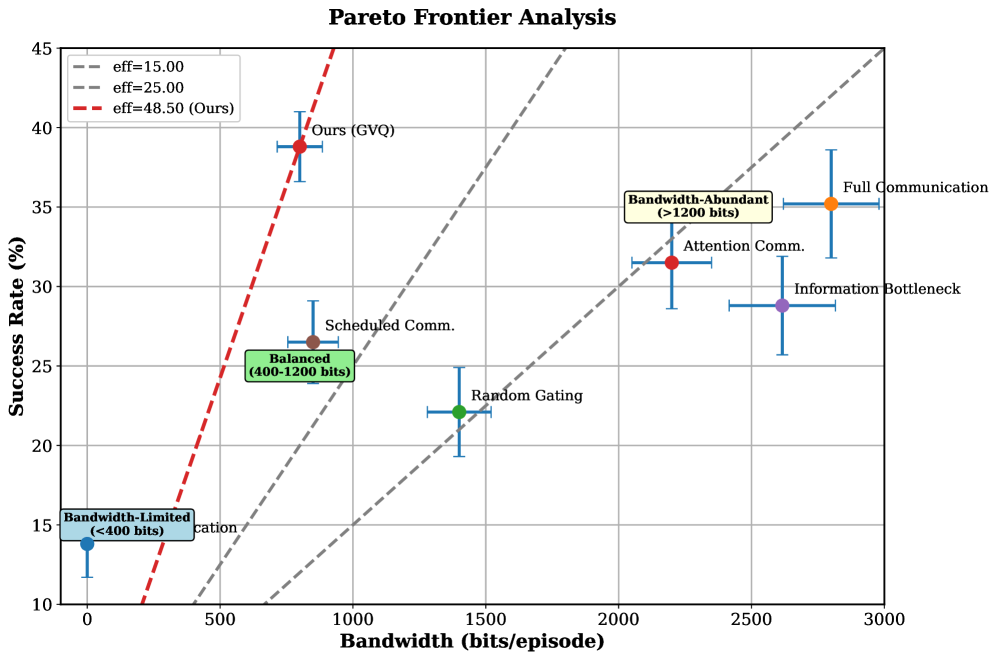
Fig 2: Figure 2: Pareto frontier analysis showing success rate vs bandwidth trade-offs with 95% confidence bands. Our method (red curve) dominates all baselines across the entire feasible region, achieving 41.4% bandwidth reduction (800 vs 2800 bits) while maintaining superior performance. The analysis reveals three distinct operating regimes: bandwidth-limited ( < 400 <400 bits), balanced (400-1200 bits), and bandwidth-abundant ( > 1200 >1200 bits). Dominance analysis shows our method achieves higher success rates at 87% of shared budget points.
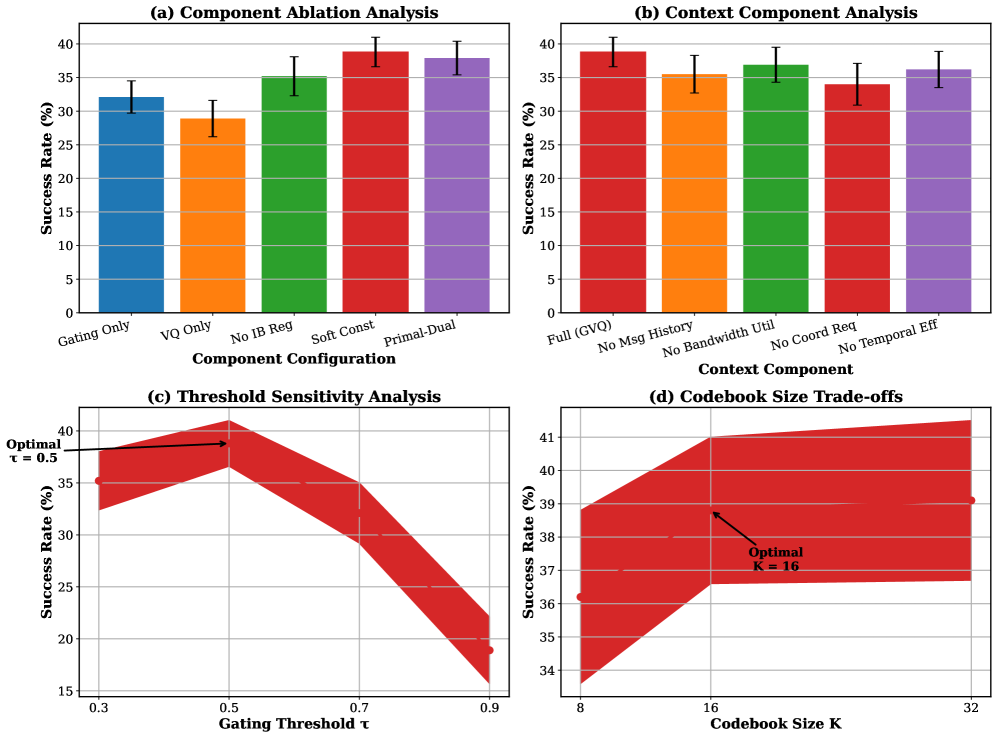
Fig 3: Figure 3: Detailed ablation study results showing (a) component contributions with statistical significance testing, (b) context component analysis revealing the importance of coordination estimates and message history, (c) threshold sensitivity analysis demonstrating optimal performance at τ = 0.5 \tau=0.5 , and (d) codebook size trade-offs between expressiveness and bandwidth efficiency.
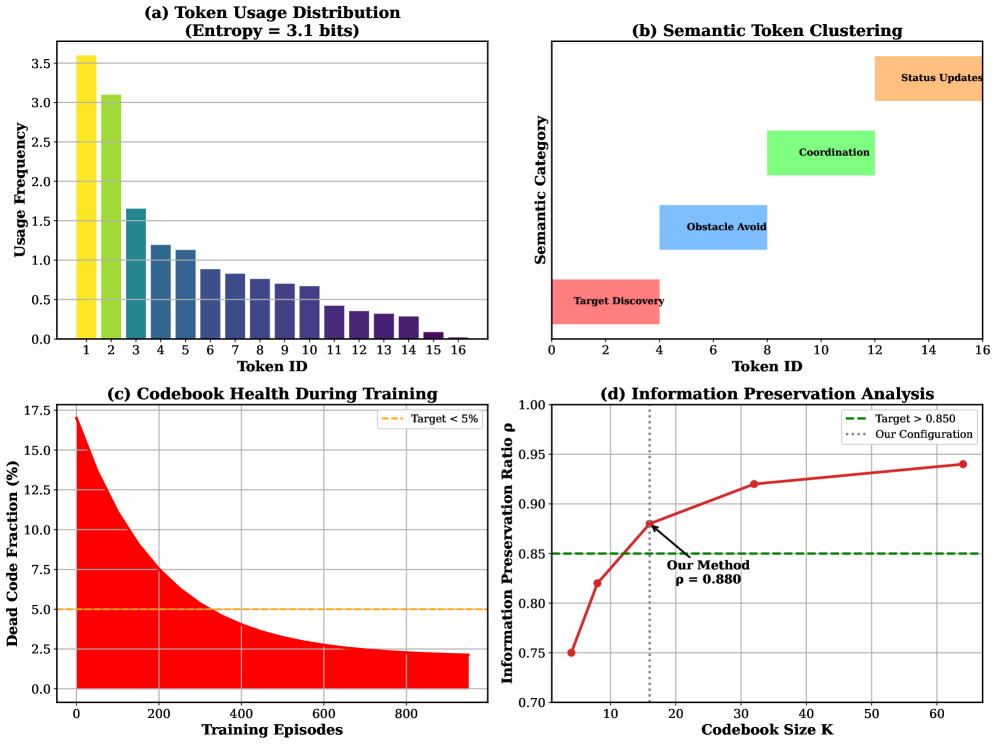
Fig 4: Figure 4: Codebook health and semantic structure analysis showing (a) token usage distribution with entropy 3.1 bits, (b) semantic clustering of tokens into four categories (target discovery, obstacle avoidance, coordination, status updates), (c) dead code fraction remaining below 5% throughout training, and (d) information preservation ratio ρ = I ( S ; M ) / I ( S ; Z ) = 0.88 \rho=I(S;M)/I(S;Z)=0.88 for our K = 16 K=16 configuration.
Ready to evaluate your AI agents?
Learn how ReputAgent helps teams build trustworthy AI through systematic evaluation.
Learn MoreLimitations
Results come from a simulated 20×20 search-and-rescue grid with partial observability, so performance in continuous-control or highly heterogeneous teams may differ. Compression and gating tuning (codebook size, gate threshold) materially affect outcomes; the paper reports good results for a 16-token codebook and gate threshold 0.5. Real-world network effects (packet loss, latency, handshakes and protocol overhead) and discrete mutual information estimation were not fully explored and could change trade-offs in practice. Potential issues include state-inconsistency.
Methodology & More
Agents learn a two-part communication strategy: a gate that decides when a message is worth sending, and a compact discrete encoding for the message itself. The gate is trained to trade off immediate communication cost against expected future task reward, while the encoding is learned with vector quantization so messages become discrete tokens (small fixed-size bitstrings). Training uses an information bottleneck objective that pushes agents to keep only task-relevant information in messages; a straight-through estimator bridges continuous latent training and discrete message transmission. Measured information preservation from continuous latent to discrete code is high (roughly 0.85–0.95), validating the quantization shortcut. throughput high, roughly 0.85–0.95, validating the quantization shortcut. In a simulated search-and-rescue benchmark, the gated vector quantization strategy raised team success from 13.8% (no communication) to 38.8% while cutting per-episode bits from about 2,800 to 800. Pareto analysis shows the approach dominates across bandwidth budgets, with three practical regimes: when bandwidth is very tight, the gate picks only the most valuable moments; at moderate budgets, quantization gives strong performance per bit; with abundant bandwidth, performance approaches full communication but remains more efficient. Practical takeaway: use learned gating to prioritize moments of coordination and modest-size discrete codebooks (paper finds K=16 effective) to get big bandwidth and energy wins, but validate on your specific control domain and network conditions.
Avoid common pitfallsLearn what failures to watch for
Credibility Assessment:
Authors show low h-indices and no institutional affiliations; arXiv-only venue.