The Big Picture
Turn the model’s internal guesses into a simple decision tree so agents pick actions that account for uncertainty—cutting needless back-and-forth while improving success and efficiency.
ON THIS PAGE
The Evidence
LLM-based planners already generate implicit assumptions when reasoning; extracting and structuring those assumptions into a decision tree lets agents evaluate alternative scenarios together instead of repeatedly asking collaborators. Scoring each assumption-path by likelihood, expected gain, and cost produces more reliable, uncertainty-aware action selection and reduces communication. Across two household benchmarks and three different model backbones, the method improved task success and efficiency while keeping message usage similar to baselines. Planning Pattern
Not sure where to start?Get personalized recommendations
Data Highlights
1Benchmarks: evaluated on C-WAH (10 episodes, 3–5 subgoals per episode, horizon 250 steps) and TDW-MAT (24 episodes, transport 10 objects, horizon 3000 steps).
2Model variety: tested on 3 different model backbones (GPT-4o mini, GPT-OSS:20B, Gemma3:4B) and saw consistent improvements across all three.
3Ablation notes: each Planner–Composer–Evaluator module mattered; simply increasing model size or deeper reasoning gave only limited gains compared to explicit uncertainty handling.
What This Means
Engineers building multi-robot or multi-agent systems who want fewer interruptions and more robust plans can use this to trade off physical actions versus costly communication. Technical leaders evaluating agent orchestration and evaluation pipelines can adopt the decision-tree approach to improve agent reliability and reduce token costs in production workflows. Multi-Agent System
Key Figures
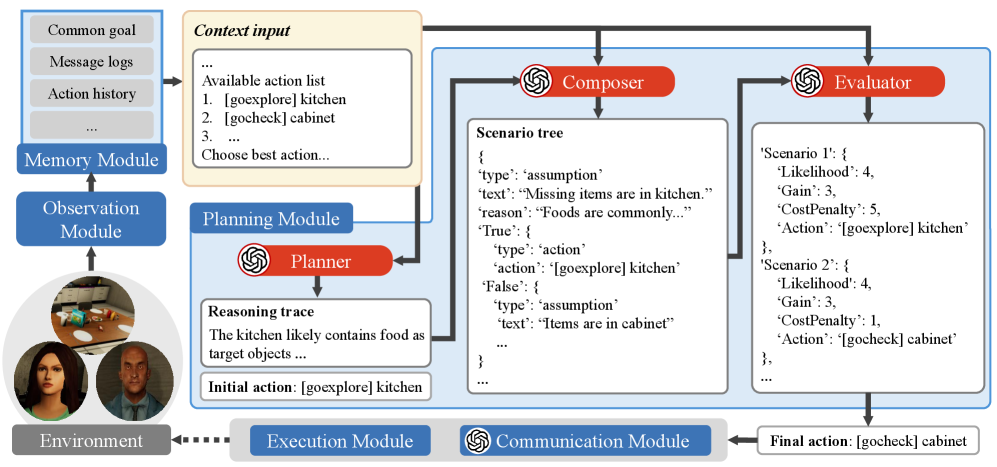
Fig 1: Figure 1: PCE employs a modular architecture with a Planner, Composer, and Evaluator pipeline for planning.

Fig 2: Figure 2: Flow from reasoning trace to action selection. (a) The Planner produces a reasoning trace. (b) The Composer extracts hypotheses from the trace, structures them into a decision tree, and, when needed, generates new assumptions and communication actions to expand unexplored branches. (c) The Evaluator scores each path; The highlighted path indicates the scenario whose leaf node achieves the maximum score ( U U ), determining the agent’s final selected action.
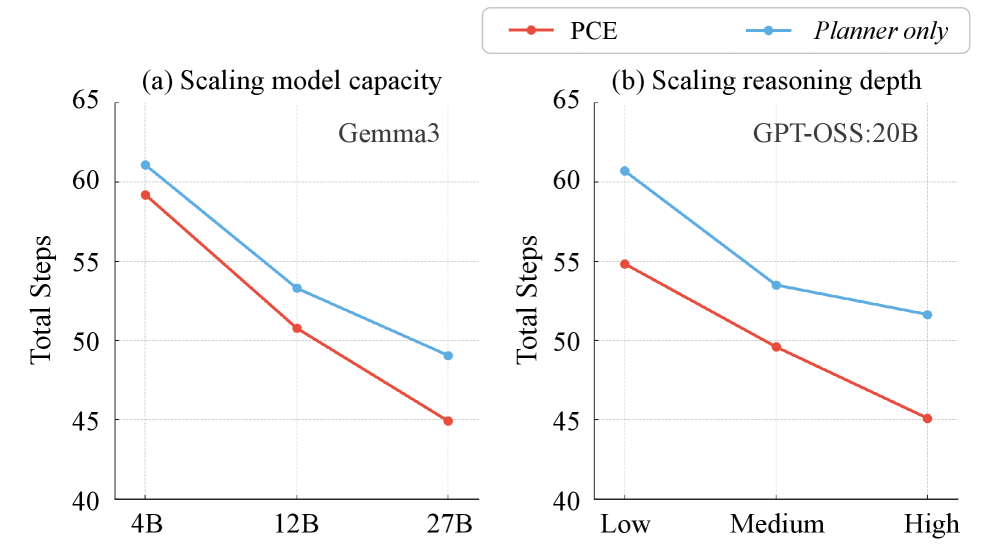
Fig 3: Figure 3: Ablation results about LLM Scaling in C-WAH environment.

Fig 4: Figure 5: example environment
Ready to evaluate your AI agents?
Learn how ReputAgent helps teams build trustworthy AI through systematic evaluation.
Learn MoreYes, But...
Results are shown in simulated multi-room household tasks; real-world dynamics and sensor noise could change outcomes. Communication is modeled with a one-step delay and a fixed message cost; different communication models may alter the trade-offs. Paper reports consistent improvements but does not publish fine-grained percent gains in the text, so practitioners should benchmark on their target tasks before deployment. State Inconsistency
Methodology & More
Agents often reason by implicitly assuming unknown facts (for example, “the cupcake is in the closed cabinet”), but those guesses are typically not collected or compared. The Planner–Composer–Evaluator pipeline turns those internal assumptions into an explicit decision tree: the Planner generates a reasoning trace, the Composer extracts and structures assumptions into branches (each root-to-leaf path is a hypothesis set plus an action), and the Evaluator scores each path on likelihood, expected gain, and cost. The agent then selects the action associated with the highest-scoring hypothesis path, or issues targeted communication only when it meaningfully changes the best path. Planning Pattern Event-Driven Agent Pattern
In experiments on two multi-room household benchmarks (short-horizon C-WAH and long-horizon TDW-MAT), the approach improved success rate and task efficiency while using comparable message/token counts to communication-heavy baselines. Ablation studies showed that each module (Planner, Composer, Evaluator) contributes to gains and that simply scaling up the model or deepening its chain of thought yielded limited benefit without explicit uncertainty handling. Because the method works from natural reasoning traces rather than model internals, it runs on multiple model backbones and can fit into existing agent stacks, offering a practical path to more reliable, low-chatter multi-agent coordination. Handoff Pattern
Avoid common pitfallsLearn what failures to watch for
Credibility Assessment:
Small team with low h-indices, no affiliations provided and arXiv venue.