The Big Picture
Giving simulated users explicit behavioral profiles (how they act) — not just identity info (who they are) — is essential to produce diverse participation styles and realistic sharing cascades in social media simulations.
ON THIS PAGE
The Evidence
Explicit behavioral traits keep simulated populations from collapsing into the same action (everyone posting) and instead sustain distinct roles like lurkers, amplifiers, and commenters. Amplification-oriented profiles drive re-share chains while interaction-oriented profiles drive comment and reaction networks. When behavioral traits are paired with preference-based recommendations, the simulated networks match structural patterns seen in real social media; identity-only agents fail to reproduce that diversity or realistic propagation. semantic capability matching
Data Highlights
1980 agents simulated total, built from 140 identity profiles across four topical domains and paired with seven behavioral archetypes
2Simulations ran for 25 iterations and were repeated across four model configurations and two large language models (Llama 3 70B and Gemma 3 27B) to isolate effects of behavior, personality, and recommendation
3Only the FullModel (behavioral traits + preference-based recommendation) sustained heterogeneous participation patterns and produced realistic propagation cascades, while IdentityOnly agents largely converged to uniform content generation
What This Means
Engineers building multi-agent social simulations and teams evaluating social AI behavior should care because behavioral traits change how content spreads and shape emergent network roles. Product and research leads designing moderation, recommendation, or evaluation systems can use these findings to simulate realistic user mixes (amplifiers vs lurkers) before deploying features. multi-agent social simulations
Not sure where to start?Get personalized recommendations
Key Figures
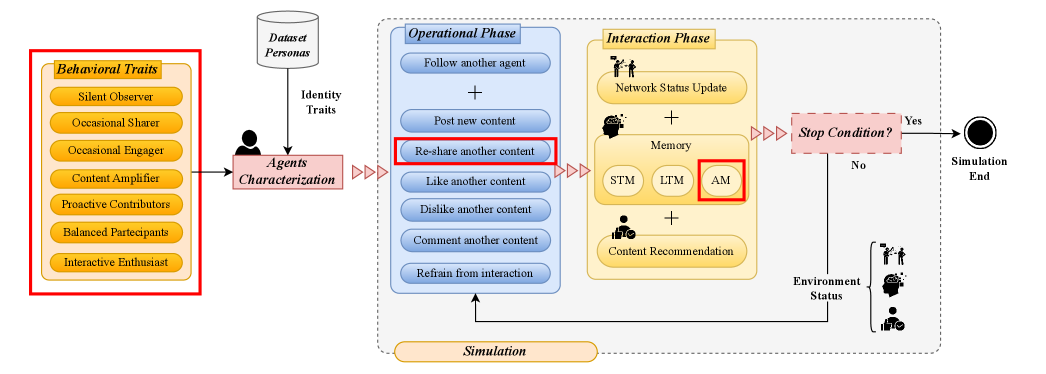
Fig 1: Figure 1: Overview of the proposed GABM-based simulation framework. The framework models large-scale social media dynamics through a population of generative agents, each defined by a two-layer profile of identity traits and behavioral traits . Agents rely on a three-part memory unit (short-term, long-term, and activity memory) to autonomously select and perform platform actions (e.g., posting, following, re-sharing, reacting) until a stop condition is reached. In the figure, the main contributions of this work are highlighted: the introduction of behavioral traits and the activity memory (AM) component, as well as an extended re-sharing mechanism that allows agents to re-share already re-shared content, enabling content propagation through re-sharing chains.
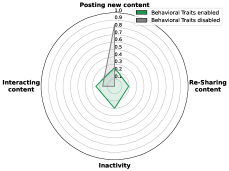
Fig 2: (a)
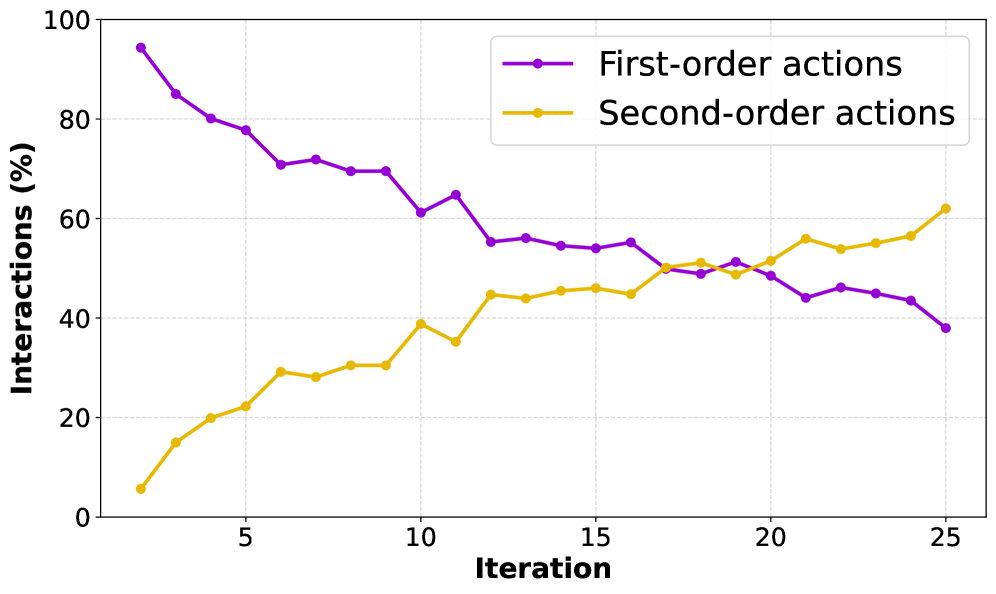
Fig 3: (a)
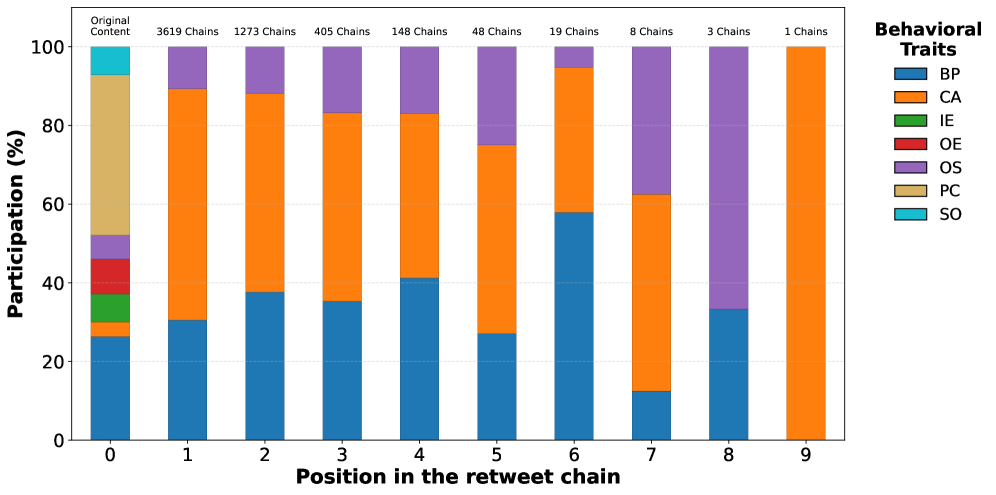
Fig 4: Figure 4: Distribution of behavioral traits across positions in propagation chains. Position 0 corresponds to the creation of original content, while subsequent positions represent successive re-shares. Bars indicate the percentage of agents from each behavioral trait contributing at each stage.
Ready to evaluate your AI agents?
Learn how ReputAgent helps teams build trustworthy AI through systematic evaluation.
Learn MoreYes, But...
The behavioral taxonomy is static during each simulation and may oversimplify real-world variation — people change over time. Experiments used two specific large language models and one persona dataset, so results may vary with other models or richer identity data. The study focused on a single platform-style action space; validating across different platforms and dynamic trait updating is needed before generalizing. Context Drift
Methodology & More
Generative agent simulations that only encode who agents are (biographical or interest profiles) tend to produce homogeneous behavior, with most agents defaulting to creating original posts. Adding a second characterization layer — explicit behavioral traits that set an agent’s propensity to post, re-share, comment, react, or stay inactive — changes that. The authors extend an existing simulation framework to pair FinePersonas identity profiles with seven archetypal behavioral profiles (for example, Silent Observers, Content Amplifiers, and Interactive Enthusiasts) and add an activity memory plus an extended re-share mechanism that allows cascades to form.
Across 980 agents, four experimental setups, and two large language models, the version that included behavioral traits and a preference-based recommender was the only configuration that kept participation diversified and produced realistic propagation chains. Amplifiers and occasional sharers disproportionately appear in re-share positions, while engagers dominate comment and reaction networks. The identity-only setup collapsed into uniform posting behavior and failed to reproduce structural roles. The work implies that anyone using language-model-driven agents to study social dynamics should explicitly model how agents act — not just who they are —and consider dynamic or context-sensitive updates to those behavioral dispositions in future work. guardrails pattern Agent
Avoid common pitfallsLearn what failures to watch for
Credibility Assessment:
No affiliations given and modest h-indices (all <10); limited credibility.