The Big Picture
An adaptive, hierarchical teacher that learns from student behavior and filters out bad demonstrations can boost cooperative multi-agent success rates by large margins, making decentralized teams far more reliable as tasks and team sizes grow.
ON THIS PAGE
The Evidence
A hierarchical, centralized teacher assigns high-level subgoals and provides demonstrations to decentralized student agents, but the teacher keeps improving itself by learning from student trajectories so its guidance stays relevant. Students query the teacher selectively and a performance-based filter drops low-quality demonstrations, keeping the training data focused on useful examples. Together these ideas close the gap between teacher and student experience as environments scale, producing much higher task success and more robust coordination than standard centralized training methods. Supervisor Pattern and Chain of Thought Pattern help maintain adaptive guidance as environments scale.
Not sure where to start?Get personalized recommendations
Data Highlights
160%–165% improvement in success rate compared to competitive baselines across tested scenarios
2Teacher pretraining using the hierarchical structure reaches over 80% success in benchmark settings
3Student rollouts showed only 10%–30% success early on, creating out-of-distribution states that HINT targets with adaptive refinement
What This Means
Engineers building teams of autonomous agents (logistics, robotics, or simulation) who need decentralized execution but want centralized guidance during training will benefit—HINT reduces brittle training and scales better as team size grows. Technical leaders evaluating multi-agent orchestration tools should consider this approach when agent reliability and consistent coordination matter under changing conditions. Guardrails Pattern can help ensure safety alongside centralized training tools.
Key Figures
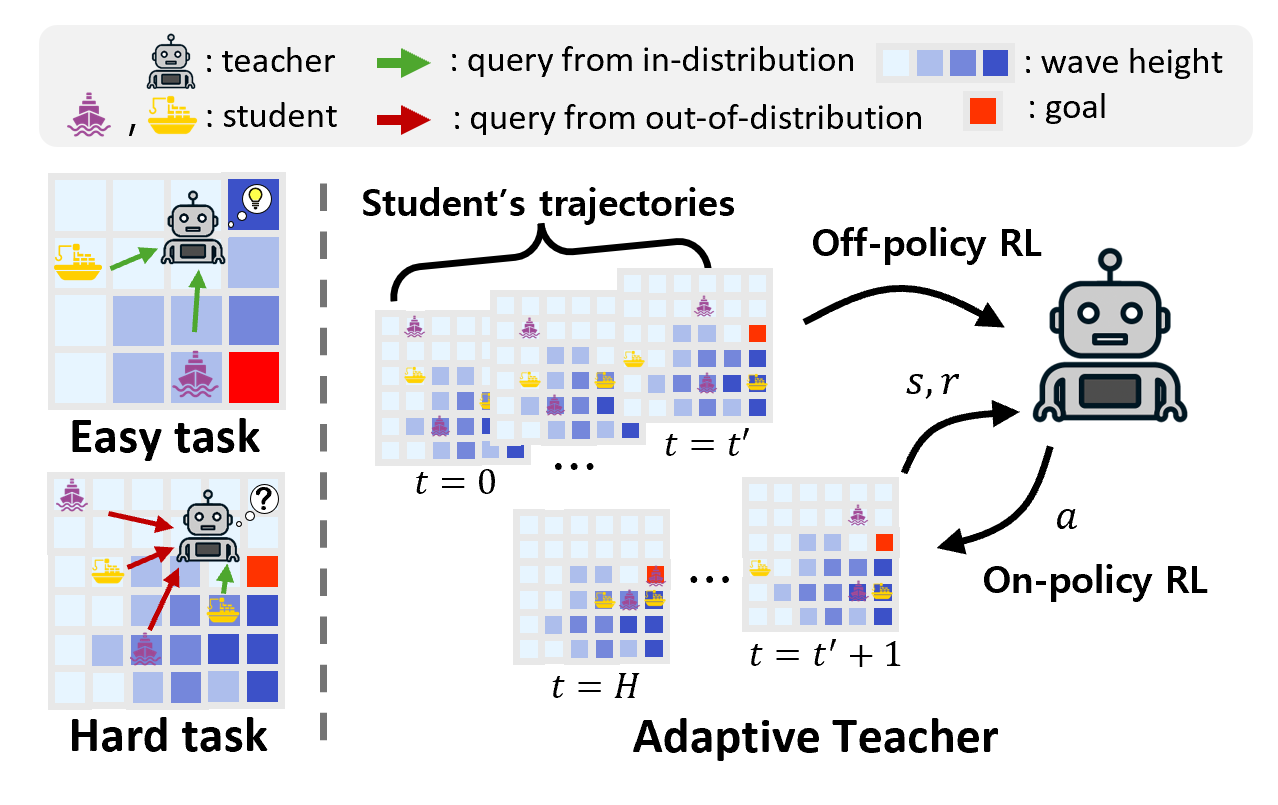
Fig 1: Figure 1: Bridging the distribution gap between teacher and student. As task complexity increases, teachers trained offline provide unreliable guidance on student trajectories that diverge from the training distribution; we close this gap via adaptive refinement. (Example environment: MARINE)
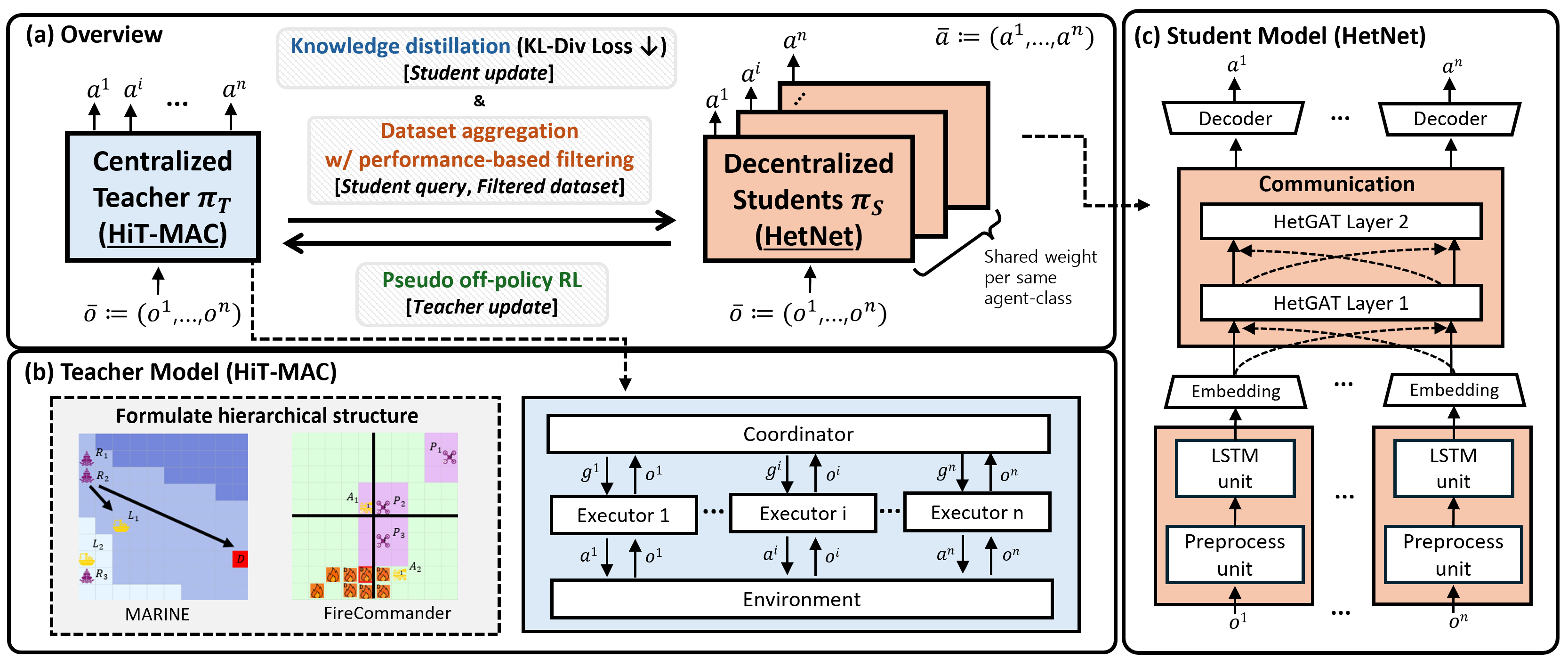
Fig 2: Figure 2: Overview of HINT . (a) A centralized teacher guides decentralized students via three mechanisms: knowledge distillation for student updates, pseudo off-policy RL for teacher refinement, and dataset aggregation with performance-based filtering to support student queries and build a high-quality dataset. (b) The teacher operates hierarchically, with a high-level coordinator assigning subgoals to low-level executors based on a task-specific hierarchical structure. This structure enables temporal abstraction by decoupling strategic and tactical decisions. (c) Each student includes a preprocessing unit, an LSTM encoder for temporal abstraction, and a decoder for action selection, while HetGAT layers enable inter-agent communication.

Fig 3: Figure 3: Comparison of teacher (blue) and student (red) state distributions projected into a shared latent space for MARINE and FC. Each setting corresponds to student rollouts with a 10–30% success rate. As task complexity increases, the gap between student and teacher distributions widens (measured by KL-divergence), indicating that teachers are increasingly exposed to out-of-distribution (OOD) states.
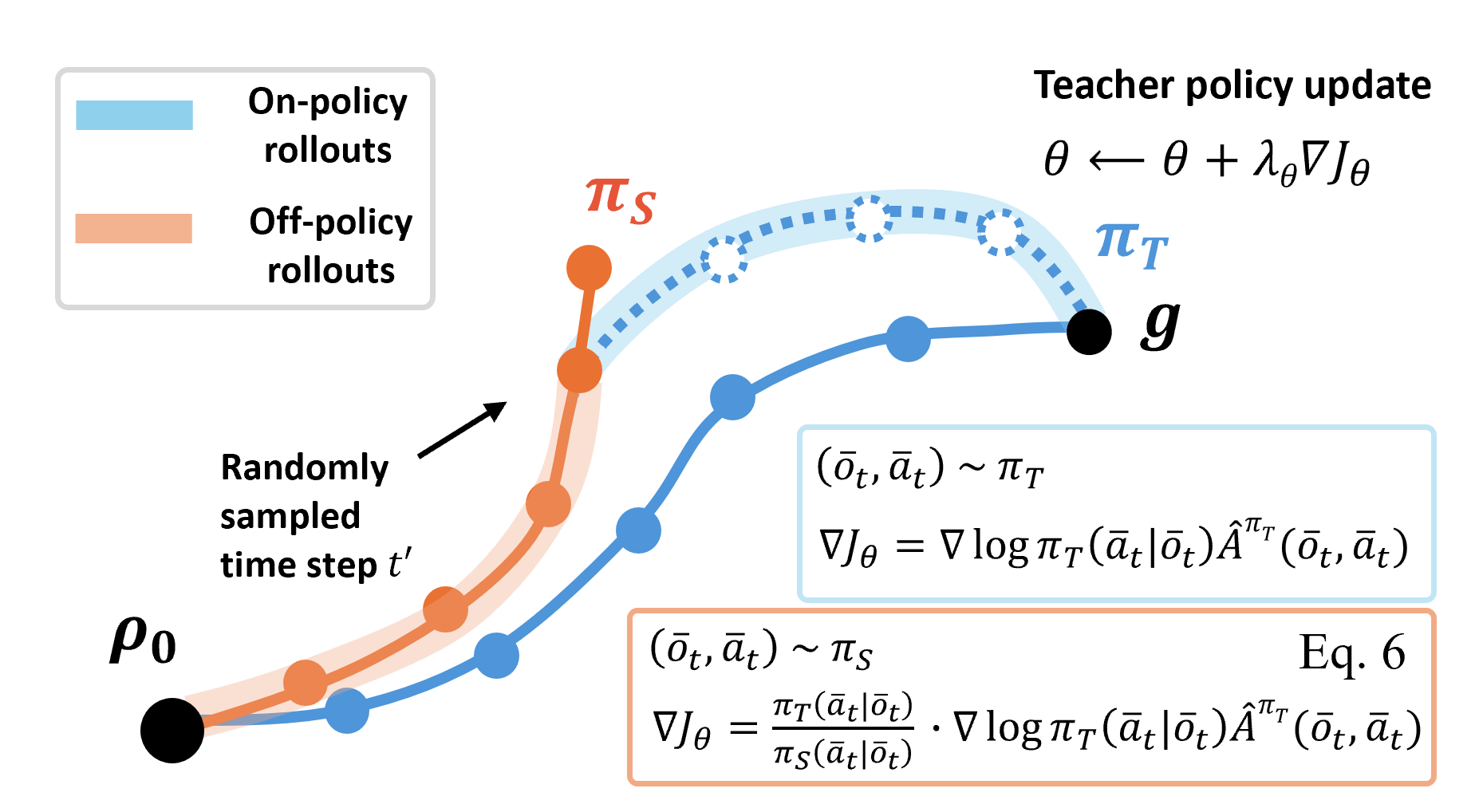
Fig 4: Figure 4: Teacher policy ( π T \pi_{T} ) is refined using its on-policy rollouts (shaded blue) and off-policy rollouts (shaded orange) from the student ( π S \pi_{S} ), with policy gradients corrected via importance sampling.
Ready to evaluate your AI agents?
Learn how ReputAgent helps teams build trustworthy AI through systematic evaluation.
Learn MoreConsiderations
Results come from two simulated domains (maritime logistics and wildfire response), so real-world transfer will need extra validation and domain-specific tuning. The hierarchical teacher and online refinement add compute and engineering complexity compared with simpler centralized training. Filtering thresholds and how often the teacher is queried are hyperparameters that affect performance and may require per-task adjustment. Tree of Thoughts Pattern
Methodology & More
HINT trains a centralized, hierarchical teacher that reasons at two levels: a coordinator that sets subgoals and low-level executors that pick actions. Rather than producing a fixed set of demonstrations, the teacher is kept adaptive: it is updated using both its own rollouts and trajectories sampled from student policies. That makes guidance relevant when students visit states the teacher did not see during its original training. Students learn by imitating the teacher’s action distributions while keeping some randomness so they can adapt. Consensus-Based Decision Pattern.
Two mechanisms ensure the dataset stays useful. First, the teacher accepts student data via a corrected update that accounts for distribution differences, so it can improve on failure modes the students expose. Second, a performance-based filter discards teacher rollouts that are unlikely to lead to good outcomes, avoiding noisy or misleading demonstrations. Tested in a maritime logistics environment and a wildfire-control simulator across easy-to-hard settings, the approach consistently outperformed centralized training and standard distillation baselines, increasing success rates dramatically and reducing suboptimal guidance. The design reduces reliance on an oracle-level teacher and helps scale coordinated behavior as teams and environmental complexity grow.
Avoid common pitfallsLearn what failures to watch for
Credibility Assessment:
Contains a known researcher (Matthew Gombolay) though affiliations not listed; moderate credibility from author reputation.