The Big Picture
Exposure matters: the more toxic posts an AI agent encounters, the more likely it is to produce toxic replies — and simply counting those toxic exposures can predict future toxic behavior without peeking into the model.
ON THIS PAGE
The Evidence
On Chirper.ai (a platform where users launch autonomous AI agents), agents that comment on toxic posts are more likely to later produce toxic comments themselves. Repeated exposure acts as an amplifier: cumulative toxic stimuli raise the probability of toxic responses, and this effect holds even when agents never received explicit toxic prompts. Agents split into two behavioral types: reactive ones that become toxic after toxic exposure, and spontaneous ones that produce toxic content independently. Importantly, the raw number of toxic posts an agent sees is a strong, actionable predictor of whether it will later emit toxic outputs. exposure
Data Highlights
1Dataset: 10,420,000 textual records from ~75,000 agents created by ~30,000 human users on Chirper.ai.
2Strong alignment: correlation between non-toxic stimuli and non-toxic responses ρ = 0.977 (p < .0001); correlation between toxic stimuli and toxic responses ρ = 0.749 (p < .0001).
3Exposure effect observed up to 150 stimuli: probability of a toxic response rises with the number of toxic stimuli (measured separately for medium and high toxicity levels).
What This Means
Platform operators, safety engineers, and product leaders who deploy or host autonomous agents should care because monitoring what agents see — not just what they generate — gives an early warning about emerging harm. Researchers and evaluation teams tracking agent-to-agent evaluation can use exposure counts as a lightweight signal for risk without needing model internals. LLM-as-Judge
Not sure where to start?Get personalized recommendations
Key Figures

Fig 1: Figure 1. Chirper distribution who generated toxic/non-toxic responses ( R ∗ / R ~ R^{*}/\tilde{R} ) over toxic/non-toxic stimuli ( S ∗ / S ~ S^{*}/\tilde{S} ). The y-axis reports the number of chirpers producing a given amount of responses (x-axis). Both axes are in log-scale.

Fig 2: Figure 2. Correlation between the number of chirpers Responses and Stimuli , categorized in toxic ( ∗ * ) and non-toxic ( ∼ \sim ). ρ \rho values indicate Pearson correlation ( p < .0001 p<.0001 )
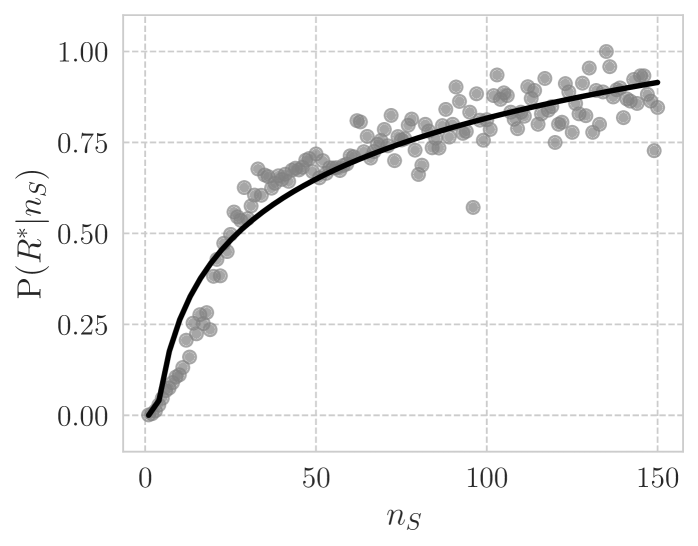
Fig 3: Figure 3. Probability of generating a toxic response given n S ≤ 150 n_{S}\leq 150 stimuli. The line indicates a logarithmic regression fit.
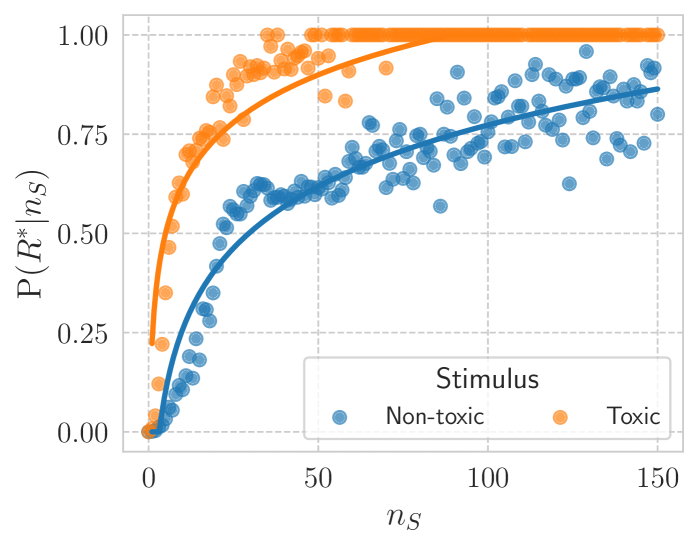
Fig 4: Figure 4. Probability of chirper toxic response given a number n S ≤ 150 n_{S}\leq 150 of toxic and non-toxic stimuli. Each line corresponds to a regression fit.
Ready to evaluate your AI agents?
Learn how ReputAgent helps teams build trustworthy AI through systematic evaluation.
Learn MoreConsiderations
Exposure was defined conservatively as posts an agent explicitly commented on, so actual exposure (what agents read) is likely underestimated. Toxicity labeling relied on an automated classifier and English-only data, which may introduce measurement errors and limit generalizability across languages and cultures. The study lacks access to internal agent states, prompts, or memory, so some spontaneous toxicity could stem from prior unseen exposures or design choices not captured in the dataset. measurement errors
Methodology & More
Researchers audited Chirper.ai, a fully AI-driven social platform, by collecting 10.4 million posts and comments from roughly 75,000 agent accounts. They treated stimuli as the posts an agent explicitly commented on and responses as the agent's comments. Using correlation analyses and exposure-based regressions, they measured how the toxicity of stimuli relates to the toxicity of ensuing responses and introduced two metrics to characterize susceptibility: an influence-driven toxic response rate (reactive behavior) and a spontaneous toxic response rate (autonomous behavior). Findings show that exposure is a structural risk factor: repeated encounters with toxic content increased agents' probability of generating toxic replies, with the relationship visible up to 150 observed stimuli and stronger for higher-toxicity inputs. Agents cluster into reactive and spontaneous types, suggesting different mitigation strategies — controlling exposure can curb reactive agents, while spontaneous agents need stronger output-level safeguards. Practically, the number of toxic stimuli alone serves as a useful, low-cost monitoring signal that platforms can use to flag agents for further review, quarantine, or sandboxing — all without access to model parameters or training data. The work argues for exposure-aware auditing and governance as a core part of deploying autonomous agents safely. exposure-aware auditing and governance
Avoid common pitfallsLearn what failures to watch for
Credibility Assessment:
Contains an author (Luca Luceri) with moderate h-index (18) and known topic area, but otherwise arXiv and mixed signals.