The Big Picture
Distributed AI services can discover one another, form temporary coalitions across networks, and split rewards so tasks that no single provider can handle get done while participants are paid fairly.
ON THIS PAGE
The Evidence
A network-native model lets specialized AI nodes announce tasks, discover complementary peers, and assemble coalitions that together meet capability requirements. Feasibility depends on both network reach (how many hops away partners are) and economics — the task reward must cover operational and communication costs so every participant has nonnegative utility. A decentralized algorithm can select minimum-effort coalitions using only local neighborhood information, making the approach practical for open ecosystems and tool protocols. planning-pattern
Not sure where to start?Get personalized recommendations
Data Highlights
1Tasks specify per-capability counts r_k: a coalition must supply at least r_k agents for each required capability (multiset requirement).
2Feasibility radius ρ_q is a concrete integer k (number of network hops) — if a coalition exists within k hops the task is k-degree feasible; if no finite k works, ρ_q = ∞.
3Budget and incentive constraints are exact: total node costs plus communication costs must satisfy ∑(cost_i + comm_i) ≤ R_q, and reward shares must cover each node’s cost to be incentive-compatible.
What This Means
Platform engineers and architects building distributed agent ecosystems who need a pre-execution coordination layer that checks whether a cross-organization workflow is both technically and economically viable. Product and platform leaders in regulated domains (healthcare, finance) who must reason about which external tools to call, who pays what, and how to ensure participating parties won’t defect. Tool Use Pattern
Key Figures
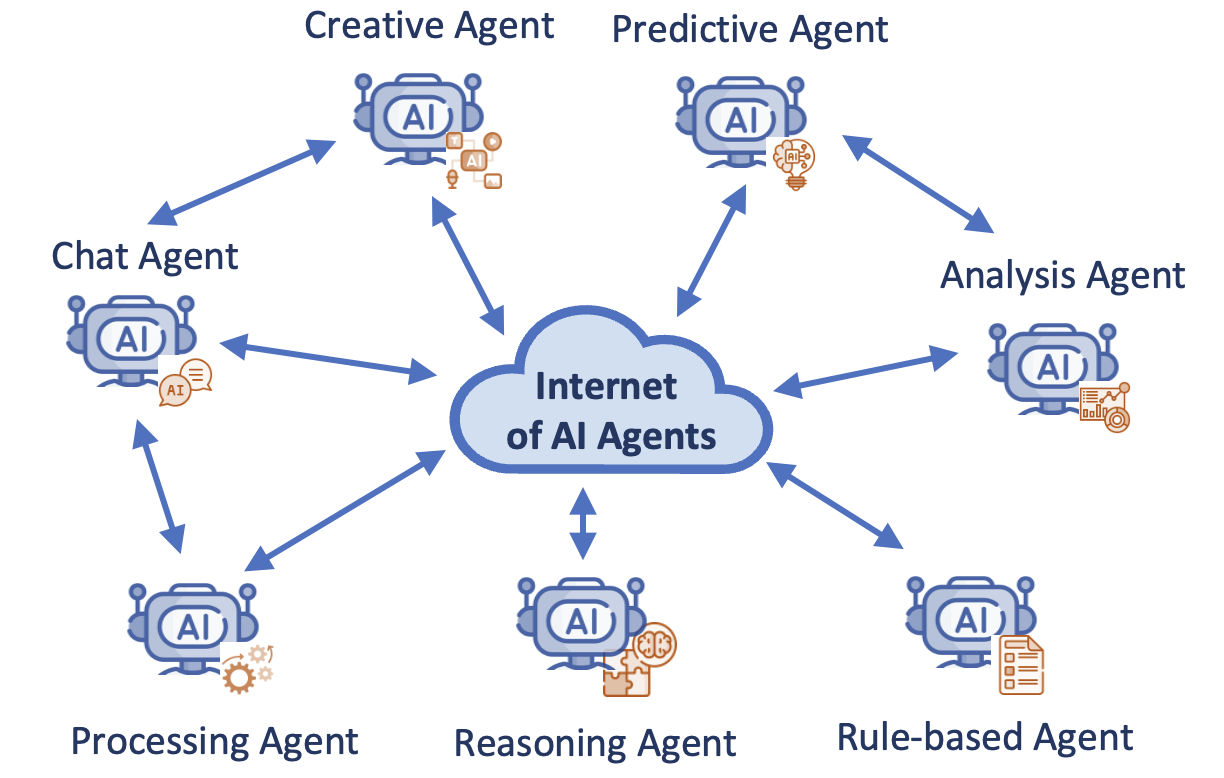
Fig 1: Figure 1 : An illustration of the Internet of Agentic AI. Each node hosts one or more specialized AI agents designed for different tasks and participates in a shared communication network.
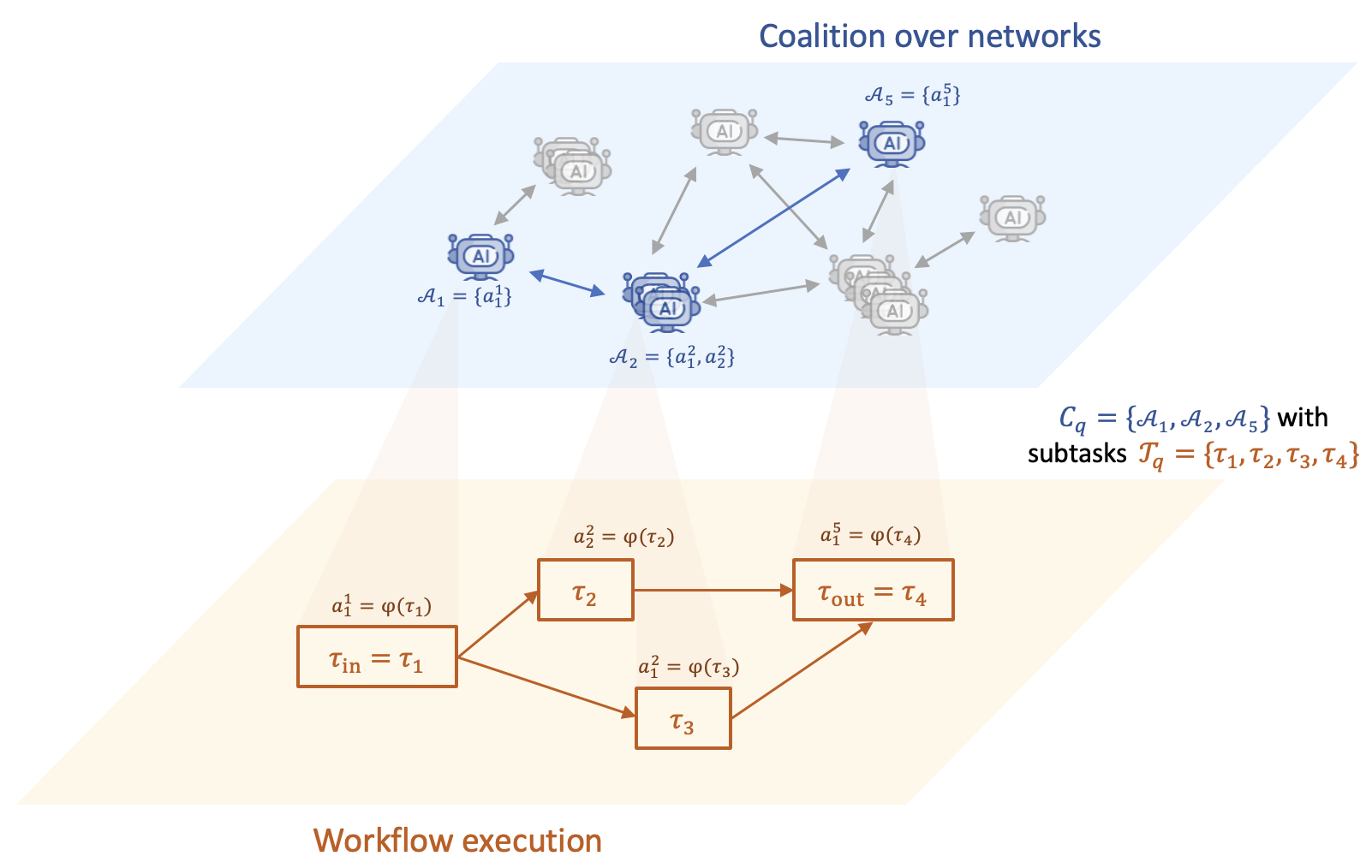
Fig 2: Figure 2 : An illustration of task-specific capability-covering coalition formation with distributed workflow execution.
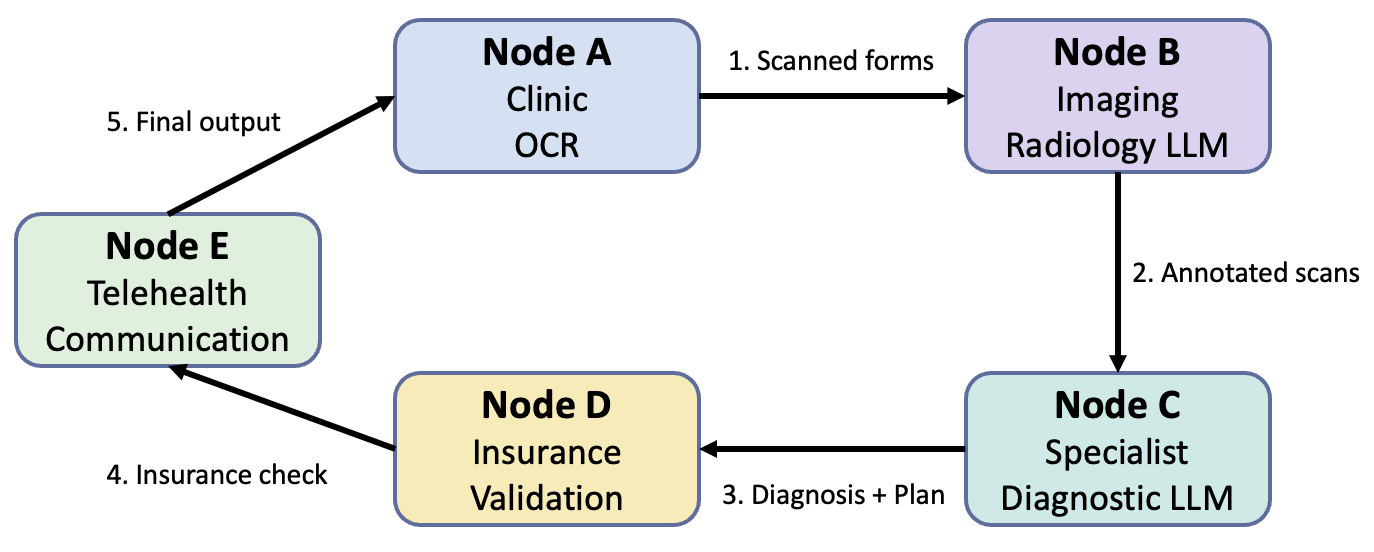
Fig 3: Figure 3 : Agentic healthcare workflow with directional information flow. The system forms a closed loop in which the downstream diagnostic, validation, and communication outputs are returned to the clinic for coordination and finalization.
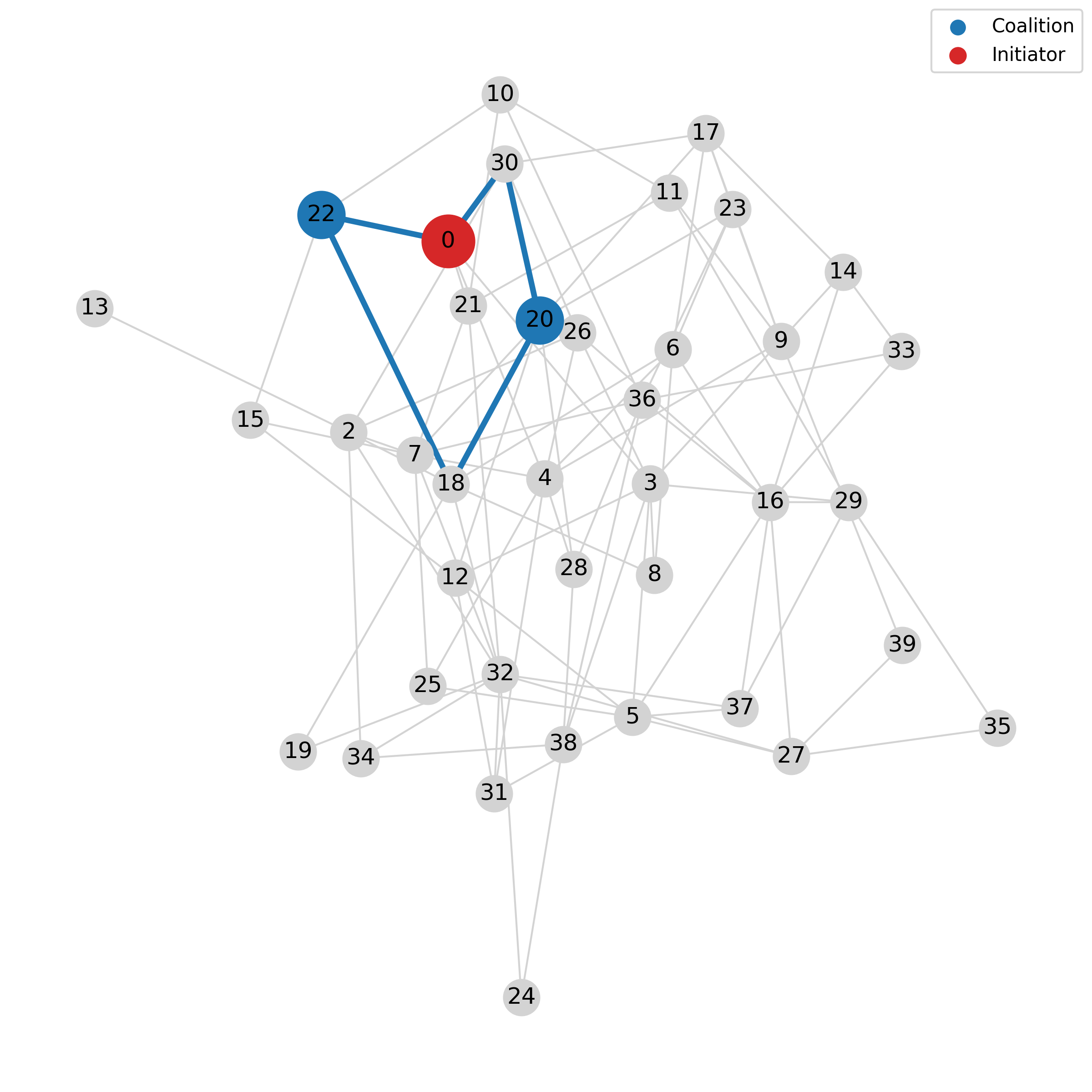
Fig 4: Figure 4 : Example feasible workflow coalition. The initiator node is shown in red, and selected coalition members in blue. Highlighted edges indicate coalition-induced communication paths used to coordinate workflow execution.
Ready to evaluate your AI agents?
Learn how ReputAgent helps teams build trustworthy AI through systematic evaluation.
Learn MoreConsiderations
The framework assumes tasks arrive one at a time and treats abstaining utility as zero, so multi-task competition and simultaneous commitments are not handled. Trust, reputation, privacy, and legal compliance are abstracted away and would need concrete mechanisms (e.g., logging, verification, contracts) in deployment. The work is mainly conceptual and algorithmic; empirical system-level performance, real monetary pricing strategies, and user studies remain future work. Guardrails Pattern
Methodology & More
Introduce a network-first view where each node hosts specialized AI agents (e.g., OCR, radiology analysis, diagnosis) and tasks are expressed as multisets of required capabilities (for example, two image analysts + one summarizer). When a node cannot meet a task by itself it broadcasts a search within its network neighborhood. A coalition is valid only if the combined agents cover every required capability and the workflow—modeled as interdependent subtasks assigned to agents—produces a well-defined outcome and reward.
Feasibility couples structure and economics: a finite feasibility radius k determines how far to search in the network, while budget feasibility and incentive compatibility require the total reward to cover all operational and communication costs and to allocate nonnegative payoffs to every participating node. The paper gives a decentralized minimum-effort coalition-selection algorithm that uses only local topology and capability information, making it compatible as a coordination layer above existing tool invocation protocols. A healthcare case study shows how clinics, imaging centers, specialist hospitals, insurers, and telehealth providers could form a task-driven coalition that routes data, runs domain models, and splits the reward so the initiating clinic can deliver a final, validated plan. Multi-Agent System Multi-Agent Data Analysis
Avoid common pitfallsLearn what failures to watch for
Credibility Assessment:
Authors have moderate h-indices (5–8) but no clear top-institution or top-venue signal; some citations present.