The Big Picture
MiRAGE uses a swarm of specialized agents plus a fact-checking agent to automatically create high-quality, multimodal question-answer pairs that force retrieval-based systems to combine disjoint evidence across documents.
ON THIS PAGE
The Evidence
A multi-agent workflow that ingests complex documents, converts images into text descriptions, and recursively gathers scattered evidence can produce realistic, domain-aligned multi-step questions. Adding a dedicated verifier agent cuts down hallucinated answers by checking each generated answer against the source context. The generated datasets show substantially higher reasoning complexity in technical domains (finance, regulations, science) while news content tends to produce fewer multi-step queries. The verifier is essential, acting as a guardrail that reduces errors; a verifier agent reinforces this check.
Not sure where to start?Get personalized recommendations
Data Highlights
1Generated 4,000 QA pairs total — 1,000 per domain (finance, regulations, science, journalism).
2Average hop count (number of reasoning steps) exceeded 2.3 for finance, regulation, and science, peaking at 2.84 on the finance (S&P) corpus with one model.
3News (NYTimes) produced much fewer multi-step items, with average hop count ≈ 1.2, reflecting sparser cross-chunk evidence in journalistic text.
What This Means
Engineers building retrieval-grounded systems who need realistic, domain-specific stress tests should use MiRAGE-style datasets to find where retrieval or grounding fails. Technical leads and evaluators can use these multi-step, multimodal QA sets to validate model improvements and to prioritize retrieval or visual-understanding fixes. Researchers studying multimodal reasoning or dataset generation can use the framework as a reproducible way to produce harder benchmarks.
Key Figures
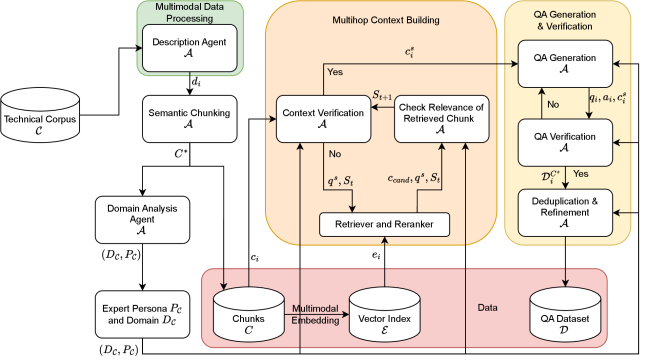
Fig 1: Figure 1: The multiagent framework of MiRAGE to evaluate RAG systems
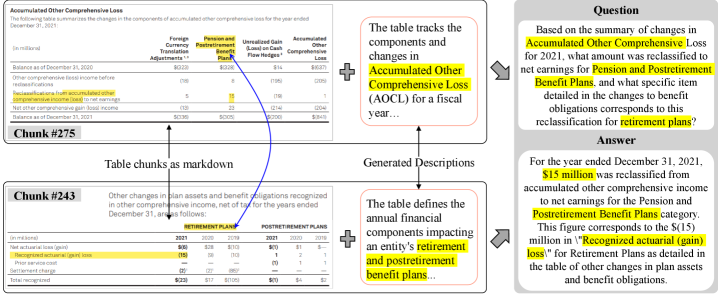
Fig 2: Figure 2: A sample question-answer pair generated from two related chunks with relevant keywords highlighted
Ready to evaluate your AI agents?
Learn how ReputAgent helps teams build trustworthy AI through systematic evaluation.
Learn MoreConsiderations
The multi-agent workflow is compute- and token-intensive, so expect higher costs and slower dataset creation than linear generation pipelines. Visual reasoning still depends heavily on high-quality text descriptions of images; current visual models may not close that gap without richer captions. The datasets are synthetic and validated against the source, but may not capture all real-world oddities or adversarial inputs encountered in production; open-source model behavior remains less explored here. We should remain mindful of potential vulnerabilities like Memory Poisoning.
Methodology & More
MiRAGE is a model-agnostic pipeline that mimics a human expert by assigning specialized roles to multiple agents. First, documents are parsed into semantic chunks and visual elements are converted to dense text descriptions. A retrieval-style agent then builds a multihop context by recursively pulling together disjoint chunks needed to answer complex queries. A QA-generation agent writes question-answer pairs conditioned on that assembled context and an injected expert persona. Finally, a separate verification agent adversarially checks answers against the source context; only validated pairs are kept, followed by deduplication and refinement. On four real-world corpora (finance, regulations, science, and journalism), MiRAGE produced 1,000 validated QA pairs per domain and consistently generated deeper reasoning items in structured, technical domains — average reasoning steps above 2.3 and a peak of 2.84 in finance. Ablations show that persona injection, multihop context construction, and the verifier are key to quality. Trade-offs are clear: higher fidelity comes with greater compute and token costs, and visual understanding still relies on good textual descriptions. Overall, MiRAGE gives teams a practical way to produce domain-targeted, multimodal benchmarks that better reveal where retrieval-based systems fail and what kind of improvements are needed. Highlighted design principles align with Supervisor Pattern and general guardrails to ensure quality and safety in deployment.
Avoid common pitfallsLearn what failures to watch for
Credibility Assessment:
Small h-index for listed author(s) and only an arXiv preprint; limited institutional signals.