The Big Picture
Orchestrating many small, specialized AI agents with independent critics turns unreliable single-model workflows into a dependable pipeline—reducing reconciliation errors from 75% to 7.9% (92.1% success), at a measurable compute cost.
ON THIS PAGE
The Evidence
Specialist roles (planner, executors, and multiple critics) catch different kinds of mistakes, so their combined output is far more reliable than a single generalist AI or self-review. An inner loop of focused critics caught most errors by targeting orthogonal failure modes (for example, code issues vs. chart issues), and an outer critique stage recovered additional failures. The architecture scales by adding specialists rather than bloating one giant prompt, and different agents can use different model providers to match strengths to tasks and reduce systemic risk.
Data Highlights
192.1% success rate across 522 production financial analysis sessions (residual error 7.9%).
2Inner-loop critics caught 87.8% of errors; an outer critique stage recovered an additional 14.6% of remaining failures.
3Reliability came at cost: 38.6% extra computational (token) cost on recovery sessions, with complex reconciliations taking up to ~12.8 minutes.
What This Means
Engineers building production AI pipelines should consider role-based orchestration to reduce catastrophic errors in high-stakes tasks like financial close, legal review, or medical extraction. Technical leaders and compliance teams can use staged critique to trade extra compute and latency for auditability, graceful degradation, and easier model swaps across vendors.
Not sure where to start?Get personalized recommendations
Key Figures
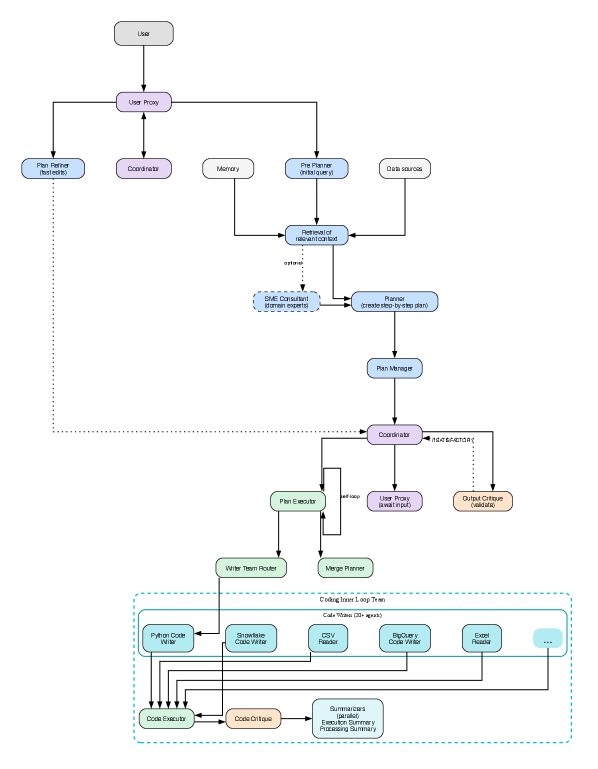
Fig 1: Figure 1. Multi-agent FSM architecture with color-coded execution phases.
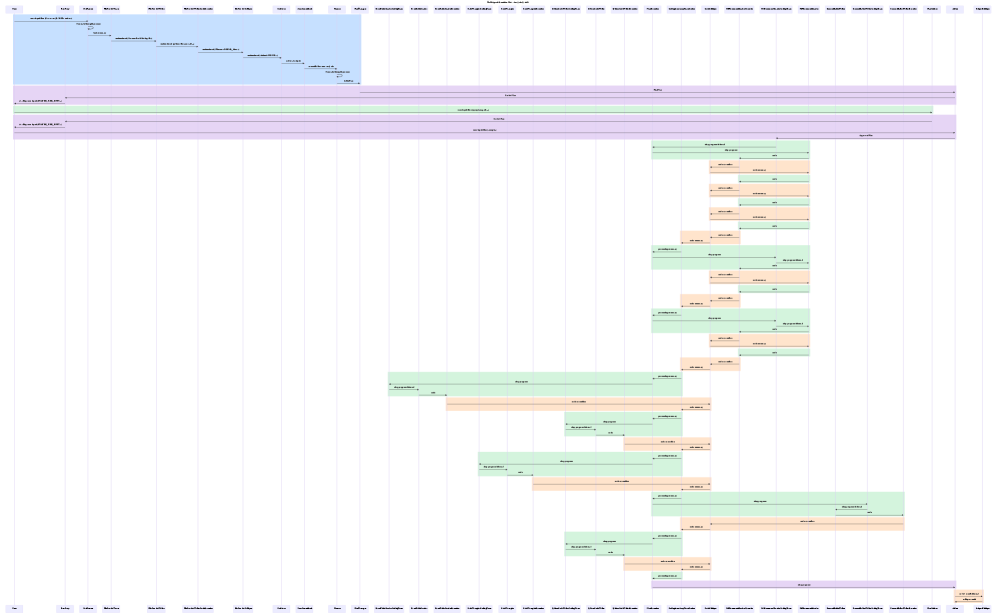
Fig 2: Figure 2. Multi-Agent Execution Flow - Analysis Cycle 1. Participants are color-coded by architectural phase: gray (user layer), blue (planning), green (execution), orange (validation), and purple (coordination). Interactions are grouped by phase with colored boxes showing the progression from planning through specialized execution teams to multi-layer validation before user presentation.
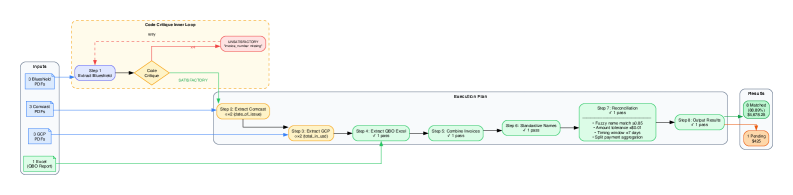
Fig 3: Figure 3. Financial reconciliation pipeline execution. The Code Critique inner loop (left, dashed) shows Step 1 requiring 4 iterations to extract missing invoice_number fields. Steps 2–3 similarly required 2 iterations each. Steps 4–8 passed on first attempt. The reconciliation step applies fuzzy matching ( ≥ \geq 0.85), amount tolerance ( ± \pm $0.01), and timing windows ( ± \pm 7 days) to produce an 88.89% match rate.
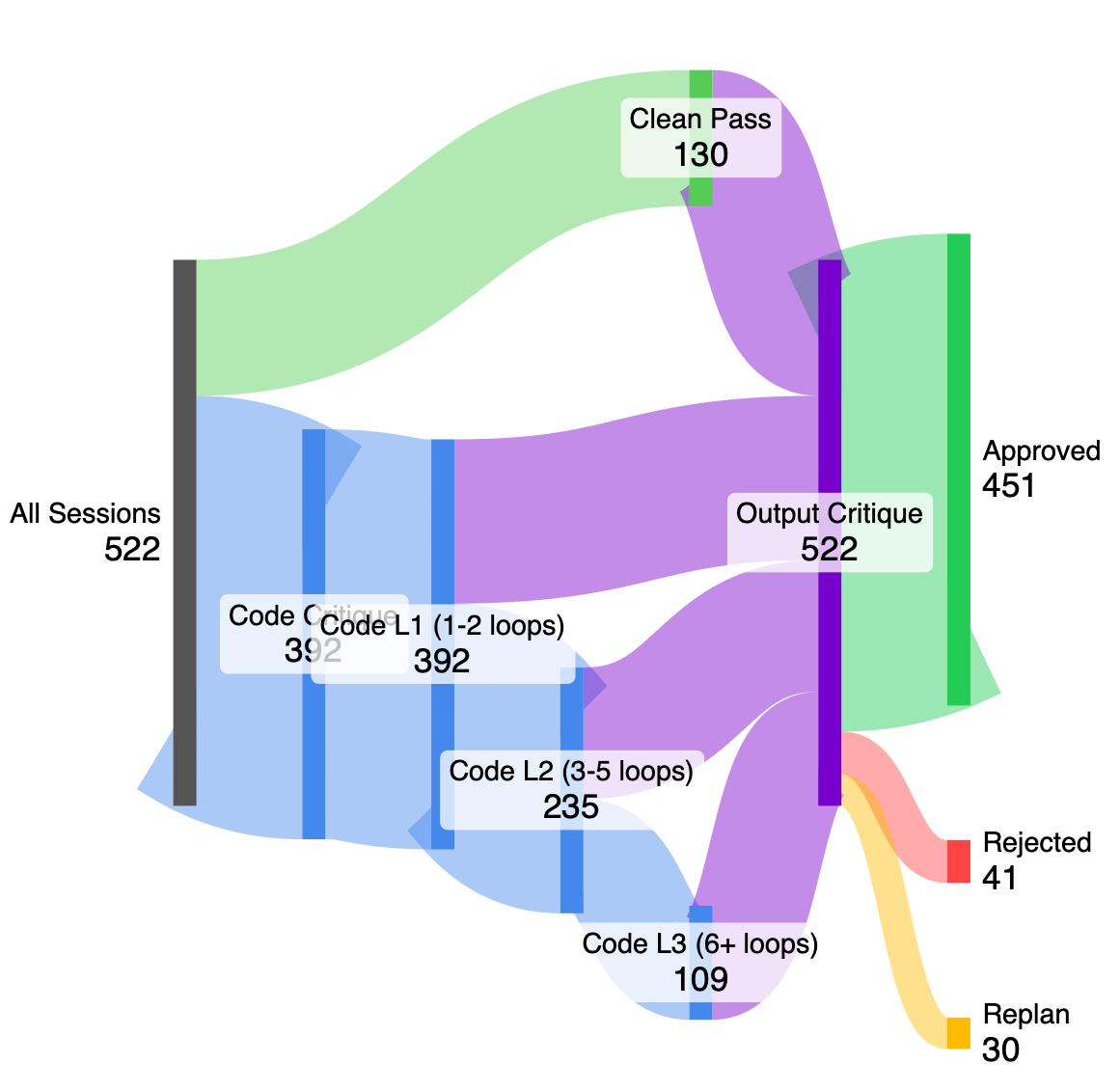
Fig 4: Figure 4. Multi-agent session recovery flow. Of 522 sessions, 130 succeeded on first pass, 344 recovered through Code Critique (337) and Chart Critique (7), 7 recovered via Output Critique, and 41 were rejected by users.
Ready to evaluate your AI agents?
Learn how ReputAgent helps teams build trustworthy AI through systematic evaluation.
Learn MoreConsiderations
Results come from 522 sessions in one domain (financial reconciliation), so performance will vary in other tasks and with more subjective outputs. The approach adds measurable cost and latency—40% of recovery sessions account for most extra token spend—so volume-sensitive systems must route or sample requests. About 7.9% of outputs still require human review; the system does not reach near-perfect accuracy for safety-critical domains. Additionally, some challenges may be sensitive to context drift.
Methodology & More
The architecture replaces a single generalist AI with a small “office” of specialists: a Planner that scopes the job, Executors that perform tailored subtasks, and multiple Critics that independently check specific failure modes (for example, code correctness or chart quality). Critics operate in an inner loop to catch the bulk of defects and an outer loop to veto remaining problems before presentation. Agents can be backed by different model providers so each role matches model strengths instead of forcing all behavior into one prompt. Evaluated on 522 real financial reconciliation sessions, the system raised success from single-agent baselines (~60% accuracy) to 92.1%, cutting the baseline error rate (75%) down to a 7.9% residual. The empirical lesson is that orthogonal specialization matters: a critic focused on code fixes different errors than one focused on visualization, and duplicating the same critic yields diminishing returns. Tradeoffs are clear—recovery and critique add about 38.6% token cost and increase end-to-end time (complex jobs up to ~12.8 minutes)—but provide audit events, checkpointing, and modularity for swapping models or adding capabilities without inflating a master prompt. Practical advice: reserve full multi-critic validation for high-stakes outputs and use lighter-weight paths for exploratory work; design critics to be orthogonal rather than redundant; and measure false positives and latency impact as part of deployment planning. For alignment with established reasoning and governance practices, consider applying LLM-as-Judge as part of the evaluation flow.
Avoid common pitfallsLearn what failures to watch for
Credibility Assessment:
Authors show low h-index values and no high-profile affiliations; arXiv venue.