The Big Picture
A five-drone team can follow one informed leader to a destination without radios or GPS by using onboard LiDAR and a learned controller that keeps the group together and avoids obstacles.
ON THIS PAGE
The Evidence
Followers with no destination information can rely solely on local LiDAR sensing and a learned control policy to stay cohesive and indirectly follow a single informed leader. A LiDAR-based perception pipeline (pose estimation, intensity-based neighbor detection, clustering and tracking) plus a deep reinforcement learning controller yields stable flocking and obstacle avoidance. The approach was trained in large-scale simulation and successfully transferred to real-world flights with five custom drones, working indoors and outdoors without external positioning or inter-drone communication. The system requires reflective markers on each drone to ensure reliable LiDAR detection. Consensus-Based Decision Pattern.
Data Highlights
1Trained for 500 million timesteps across 512 parallel simulation environments using GPU-accelerated simulation.
2Validated on a five-UAV swarm configuration (1 informed leader + 4 uninformed followers) navigating cluttered indoor and outdoor courses.
3Real hardware used: custom 250 mm quadrotors with Livox Mid-360 LiDAR and Jetson Orin NX; goals sampled on a 30 m radius circle during training for generalization.
What This Means
Engineers building drone swarms for search-and-rescue, disaster response, or remote inspection will benefit because the method removes reliance on radios and GPS. Technical leads evaluating robust multi-robot deployments can use this approach where communications may be jammed or unavailable. Researchers in multi-agent systems can build on the implicit leader-follower idea to explore larger swarms and role dynamics. Semantic Capability Matching Pattern.
Not sure where to start?Get personalized recommendations
Key Figures
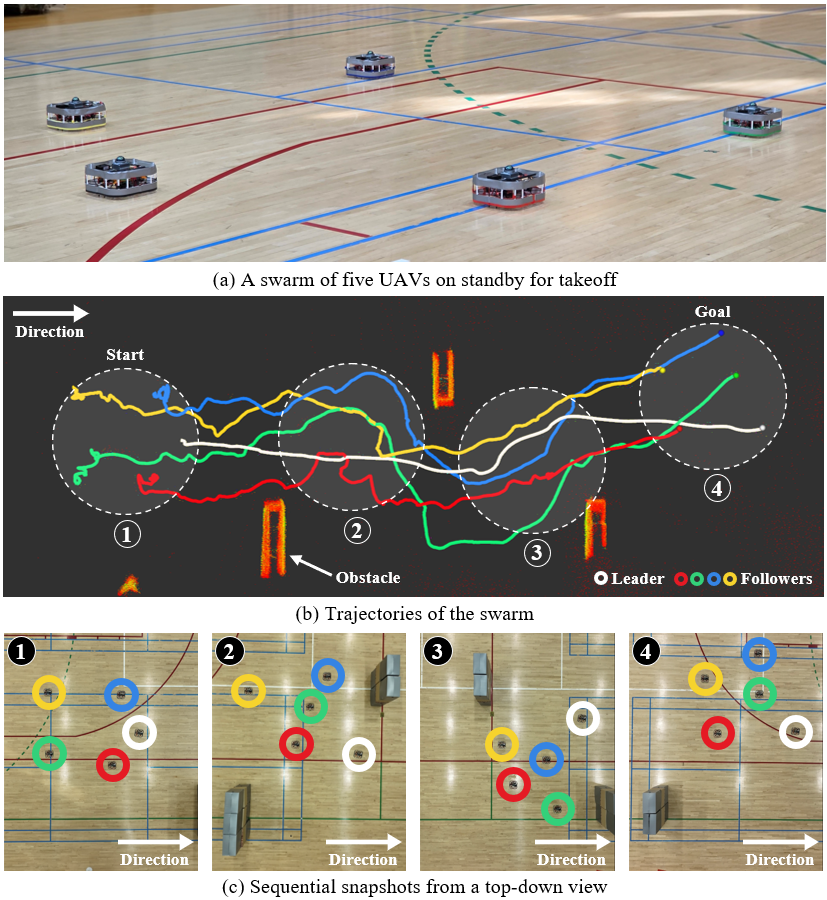
Fig 1: Figure 1: An example of real-world validation of the proposed LiDAR-based collective navigation. (a) A swarm of five UAVs on standby for takeoff. (b) Trajectories of the swarm reconstructed from onboard LiDAR. (c) Sequential snapshots of the swarm avoiding obstacles to reach a goal without external localization or communication. More details can be found in the attached video at https://youtu.be/U4i3Spisugg.
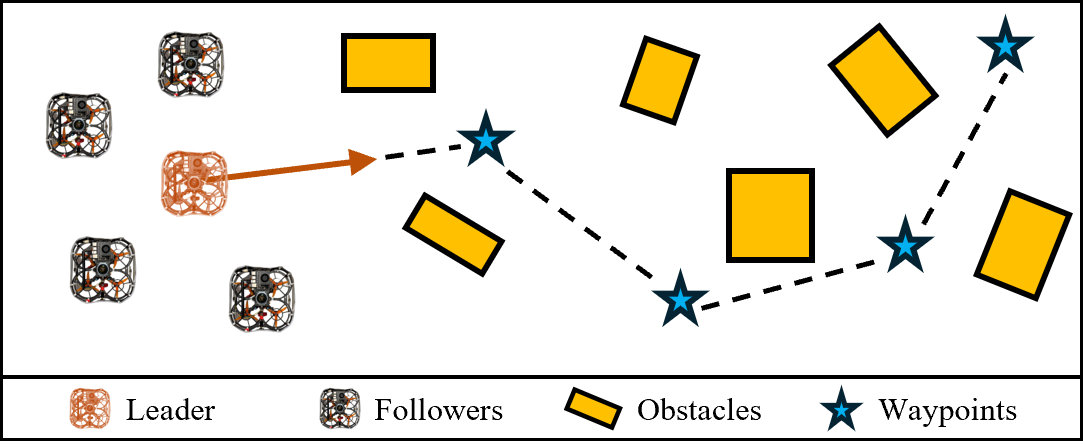
Fig 2: Figure 2: Scenario of the communication-free collective navigation problem. A leader visits a known waypoint sequence, while followers, unaware of the goal or leader’s identity, use only local perception for flocking and obstacle avoidance to indirectly follow the leader.
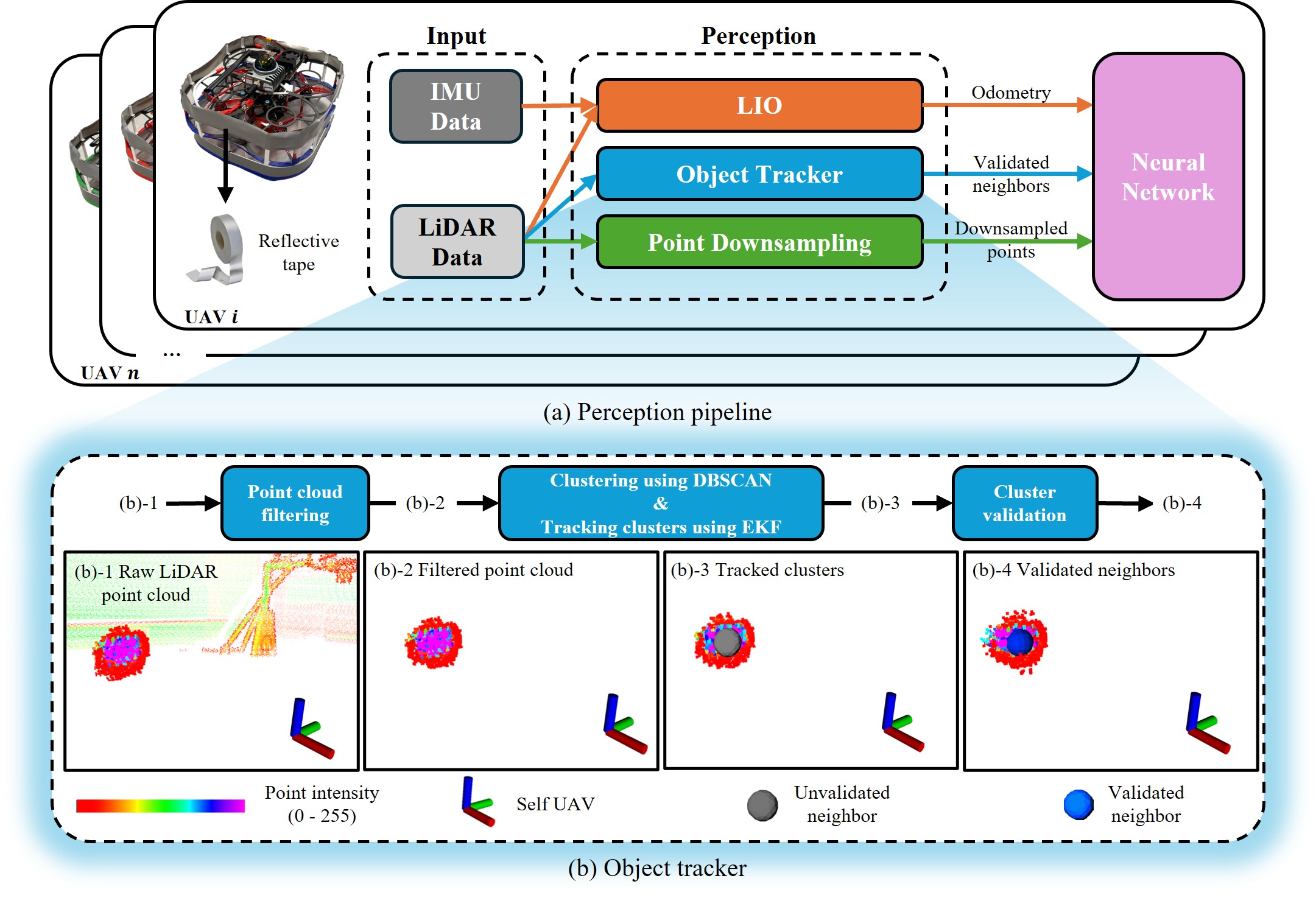
Fig 3: Figure 3: Overview of the onboard perception system. (a) The perception pipeline. (b) The object tracker filters raw LiDAR points, clusters them using DBSCAN, tracks them with an EKF, and validates them based on temporal consistency.
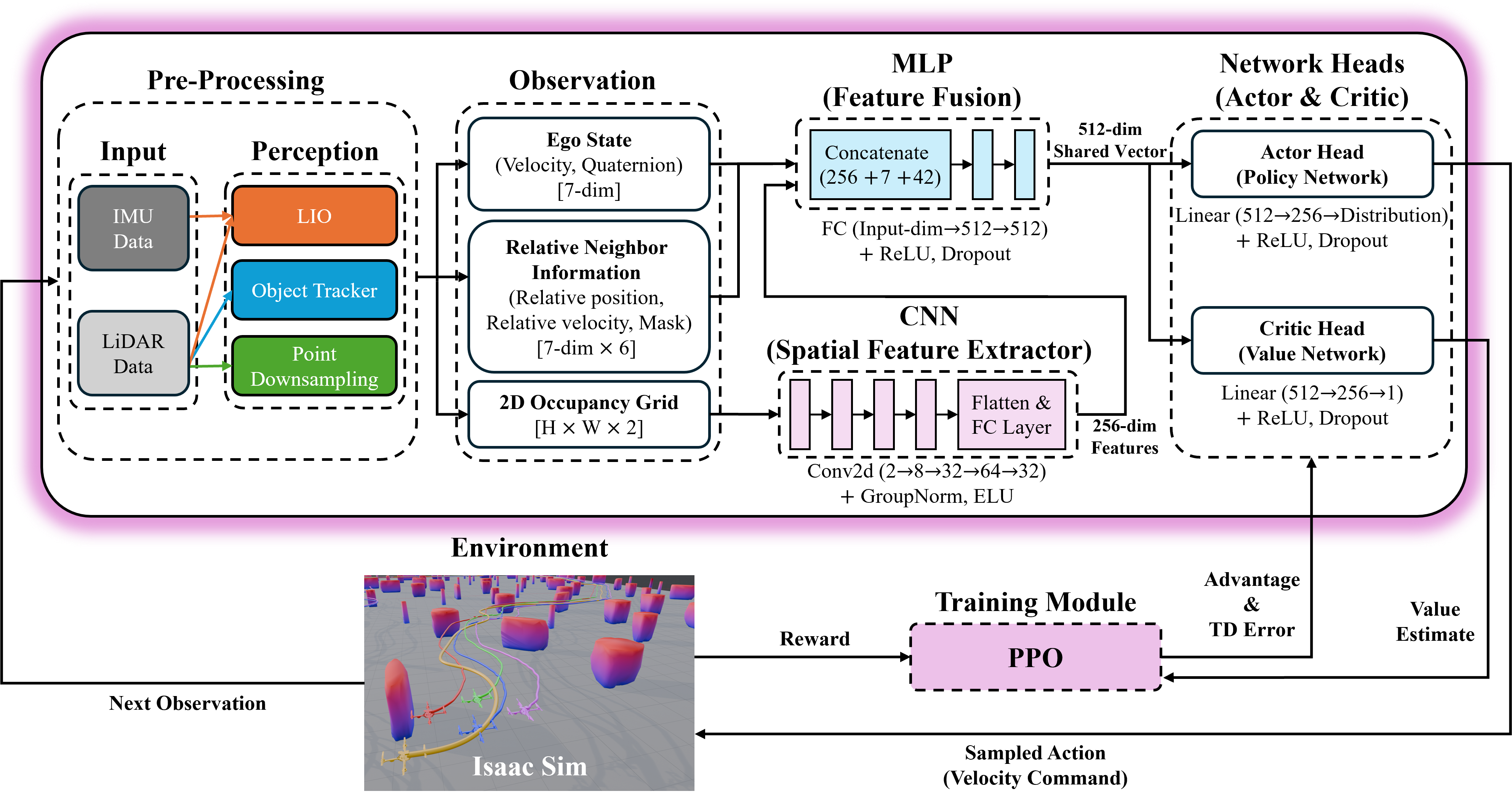
Fig 4: Figure 4: The proposed DRL architecture. An encoder processes observations into a latent vector, and actor and critic heads use it to determine the policy and estimate value.
Ready to evaluate your AI agents?
Learn how ReputAgent helps teams build trustworthy AI through systematic evaluation.
Learn MoreConsiderations
The current system depends on reflective tape on every drone to produce reliable LiDAR returns, which may not be feasible in all scenarios. Experiments were demonstrated with five drones; performance and failure modes for much larger swarms remain untested. Policies were trained with specific sensors and hardware, so switching LiDAR type or onboard compute may require additional training or tuning. Context Drift.
Methodology & More
A decentralized system lets each drone perceive only its local surroundings with a single LiDAR and act independently. The perception pipeline estimates ego pose, filters and stacks recent point clouds, selects high-intensity returns (from reflective markers) and region-of-interest points, then clusters and tracks neighbors. Those low-dimensional observations feed an encoder and actor-critic policy trained to balance flocking (stay close but avoid collisions), obstacle avoidance, stable flight, and recovery when neighbors are lost. Training used GPU-accelerated simulation with hundreds of parallel environments to expose the policy to randomized goals, leader behaviors, and cluttered obstacle fields. The learned policy produced an implicit leader-follower behavior: uninformed followers, without any communication, learn to remain near neighbors and thus follow the informed leader toward the waypoint. The approach transferred to real hardware—custom quadrotors running full perception and control onboard—demonstrating navigation in indoor and outdoor obstacle courses without external localization or inter-drone messaging. Future work aims to scale to larger swarms and enable adaptive role changes without breaking the communication-free setup. Consensus-Based Decision Pattern Guardrails Pattern.
Avoid common pitfallsLearn what failures to watch for
Credibility Assessment:
Authors show low h-index values and no clear top-institution affiliations; arXiv preprint.