The Big Picture
Agents that restrict what they read and only write ontology-validated updates can coordinate reliably without a central controller; local checks let you verify global safety slice-by-slice.
ON THIS PAGE
The Evidence
A semantic 'slice' model lets each agent keep a scoped view of shared meaning and propose only structured, ontology-conformant updates. Local validation plus selective refresh creates a global, auditable state without explicit messaging or a central store. Formal results prove local traces behave equivalently to their global projections, and the model tolerates asynchronous operation and probabilistic message loss while still converging over time. semantic capability matching.
Not sure where to start?Get personalized recommendations
Data Highlights
1250-agent simulation: 50 search agents, 100 relay agents, 100 rescue agents used only scoped semantic slices to coordinate.
2Message cost matches the expected bound f·200 + 1 for slice fraction f; the broadcast baseline would be 201 recipients, showing substantial savings when slices are small.
3Mid-run removal of 2 agents (0.8% of the fleet) did not break semantic safety; local memories still converged, consistent with the proven almost-sure convergence guarantee.
What This Means
Engineers building decentralized robot fleets, sensor networks, or multi-agent AI services who need verifiable, auditable coordination without central control. Technical leaders evaluating agent trust and governance can use slice-scoped semantics to enforce safety rules locally while still getting system-wide guarantees. Consensus-Based Decision Pattern
Key Figures

Fig 1: Figure 1. Reference architecture instantiating Semantic Fusion (SF). Agents operate over scoped semantic slices, proposing and validating structured updates to shared semantic memory. Coherence and coordination arise from ontology-scoped validation and refresh propagation rather than explicit messaging or global control.

Fig 2: Figure 2. Probabilistic bisimulation between an agent’s local memory execution and its projected global memory slice under probabilistic update generation and refresh synchronization. The sync transition is depicted as aligning the agent’s memory with the global projection at time t + 1 t{+}1 for illustrative clarity. In general, however, an agent’s local memory may lag, and the corresponding global state reflected in its slice may have been committed at an earlier time t ′ ≤ t + 1 t^{\prime}\leq t{+}1 , consistent with Theorem 5.21
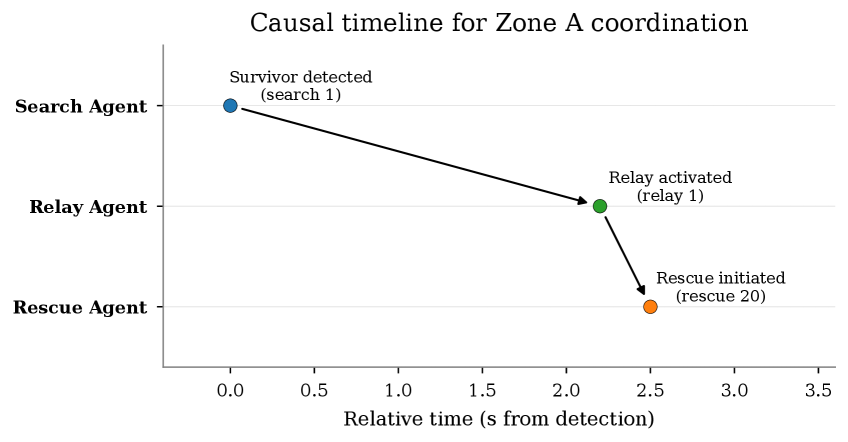
Fig 3: Figure 3. A survivor is detected by search1 , triggering an ontology-valid update to shared memory. This change activates relay1 , which moves to the zone and signals presence. Upon detecting relay support, rescue20 initiates recovery. Each agent acts independently based on scoped semantic memory, without direct coordination or explicit messages.
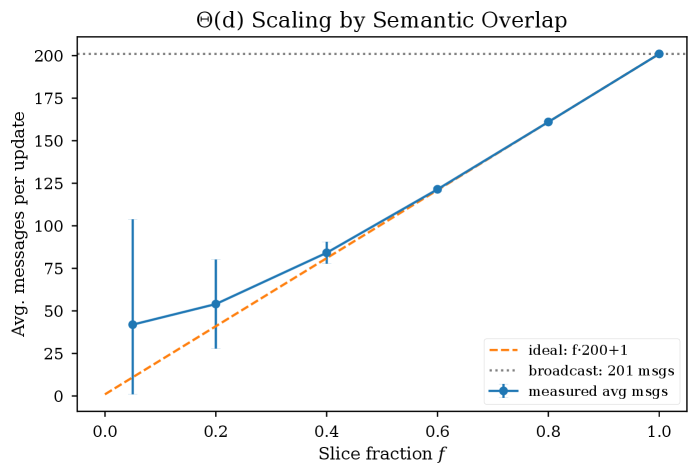
Fig 4: Figure 4. Message complexity scaling under semantic overlap. Each point shows the average number of agents receiving an update on a semantic key, as a function of the slice fraction f f , averaged over 100 randomized slice assignments. Agents subscribe to a random f f -fraction of ontology keys, and each update is received by all agents whose slice overlaps with the updated key. The expected message cost is k + 1 k+1 with k = round ( f ⋅ 200 ) k=\mathrm{round}(f\cdot 200) . Observed values closely match the ideal bound f ⋅ 200 + 1 f\cdot 200+1 (dashed line), with highest variance at low f f due to small slice sizes. The dotted line shows the broadcast baseline (201 messages).
Ready to evaluate your AI agents?
Learn how ReputAgent helps teams build trustworthy AI through systematic evaluation.
Learn MoreConsiderations
Formal guarantees assume scoped delivery semantics—practical deployments need reliable refresh or epidemic-style dissemination to approach the theory. Convergence becomes probabilistic under real network loss or adversarial interference, so operational tuning and trust/endorsement layers are needed. The framework ensures semantic correctness (well-formed, ontology-compliant updates) but does not guarantee task efficiency or optimality of agent behavior. Memory Poisoning
Methodology & More
Semantic Fusion replaces heavy message-passing or a centralized state with a shared notion of meaning: a global ontology and per-agent slices (a subset of that ontology). Each agent only observes its slice, reasons locally (with rules, policies, or learned modules), and proposes structured updates that are accepted only if they validate against the slice ontology. Accepted updates trigger scoped refresh notifications to interested peers; over time these scoped interactions produce a coherent global semantic picture without requiring global clocks or full broadcast. Guardrails Pattern and Chain of Thought Pattern help formalize safety and reasoning traces in the design. The work provides three families of formal results: deterministic properties (semantic coherence, slice convergence, causal isolation), behavioral equivalence (a bisimulation showing local traces match global projections up to stuttering), and probabilistic guarantees (convergence under probabilistic refresh and nondeterministic update generation). A reference implementation exercised these ideas in a 250-agent search-and-rescue simulation, showing message costs scale with slice overlap as predicted and that alignment delays follow exponentially decaying tails. Practically, the approach offers a way to make learned or flexible agent components auditable and verifiable: enforce local validation and scoped propagation to get system-level safety properties that can be checked per agent slice.
Avoid common pitfallsLearn what failures to watch for
Credibility Assessment:
Single author with no affiliation or h-index and arXiv-only posting with no citations — minimal identifiable credibility.