At a Glance
Friction rises when decision authority doesn’t match who bears the consequences; aligning who decides with who has the stakes and improving information flow greatly lowers coordination costs.
ON THIS PAGE
Key Findings
A single structural rule—give authority proportional to stake—explains why similar changes cause very different amounts of disruption. Friction is governed by three factors: how well decision-holders’ goals align with affected parties, how large the stakes are, and how much information is lost between them. A compact formula captures this: friction grows with stake size and information loss and drops as alignment improves. Systems where consent matches stakes tend to emerge and persist because they avoid the negative selection pressure created by friction. Consensus-Based Decision Pattern can help operationalize how consent scales with stakes.
By the Numbers
1Externally imposed changes can amplify system volatility by more than 5.7× compared to community-ratified proposals.
2When consent-holders perfectly align with stake-holders and information is perfect, friction falls to a baseline of σ/2 (half the stake magnitude).
3As alignment approaches perfect opposition (α→−1), predicted friction diverges (becomes unbounded); with active suppression, latent friction grows exponentially with suppression duration.
What This Means
Engineers building multi-agent and AI systems should use these ideas to decide who gets control of resources and which signals to monitor, reducing wasted computation and failure modes. Technical leaders and governance designers can apply the friction equation to compare proposed authority assignments and to prioritize transparency and channels that reduce information loss. Consensus provides a shared reference for alignment expectations across stakeholders.
Avoid common pitfallsLearn what failures to watch for
Key Figures
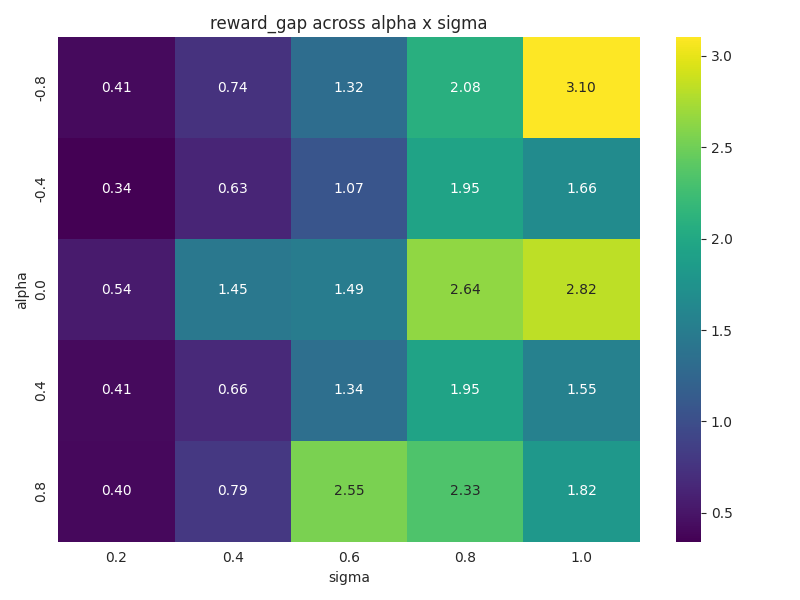
Fig 1: Figure 1: Reward gap across alignment ( α \alpha ) and stakes ( σ \sigma ) conditions. Higher values indicate greater coordination failure. The pattern confirms theoretical predictions: friction increases with stakes (left to right) and decreases with alignment (top to bottom). Preliminary results from reduced sweep; full factorial results available at repository.
Ready to evaluate your AI agents?
Learn how ReputAgent helps teams build trustworthy AI through systematic evaluation.
Learn MoreYes, But...
Alignment, stakes, and information loss are latent and must be inferred from behavior, so measurement error matters and must be quantified. The framework abstracts many institutional details (power, coercion, enforcement costs), so numeric predictions require careful domain-specific calibration. Suppression mechanisms can hide friction for long periods, producing sudden, large transitions when they fail, which limits short-term forecasting. Semantic Capability Matching Pattern can guide how to infer alignment and capabilities from observed behavior.
The Details
Start from a single structural axiom: actions that affect agents require authorization from those agents in proportion to their stakes. From that rule follow three primitives—alignment (how similar decision-holders’ preferences are to affected parties), stake magnitude (how much is at risk), and entropy (how much uncertainty or information loss exists between them). A simple friction formula, F = σ(1+ε)/(1+α), ties these together: friction rises with stake and information loss and falls as alignment improves. When alignment is perfect and information loss is zero, delegation still costs at least σ/2. Guardrails Pattern can help ensure safeguards persist as stakes and information loss interact. Map these static ideas into dynamics by treating social or agent types as populations under selection: consent-respecting configurations are attractors because lower friction gives survival advantage. Measurement relies on revealed-preference methods, multiple observable proxies, and domain-specific instruments to estimate latent variables. Practical implications: assign authority proportional to stake when possible, reduce information loss through richer channels and logging, and monitor latent friction (especially where suppression hides discontent) to avoid catastrophic transitions. The framework applies across cryptocurrency governance, human–AI coordination, and institutional design without changing its core form. Multi-Agent Government Services
Test your agentsValidate against real scenarios
Credibility Assessment:
Single author with very low h-index and no affiliation or venue signals — minimal credibility under rubric.