At a Glance
Combining language understanding, formal planners, and reactive behavior control lets heterogeneous robot teams turn one high-level instruction into reliable, coordinated action—raising simulated task success from 12% to 55%.
ON THIS PAGE
Key Findings
A three-stage pipeline translates a natural-language instruction into a formal planning problem, refines the plan with a hybrid planner, and compiles the result into parallel behavior trees for execution. Robots share a blackboard for state syncing and can run different skill sets, so teams of 2–4 heterogeneous robots coordinate on both independent and tightly dependent tasks. In a new 42-task benchmark, the approach markedly improved end-to-end task success and the fraction of goal conditions met compared with a strong baseline. semantic-capability-matching-pattern
Avoid common pitfallsLearn what failures to watch for
Data Highlights
1Task success rate rose from 12% to 55% versus the strongest baseline (LaMMA-P).
2Goal condition recall increased from 32% to 72% on the benchmark.
3Evaluated on MACE-THOR: 42 tasks across 8 floor plans, with balanced sets of 21 independent and 21 collaborative tasks (2–4 robots configured).
What This Means
Engineers building multi-robot systems who need practical ways to turn high-level instructions into coordinated action will find the architecture useful. Technical leaders evaluating agent orchestration solutions can use the results to compare flexibility and fault tolerance. Researchers interested in hybrid systems that combine language models with classical planning and reactive control will get a working integration pattern to build on. llm-as-judge
Key Figures
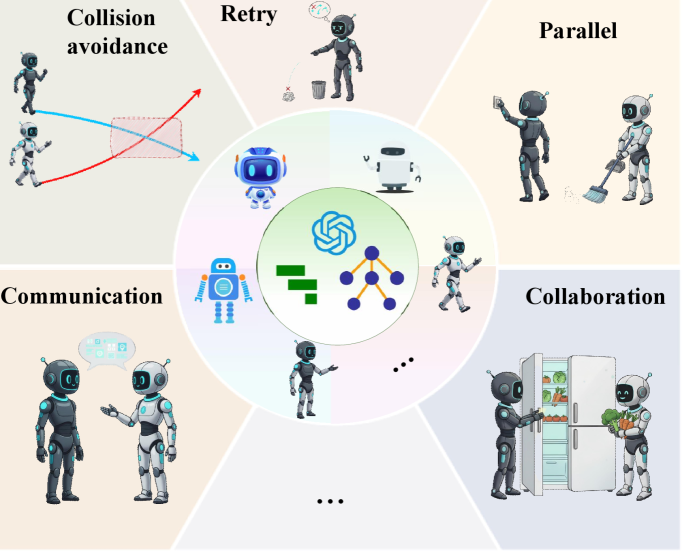
Fig 1: Figure 1 : Overview of H-AIM. The diagram illustrates the core composition of our approach: the technical foundation (LLM, PDDL, BT), the executing heterogeneous robot team, and representative application scenarios.
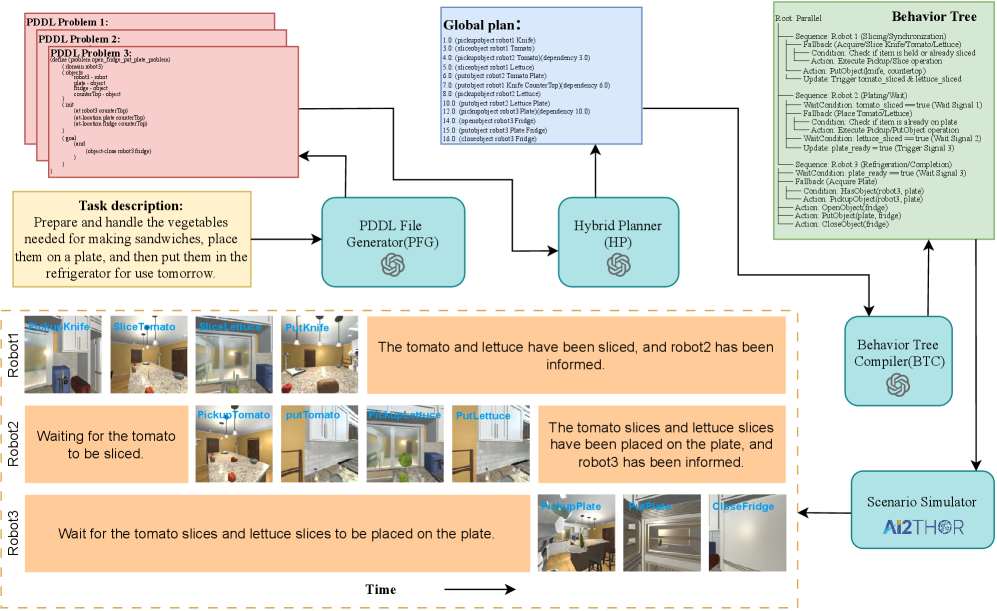
Fig 2: Figure 2 : H-AIM architecture. The framework orchestrates three LLM-driven modules (PFG, HP, BTC) to convert language instructions into executable plans.
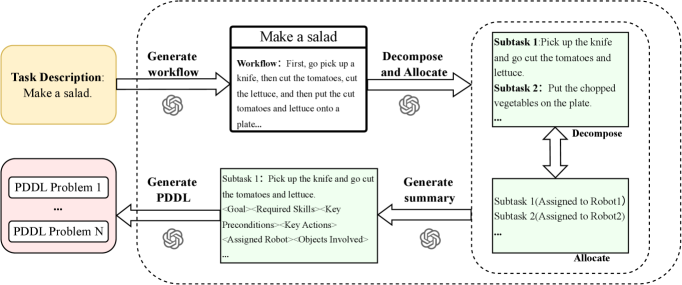
Fig 3: Figure 3 : PFG. This module transforms natural language instructions into structured PDDL problem files by parsing the input, decomposing the task, allocating subtasks, and formalizing planning elements.
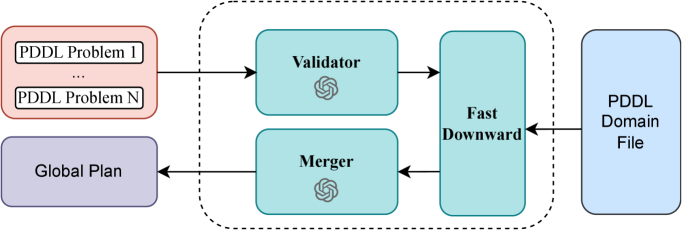
Fig 4: Figure 4 : HP. This module orchestrates classical and LLM-driven planning stages to generate optimized, robust action sequences.
Ready to evaluate your AI agents?
Learn how ReputAgent helps teams build trustworthy AI through systematic evaluation.
Learn MoreConsiderations
Results are shown in a fully observable simulation environment, so real-world sensor noise and partial observability weren't tested. The system relies on a predefined library of robot skills and APIs, which means upfront engineering to wrap robot capabilities as behavior subtrees. Performance depends on the underlying language model and planner—edge cases or unexpected environment changes may still require additional re-planning or perception integration. capability-attestation-pattern
The Details
H-AIM uses a three-stage cascade to move from a high-level instruction to executable robot behavior. First, a language-driven PDDL file generator parses and decomposes the instruction into sub-tasks, assigns them to robots based on available skills, and encodes preconditions and goals. Second, a hybrid planner combines classical planning search with language-model-driven refinement to produce robust, temporally consistent action sequences. Third, a behavior tree compiler turns the plan into parallel behavior trees—one subtree per robot—so tasks can run concurrently while a shared blackboard keeps state synchronized and handles required coordination. chain-of-thought-pattern The system was tested in AI2-THOR via the new MACE-THOR benchmark (42 household tasks covering independent and tightly dependent collaborations). Compared to a leading baseline, H-AIM raised task success from 12% to 55% and goal condition recall from 32% to 72%, demonstrating that blending semantic understanding, formal verification, and reactive control improves robustness for long-horizon multi-robot tasks. Key limitations include reliance on full observability and pre-wrapped skills; next steps would add perception-driven re-planning and tests on physical robots to handle partial observability and real-world dynamics. tree-of-thoughts-pattern
Need expert guidance?We can help implement this
Credibility Assessment:
No evident high-profile affiliations or high h-index authors; arXiv preprint.