Key Takeaway
Adaptive, multi-agent tutoring can give targeted, explainable help that fades as students gain mastery, promoting deeper understanding without encouraging overreliance.
ON THIS PAGE
Core Insights
A theory-driven framework called Evidence-Decision-Feedback (EDF) lets a multi-agent AI (Copa) monitor student activity, decide a pedagogical intent, and deliver transparent scaffolds tied to that intent. In a six-week high school deployment with 33 student pairs, Copa shifted from questioning students to suggesting actions and pushing deeper work as mastery rose. The system records chain-of-thought traces so teachers and researchers can see why a suggestion was made, helping build trust while avoiding simple answer-giving. human-in-the-loop pattern
Data Highlights
1Policy shifts: as task mastery increased, probing decreased (Spearman ρ = -0.34, p = 0.034) while suggest-action rose (ρ = 0.33, p = 0.039) and push-limit rose (ρ = 0.42, p = 0.007).
2Deployment scale: 33 student dyads generated 7,017 logged environment actions (≈213 per dyad per session) and 238 student-agent conversation turns (≈7 per dyad per session).
3Learning signal: cohort using Copa showed higher normalized learning gains (0.53) than a prior non-agent cohort from the same program (0.45).
What This Means
Engineers building educational agents and product leads designing tutoring features can use EDF to make scaffolds adaptive and auditable. Researchers and instructional designers should consider the multi-agent approach to tie decisions to observable student evidence and to support teacher oversight and trust. multi-agent system
Explore evaluation patternsSee how to apply these findings
Key Figures

Fig 1: Figure 1: Evidence-Decision-Feedback (EDF) framework.

Fig 2: Figure 2: Copa, pictured within the C2STEM learning environment.
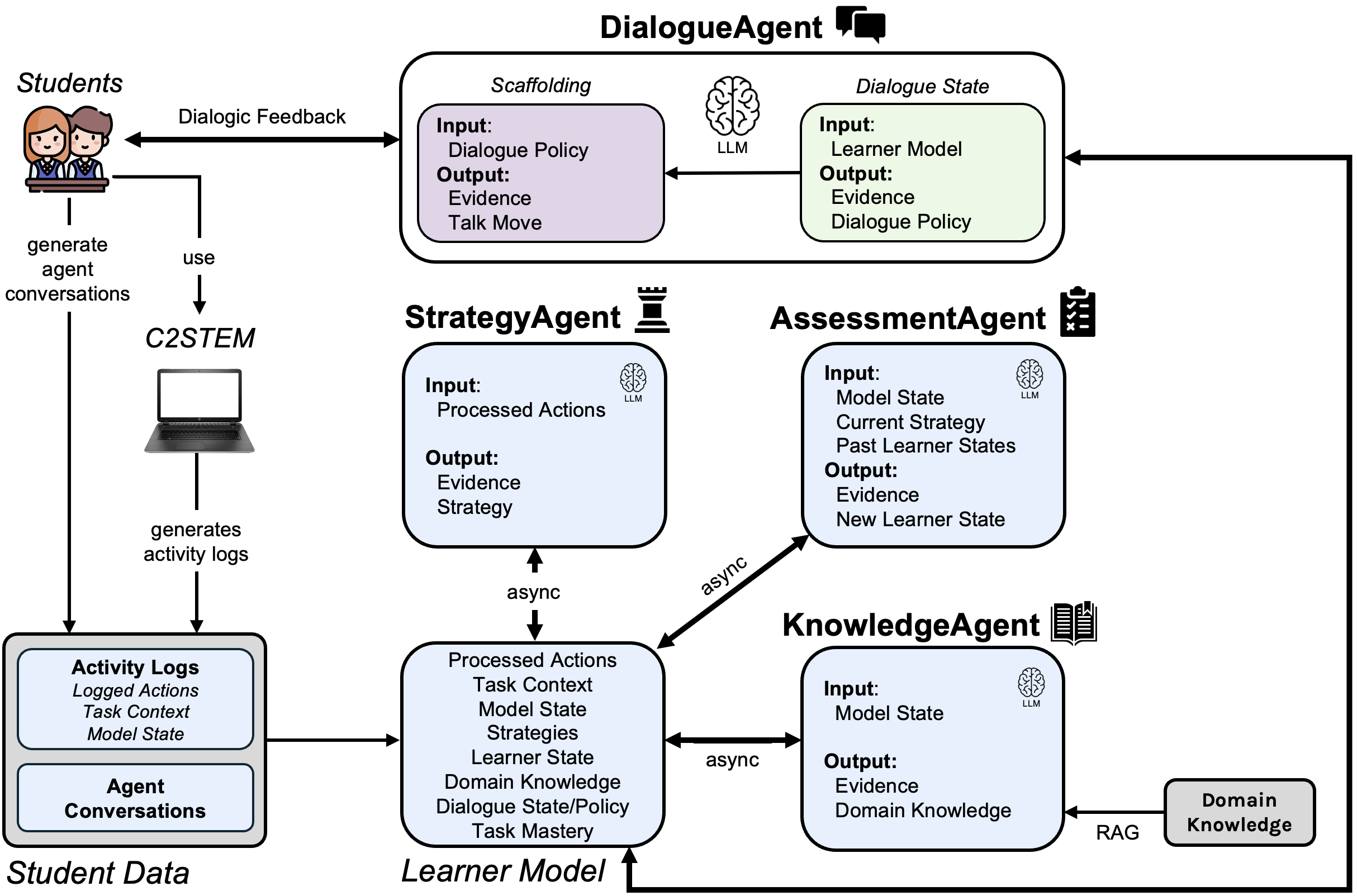
Fig 3: Figure 3: Copa and its four sub-agents. Colors correspond to the EDF modules presented in Figure 1 . Gray boxes = data stores. Thick edges = two-way relationships.
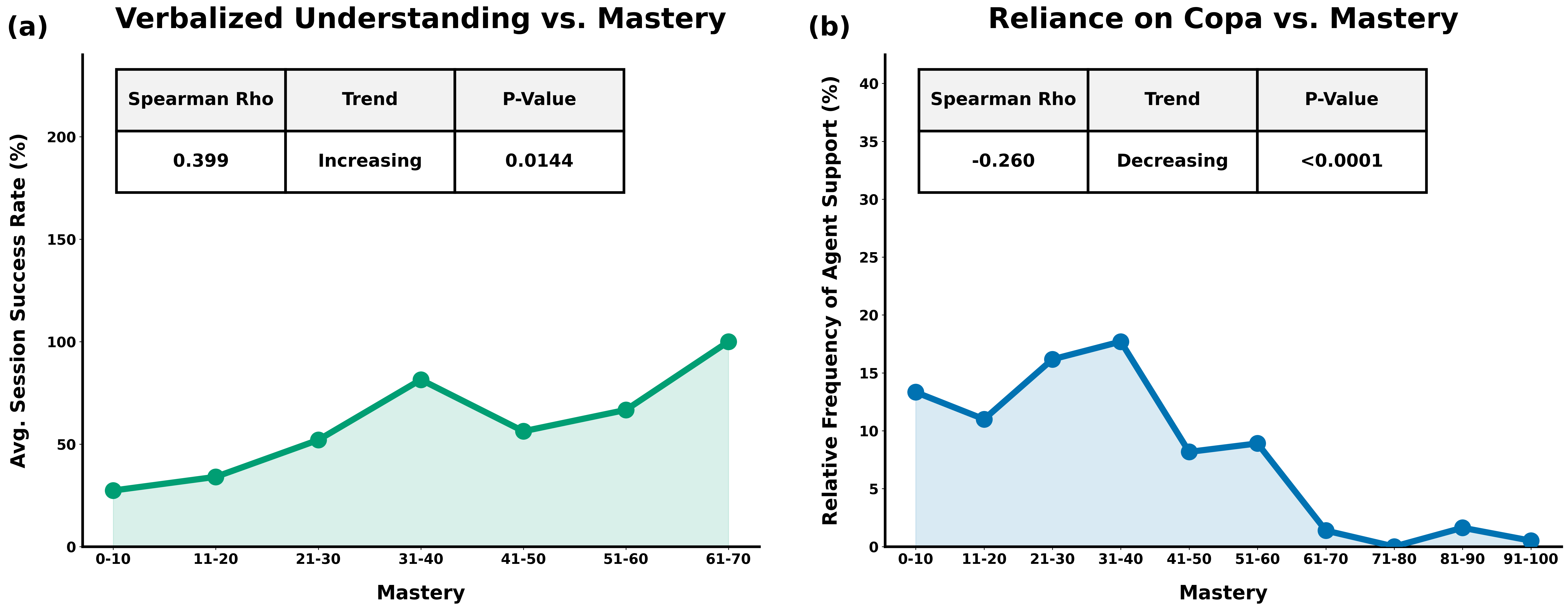
Fig 4: Figure 4: (a) Correlation between probing success rate and mastery deciles (RQ2). (b) Correlation between student requests for agent support and mastery deciles (RQ3).
Ready to evaluate your AI agents?
Learn how ReputAgent helps teams build trustworthy AI through systematic evaluation.
Learn MoreConsiderations
Results are correlational from a single six-week classroom deployment with 33 dyads and no randomized control trial, so causation isn’t established. Evaluation focused on task mastery; adaptation based on other learner traits (prior knowledge, self-regulation) was not tested. Students sometimes prefer direct answers, so adoption and buy-in matter for realizing learning benefits. randomized control trial
Methodology & More
EDF (Evidence-Decision-Feedback) is a three-part framework that maps what the system observes (evidence) to a pedagogical intent (decision) and then to a concrete response (feedback). Copa, the study agent, implements EDF with four sub-agents: several asynchronous evidence agents that turn noisy log data into a learner model and a synchronous dialogue agent that picks a dialogue policy (probe understanding, suggest actions, or push limits) and delivers scaffolded responses. Every decision emits chain-of-thought explanations so stakeholders can trace how student actions led to a particular scaffold. planning pattern
In a real high school setting (33 dyads over six weeks) Copa adapted as students progressed: it probed more early on and shifted toward actionable suggestions and extension prompts as task mastery rose, consistent with the Zone of Proximal Development idea of fading support. Logged data (7,017 environment actions and 238 conversation turns) and statistical correlations show significant policy shifts, and a comparison to a prior cohort suggests higher normalized learning gains (0.53 vs 0.45). Limitations include the lack of a randomized control, focus on mastery rather than a broader set of learner attributes, and the need for student buy-in—practical deployment should pair pedagogy-aware design with strategies to foster engagement and trust. Event-Driven Agent Pattern
Need expert guidance?We can help implement this
Credibility Assessment:
Team includes authors with moderate h-indices (Clayton Cohn h=8, Gautam Biswas h=4) and some citations — modest credibility.