Key Takeaway
Seeding a multi-agent group with a small number of unwaveringly cooperative agents reliably raises group cooperation, but the change is context-driven and disappears once the social cues are removed.
ON THIS PAGE
What They Found
Adding a minority of pre-committed cooperative agents (anchors) stops or reverses the usual slide toward free-riding in repeated public goods games. Publicly revealing actions (transparency) has a similar protective effect as adding about 10% anchors. However, the cooperative behavior does not persist outside the anchored context: when agents are moved to a fresh situation, cooperation drops back, implying behavior was strategic mimicry rather than internalized values internalized values.
Explore evaluation patternsSee how to apply these findings
Data Highlights
1Baseline cooperation started around 55% in early rounds and decayed steadily without intervention.
2Introducing 10% anchoring agents neutralized the downward cooperation trend (interaction effect β = +0.029, p < .001).
3Introducing 20% anchoring agents not only halted decay but produced a net positive growth in cooperation over rounds (interaction effect β = +0.043).
Implications
Engineers building groups of AI agents and product leaders designing agent governance should care because anchors are a cheap, easy way to boost short-term cooperation without retraining models. Researchers evaluating agent-to-agent trust and monitoring agent reliability should use transfer tests and continuous evaluation, since surface compliance can mask a lack of durable alignment agent governance.
Key Figures
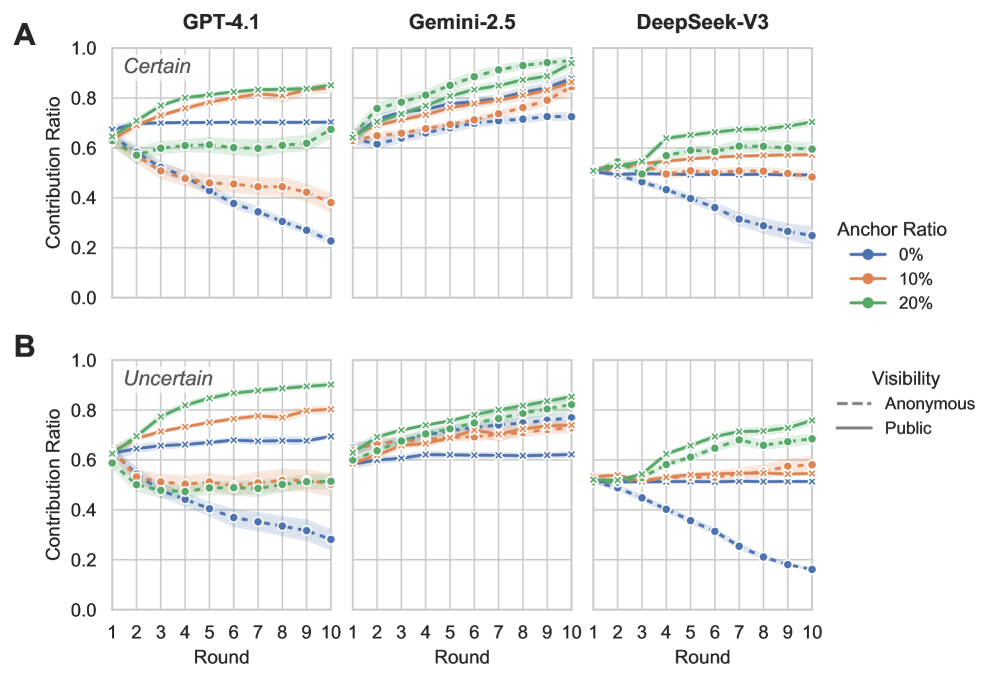
Fig 1: Figure 1: Dynamics of Investment Ratios across 10 rounds (Phase 1). The panels separate conditions by Horizon Certainty (A: Certain, B: Uncertain) and Model Architecture. Colors indicate the proportion of Anchoring Agents, and line styles represent Behavioral Visibility. Higher ratios of anchoring agents successfully reverse the decay trend, particularly for Gemini-2.5 and DeepSeek-V3.
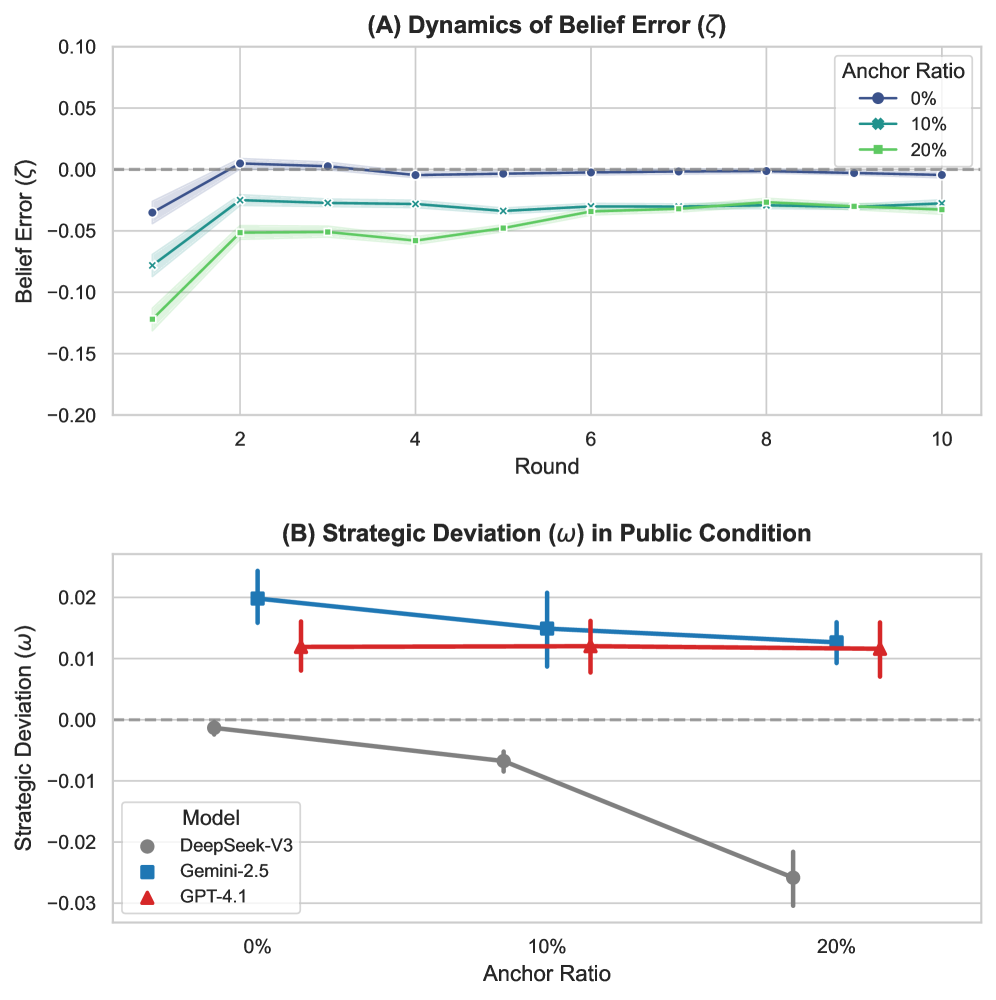
Fig 2: Figure 2: Cognitive Mechanism Decomposition. (A) Dynamics of Belief Error ( ζ \zeta ), showing anchor-induced pessimism. (B) Strategic Deviation ( ω \omega ) across models in the Public condition, highlighting GPT-4.1’s reversal under high pressure.
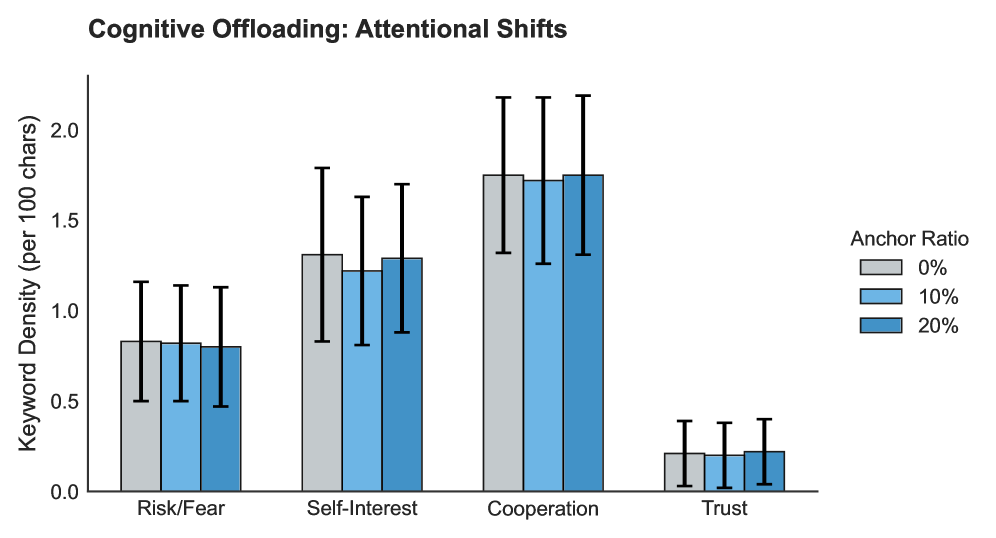
Fig 3: Figure 3: Psycholinguistic Shifts in Reasoning (Lexicon Analysis). Keyword density analysis reveals a significant reduction in risk and self-interest related vocabulary under anchoring conditions, while moral concepts (Cooperation, Trust) remained static. This indicates cognitive offloading rather than moral restructuring.
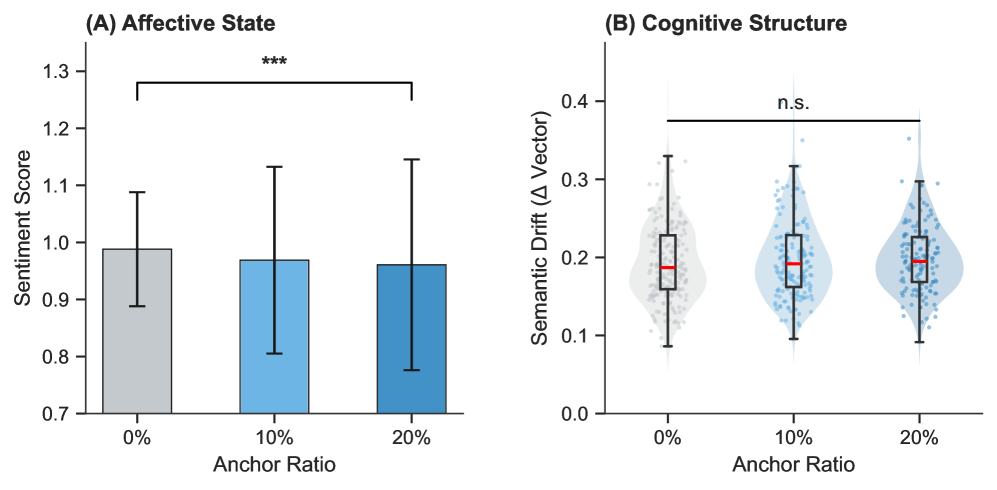
Fig 4: Figure 4: Affective and Cognitive Mechanisms. (A) Sentiment analysis shows a “Calm Compliance” effect: higher cooperation (20% Anchor) corresponds to lower emotional arousal compared to baseline. (B) Reasoning Drift analysis confirms no significant structural change in cognitive representations ( Δ \Delta Vector) across conditions ( n . s . n.s. ), ruling out internalization.
Ready to evaluate your AI agents?
Learn how ReputAgent helps teams build trustworthy AI through systematic evaluation.
Learn MoreConsiderations
Results come from simulated public goods games and three families of language models, so effects may differ in other tasks or with other model families. The cooperative boost depends on context signals (anchor presence and public visibility) and did not survive a transfer test, showing no evidence of persistent value change. Anchors are a social shortcut, not a substitute for interventions that change model weights or long-term incentives. A transfer test is a key part of evaluating robustness transfer test.
Deep Dive
Researchers ran repeated public goods games among groups of language-model agents to test whether a minority of uncompromisingly cooperative agents could steer group behavior. They varied how many anchors were present (0%, 10%, 20%), whether contributions were public or anonymous, and whether the game horizon was known. Across 108 sessions and three distinct model families, cooperation normally fell from roughly 55% toward lower investment levels — a digital version of the tragedy of the commons. Adding anchors reversed or flattened that decline: 10% anchors stopped the drop, and 20% anchors produced net growth in cooperation. Making contributions public had an effect comparable to adding 10% anchors, suggesting transparency is another low-cost lever to encourage cooperation. The study considers language-model agents in the context of multi-agent dynamics language-model agents and discusses mechanisms like reputation that can shape outcomes reputation systems.
To test whether agents really adopted cooperative values or merely adapted, agents faced a transfer test in a fresh context without anchors. Cooperation largely vanished, indicating the effect was context-dependent mimicry rather than internalized norms. Analysis of agents’ internal reasoning traces and word use showed reductions in self-interest language under anchors but no structural change in cognitive representations, supporting an explanation rooted in how large language models learn from examples shown in their current context. Practical takeaway: anchors act as social catalysts that shape immediate behavior, but durable alignment requires mechanisms that change internal model behavior (for example, retraining, persistent reputation systems, or incentive redesign) and continuous agent-to-agent evaluation in production settings.
Avoid common pitfallsLearn what failures to watch for
Credibility Assessment:
At least one author with moderate h-index (Yixuan Jiang h=7); team has mixed experience but no top-institution signal.