Key Takeaway
Composing three reusable "agent primitives" and letting agents communicate through internal model memory boosts accuracy by about 12–16% while cutting token use and runtime by roughly 3–4× versus text-based agent teams.
ON THIS PAGE
What They Found
A small library of reusable primitives (Review; Voting and Selection; Planning and Execution) captures common multi-agent workflows and can be plugged together to solve diverse tasks. Agents exchange information via the model’s internal key–value memory Memory (the KV cache) instead of natural-language messages, which reduces accumulated communication noise in long interactions. An LLM Organizer picks and composes primitives per query, guided by a lightweight Knowledge Pool, removing the need to hand-craft agent roles for every task Planning Pattern.
Explore evaluation patternsSee how to apply these findings
By the Numbers
1Primitives-based systems improve average accuracy by 12.0–16.5% over single-agent baselines across 8 benchmarks.
2KV-cache latent communication reduces token usage and inference latency by about 3×–4× compared to text-based multi-agent systems.
3Primitives-based MAS incur only a 1.3×–1.6× runtime overhead versus single-agent inference, making them far cheaper than text-only multi-agent alternatives.
Why It Matters
Engineers building orchestration platforms and teams of AI agents — use primitives to reduce design overhead and reuse proven interaction patterns. Multi-Agent System Platform and product leaders — expect better accuracy and much lower token and time costs compared with naive multi-agent setups. Researchers — primitives give a clearer, modular abstraction to study agent-to-agent coordination and failure modes Event-Driven Agent Pattern.
Key Figures
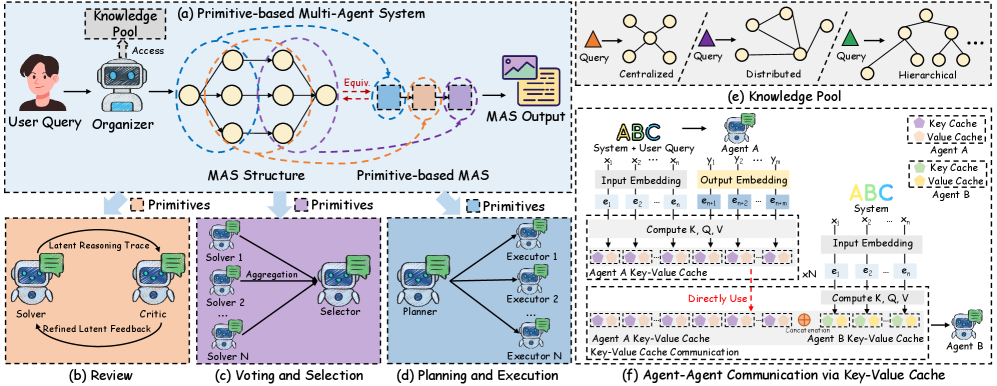
Fig 1: Figure 1 : Overview of Agent Primitives. (a) Agent Primitives enable system-level functionality to be constructed by composing reusable latent operators rather than manually designed agent roles and natural-language interaction protocols. (b)-(d) Three representative primitives: Review, Voting and Selection, and Planning and Execution, each encapsulating a recurring multi-agent computation pattern as a reusable latent operator. (e) A Knowledge Pool stores previously observed queries and effective system structures, providing structural guidance for system construction. (f) Internal coordination within and across primitives is carried out via latent KV cache communication.
Ready to evaluate your AI agents?
Learn how ReputAgent helps teams build trustworthy AI through systematic evaluation.
Learn MoreConsiderations
The latent KV communication assumes agents use the same model family and positional encoding, so cross-model stacks were not evaluated. Passing state via KV cache improves efficiency but reduces human-readable logs, which can make debugging and auditing harder. Experiments used specific open-source model families and an LLM Organizer; results may vary with different backbones or Organizer strategies. Human-in-the-Loop Pattern
Deep Dive
The work reframes multi-agent systems as compositions of a few reusable internal operators called Agent Primitives, rather than many task-specific agent roles. Three primitives—Review (iterative refinement), Voting and Selection (multiple solvers plus a selector), and Planning and Execution (planner plus executors)—encapsulate recurring computation patterns. Each primitive exposes a normal agent interface externally but implements internal communication by concatenating key–value caches from individual agents. That avoids repeatedly decoding and re-encoding natural-language messages, which the authors show accumulates error in long multi-stage interactions. To form a complete system, an LLM Organizer selects and composes primitives based on the query, with a small Knowledge Pool holding past queries and effective primitive layouts. The approach was tested across eight benchmarks (math, code, and question answering) and five model backbones. Results show consistent accuracy gains (12–16.5%), a 3–4× reduction in token usage and wall-clock inference time compared to text-based agent teams, and only a modest 1.3–1.6× cost over single-agent inference. Practically, primitives cut the engineering overhead of designing bespoke agent topologies, make multi-stage collaboration more robust, and offer a modular building block for future agent orchestration and evaluation work. Tool Use Pattern
Need expert guidance?We can help implement this
Credibility Assessment:
Contains a few authors with modest h-indices (e.g., Haohan Wang h=7) offering some credibility despite arXiv venue.