Key Takeaway
Allowing a limited, auditable self-change of the coordination rules helped a small AI team accept one more design (2 → 3) while keeping hard safety limits intact, but it trades off how much each component can independently block decisions.
ON THIS PAGE
What They Found
A governed, bounded self-modification step for coordination rules can be implemented with current AI models and produce a measurable change in system behavior: one-step modification increased accepted proposals in the experiment. Pure veto-only coordination leads to deadlock even when every proposal meets mandatory safety constraints. The right architecture combines immutable safety limits, a narrow space of allowed rule changes, validation checks, and audit logs so human supervisors can review and approve protocol edits. This aligns with the Planning Pattern.
Data Highlights
16 proposals were evaluated by 6 specialized decision modules in the experiment.
2A single bounded protocol modification raised accepted proposals from 2 to 3 — a 50% relative increase in coverage.
3Phase 1 veto-only coordination produced deadlock: no proposals were accepted despite all meeting hard constraints.
Implications
Engineers building multi-component AI systems (for example, trading platforms, healthcare pipelines, or safety monitors) should care because coordination rules, not just component logic, determine deployable behavior. Technical leaders and compliance teams should care because bounded, auditable rule changes offer a middle way between rigid veto hierarchies and opaque score-averaging, improving explainability for regulators. See the Human-in-the-Loop Pattern for safer deployment.
Explore evaluation patternsSee how to apply these findings
Key Figures
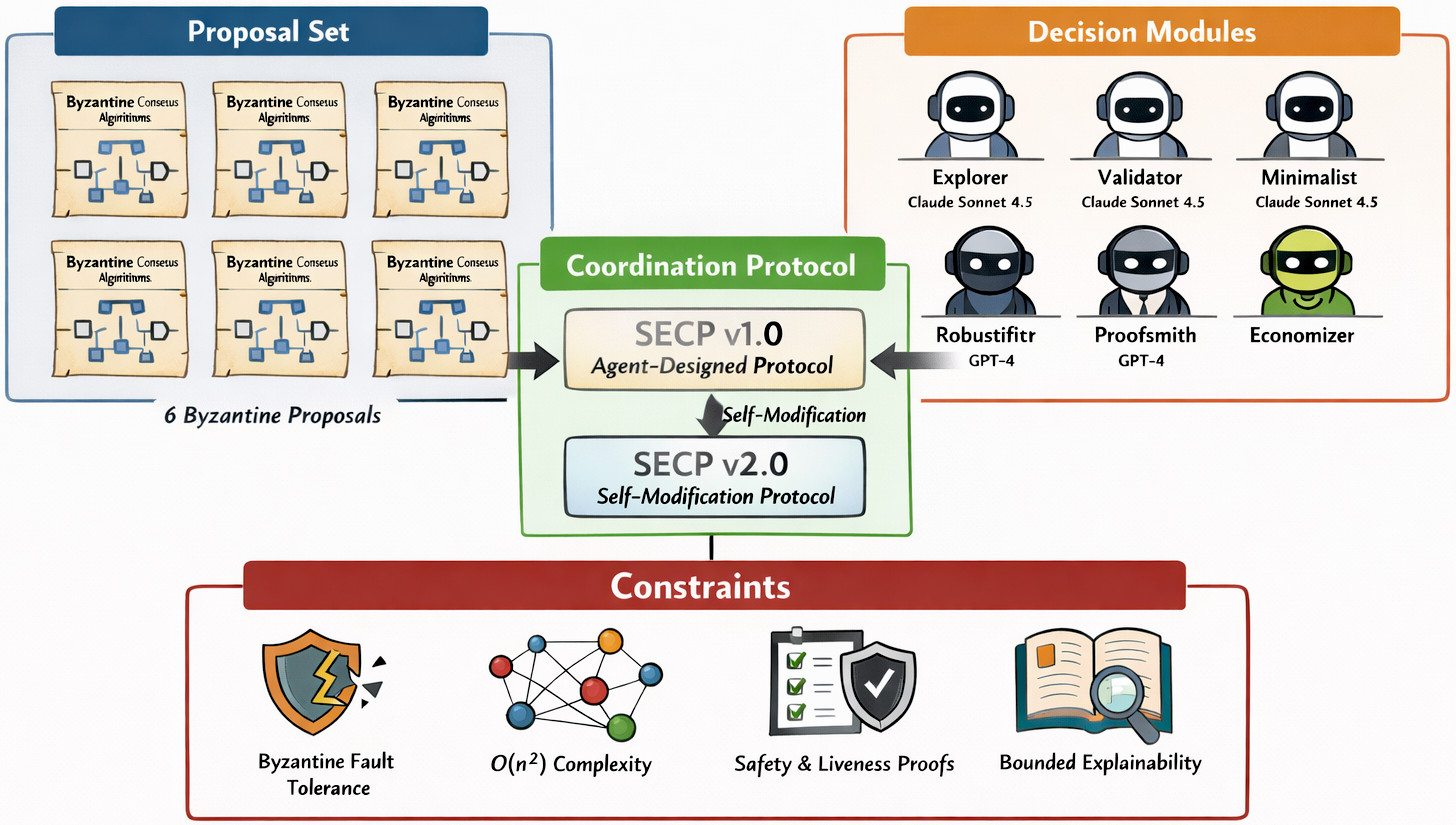
Fig 1: Figure 1: Schematic overview of the problem setting. A fixed set of Byzantine consensus proposals is evaluated by a heterogeneous set of decision modules. Their assessments are aggregated by a coordination protocol operating under fixed hard constraints (Byzantine fault tolerance, complexity bounds, formal correctness, and bounded explainability). The coordination protocol itself may undergo bounded, validated modification while preserving these invariants.
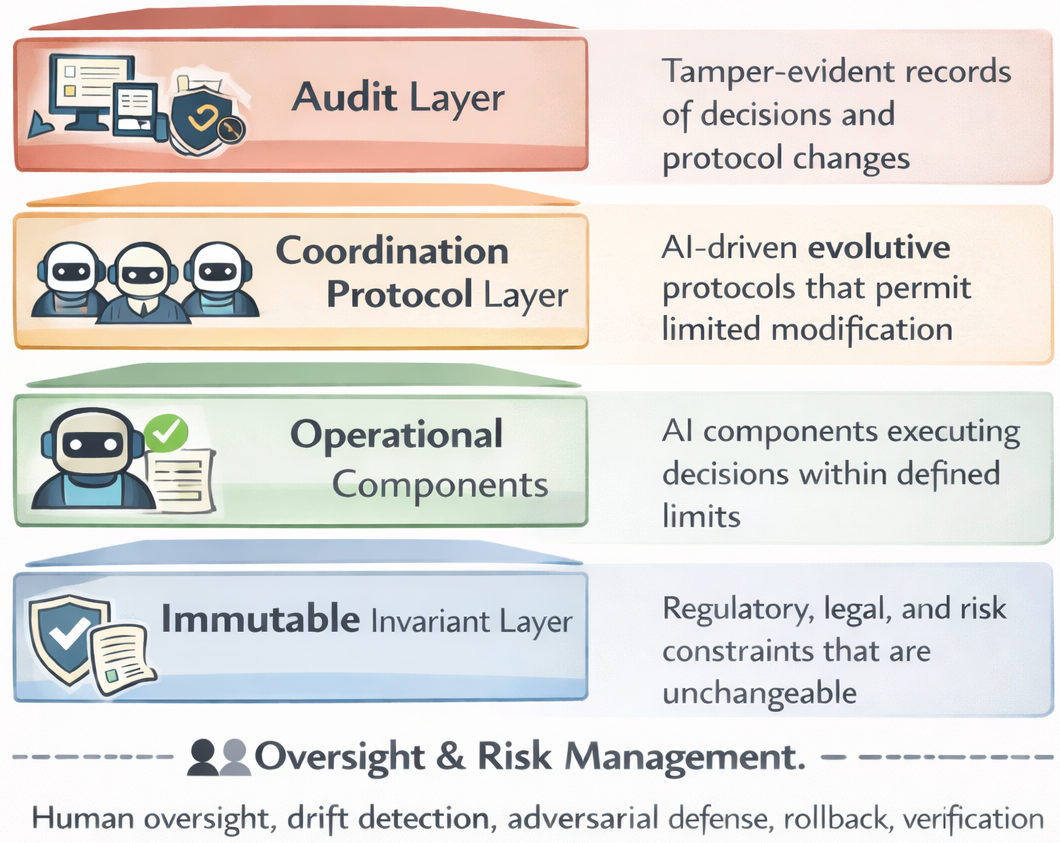
Fig 2: Figure 2: Layered governance architecture for production deployment. From bottom to top, the system is structured into an immutable invariant layer (regulatory, legal, and risk constraints), an operational layer executing decisions within those constraints, an evolutive coordination protocol layer permitting bounded self-modification, and an audit layer providing tamper-evident records of decisions and protocol changes. Human oversight and risk-management functions act across layers, enforcing approval, monitoring, rollback, and continuous compliance.
Ready to evaluate your AI agents?
Learn how ReputAgent helps teams build trustworthy AI through systematic evaluation.
Learn MoreLimitations
The experiment was single-shot and small (six modules, six proposals) so results show feasibility, not general performance. Only one protocol modification was tested, so long-run dynamics—whether repeated edits converge, oscillate, or worsen behavior—are unknown. Practical deployment requires human-in-the-loop validation, clear invariants, and conservative limits on what the coordination rules can change. Practical deployment requires Human-in-the-Loop Pattern validation.
Deep Dive
The study explored whether a coordination layer that can modify its own decision rules, within strict limits and with auditability, is feasible using contemporary AI. Researchers set up a controlled test where six specialized modules (each with different evaluation priorities) assessed six candidate designs. An initial veto-only coordination step caused deadlock: although all candidates satisfied mandatory safety constraints, any single module could block proposals and nothing passed. Then the coordination protocol performed one governed modification step (a constrained, validated rule change) and re-evaluation accepted one additional proposal.
The experiment demonstrates an architectural pattern: keep irreversible safety and compliance requirements as immutable invariants, allow only narrow, well-defined adjustments to the coordination rules, and require explicit validation and tamper-evident logs for any change. In practice this reduces the chance of deadlock while preserving audibility and human oversight. The study is a feasibility proof — not a performance benchmark — and highlights a persistent trade-off between how many proposals a protocol will accept (coverage) and how much individual modules can autonomously veto decisions (decision autonomy).
This study echoes the Guardrails Pattern to enforce safety boundaries and maps to the Consensus-Based Decision Pattern for collaborative evaluation.
Avoid common pitfallsLearn what failures to watch for
Credibility Assessment:
Authors have very low h-indices, no affiliations listed, minimal citations — limited signals of credibility.