Key Takeaway
Testing trading strategies inside a living market of many interacting agents reveals adaptation, alliances, and fragility that isolated backtests miss—use ecological simulations to evaluate robustness.
ON THIS PAGE
What They Found
Simulating a diverse population of traders (rule-based, neural forecasts, learning agents, and language-model agents) uncovers emergent effects like dominance cycles, coalition formation, and rapid re-concentration after shocks. Performance depends on the ecosystem: a strategy that looks good alone can fail when other agents adapt or form alliances. Varying evolutionary pressures—selection strength, innovation rate, and external perturbations—predictably changes market concentration, strategy diversity, and volatility contribution. emergent behavior
Data Highlights
1Experiments use 20 distinct trader archetypes spanning four categories (rule-based, deep learning, reinforcement learning, and language-model agents).
2Each experiment was repeated with 128 Monte Carlo runs and results reported with 95% confidence intervals to ensure robustness.
3Cumulative returns in an intraday scenario were evaluated with a 0.5% transaction cost (including slippage) to reflect realistic frictions.
Implications
Engineers building agent-based trading systems and platform teams running pre-production stress tests can use ecological simulations to reveal interaction-driven failure modes. Technical leaders and risk teams can use this framework to compare candidate strategies not just on isolated returns but on resilience when other market participants adapt. Human-in-the-Loop Pattern
Explore evaluation patternsSee how to apply these findings
Key Figures
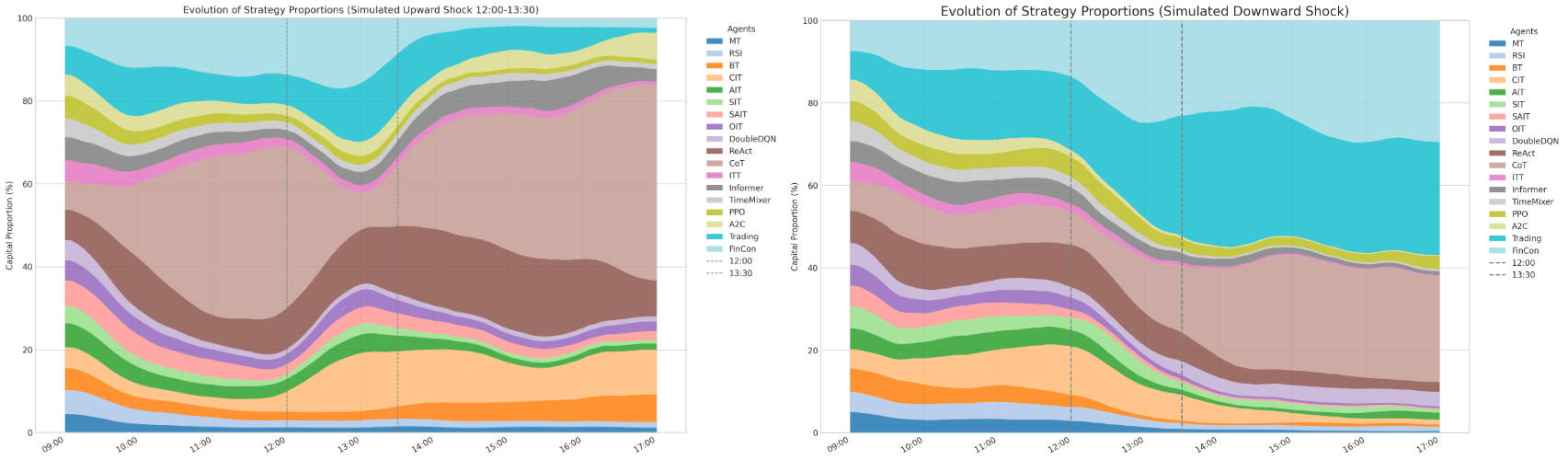
Fig 1: Figure 1: Agent population shares over time. Left: positive shock; Right: negative shock.
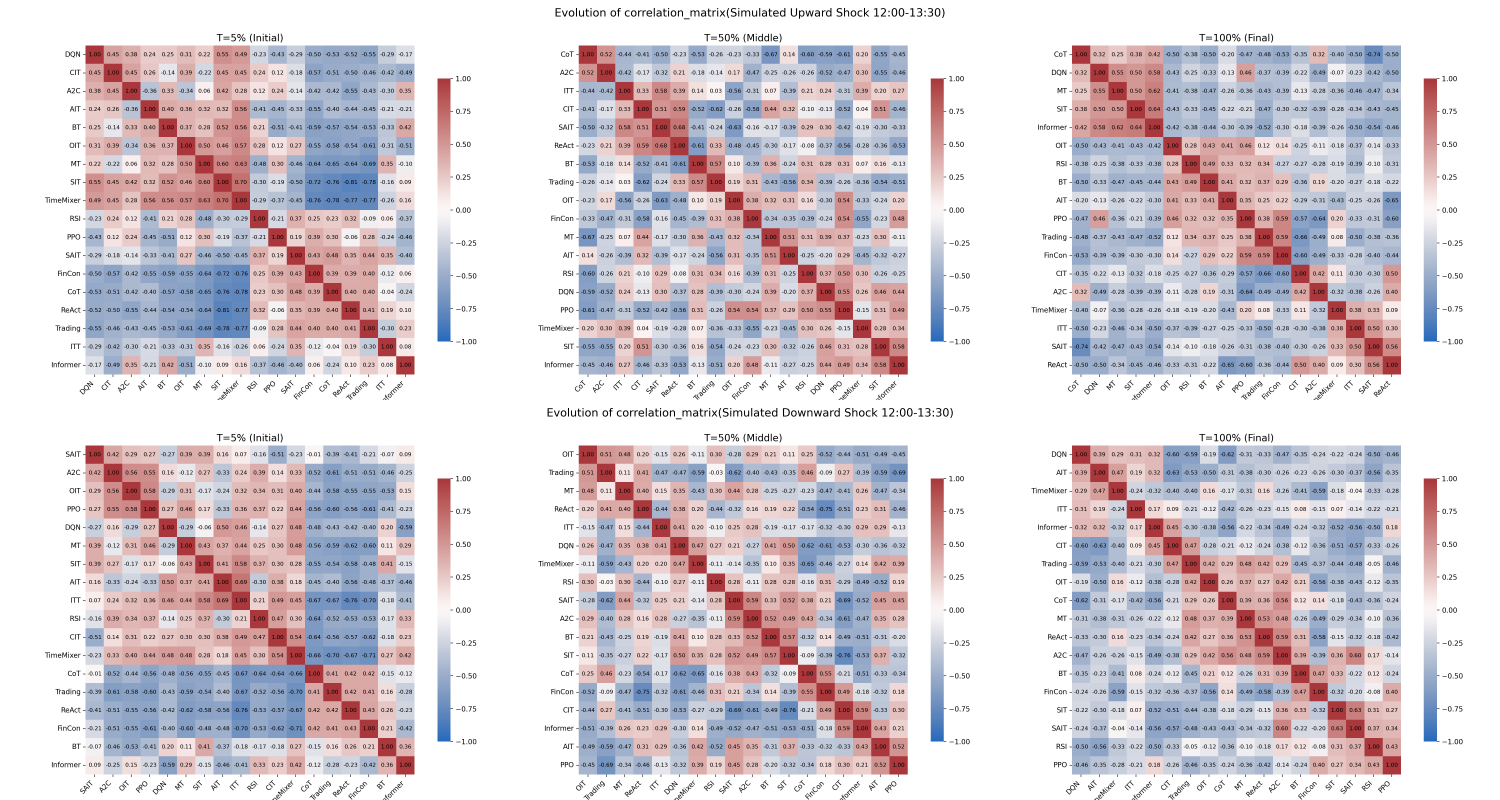
Fig 2: Figure 2: Correlation matrices over time under positive (top) and negative (bottom) shocks. Red = cooperation, Blue = competition.
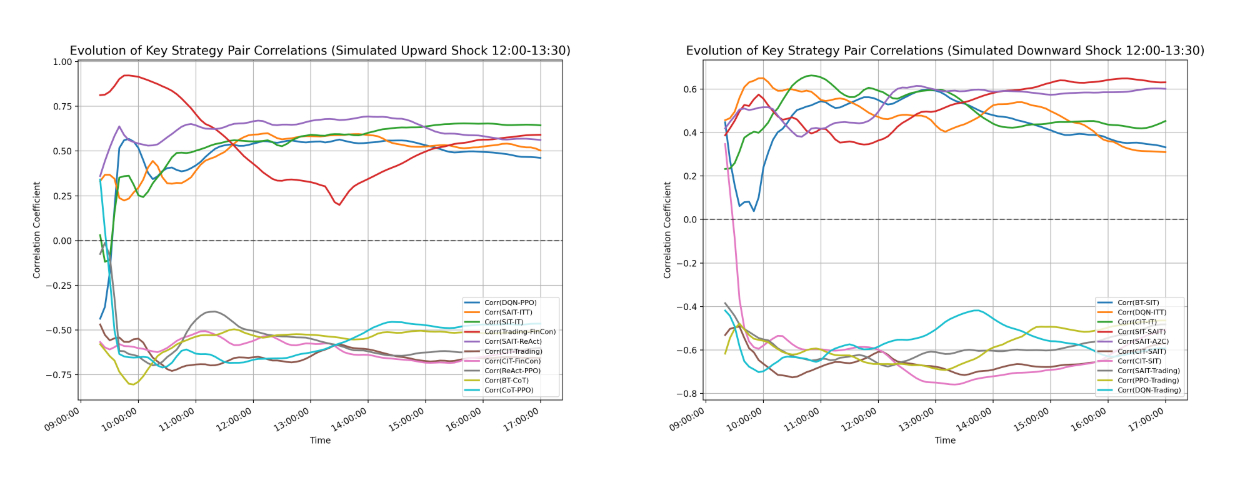
Fig 3: (a) Strategy-pair correlations under shocks.
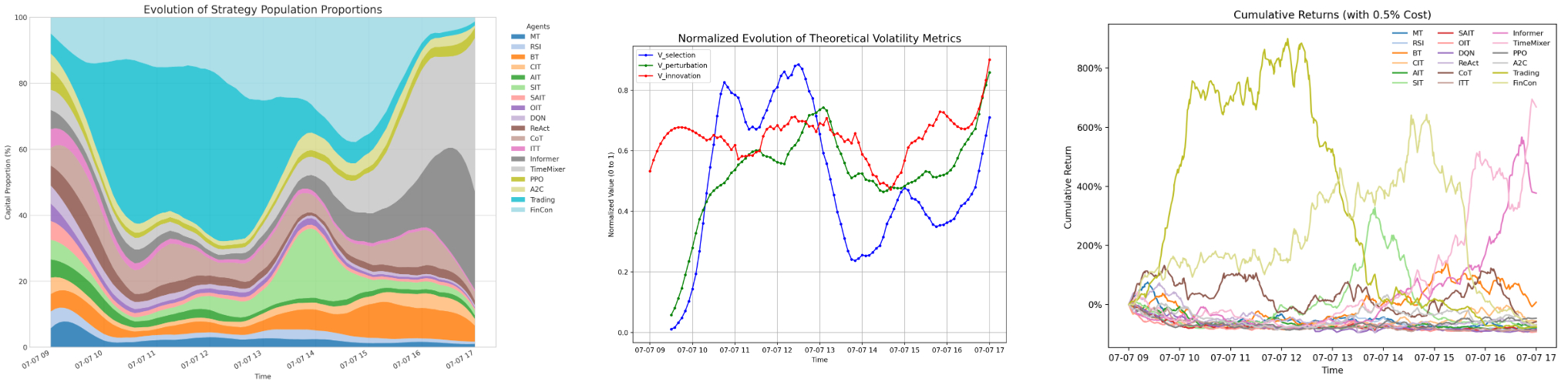
Fig 4: Figure 4: Intra-day evolution on July 7, 2025: (left) agent population proportions, (middle) theoretical volatility metrics, and (right) cumulative returns under a 0.5% transaction cost (including slippage).
Ready to evaluate your AI agents?
Learn how ReputAgent helps teams build trustworthy AI through systematic evaluation.
Learn MoreLimitations
The results depend on the simulated market mechanics, agent designs, and synthetic news models used—real markets may differ in important ways. The framework is intended for evaluation and research, not as a ready-to-deploy trading system. Parameter choices (selection strength, innovation rate, shock model) strongly influence outcomes, so sensitivity testing is essential before drawing operational conclusions. Planning Pattern
Deep Dive
FinEvo frames market evaluation as an ecological game where many heterogeneous traders interact and adapt. Agents include rule-based strategies (trend-following, mean-reversion, noise, fundamentals), supervised forecasting models, reinforcement learning agents, and language-model agents that parse news. Trades clear through a continuous double-auction, portfolios and wealth update endogenously, and population shares evolve according to a stochastic differential equation that decomposes selection (fitness-based replication), innovation (strategy mutation or introduction), and environmental perturbation (exogenous shocks).
In large-scale simulations that include artificial shocks and real-world news days, ecosystem dynamics reveal behaviors absent from isolated backtests: strategies that dominate in calm periods can collapse after a shock, language-model agents can become concentrated hubs under certain negative shocks, and alliances between strategies produce measurable cooperation or competition patterns in correlation matrices. Ablation and sensitivity studies show selection strength raises concentration, higher innovation rates sustain diversity, and stronger perturbations increase the share of volatility attributable to external shocks. Use cases include robustness testing, policy evaluation, and benchmarking agent interactions; however, outcomes should be interpreted considering the simulation assumptions and parameter sensitivity. Graceful Degradation Failure Event-Driven Agent Pattern
Explore evaluation patternsSee how to apply these findings
Credibility Assessment:
All authors have low h-indices and there are no recognizable affiliations or top-tier publication venue.