Key Takeaway
TABX provides a high-speed, GPU-backed sandbox where you can instantly reconfigure battlefield elements (units, terrain, heuristics) to run large-scale multi-agent experiments and study generalization without changing simulation code.
ON THIS PAGE
What They Found
TABX is a JAX-based, vectorized battle simulator that exposes unit specs, terrain effects, and heuristic opponents as easy-to-change parameters, plus a graphical editor for scenario design. The simulator supports non-targeted attack/heal mechanics, fan-shaped partial observations, and heterogeneous unit roles, enabling research on coordination under limited sight and complex terrain. Because environments can be reconfigured per episode without recompiling, TABX makes large-scale studies—exploration in long-horizon tasks, the value of centralized training signals under partial observability, and zero-shot generalization via environment randomization—practical and reproducible. The implementation is designed for high throughput on modern accelerators, simplifying systematic comparisons across many environment variants throughput.
By the Numbers
1Nine distinct unit types included out of the box: 4 melee, 3 ranged, and 2 supporter units.
2Training and stress tests include runs up to 10^9 environment steps to evaluate long-horizon behavior.
3Throughput and sampling benchmarks used 100 distinct scenarios (including compilation overhead) to compare TABX’s environment sampling against a baseline simulator.
Implications
Researchers and engineers building or evaluating multi-agent systems will benefit because TABX reduces the engineering cost of testing many environment variants and supports controlled studies of coordination, exploration, and generalization. Platform and benchmarking teams can use the GUI and config-based scenarios to share reproducible workloads and compare agent methods without custom environment code Multi-Agent System.
Explore evaluation patternsSee how to apply these findings
Key Figures
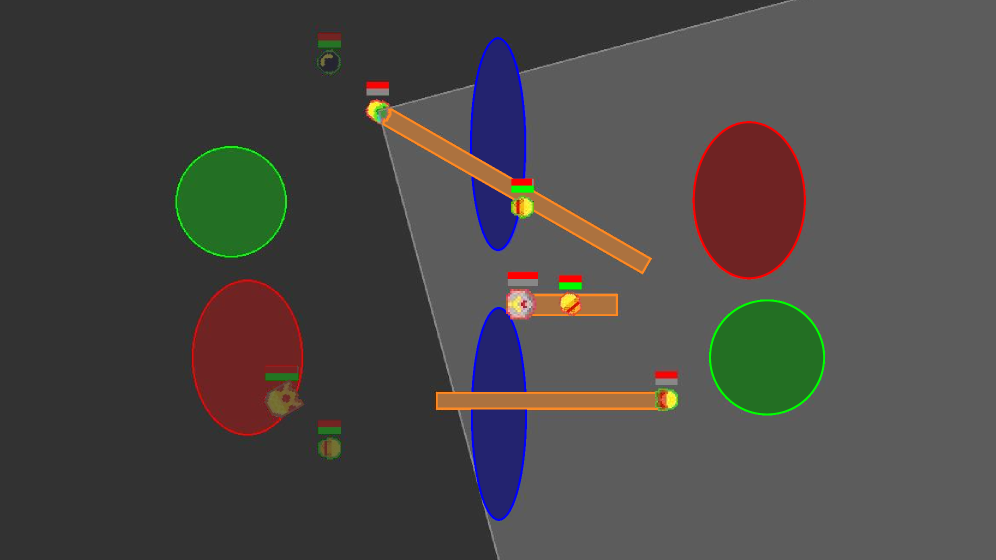
Fig 1: Figure 1 : An illustrative scenario showcasing core features of TABX: (a) fan-shaped partial observability, (b) non-targeted interactions, (c) heterogeneous unit roles, and (d) terrain zones that impose complex strategic demands.

Fig 2: Figure 2
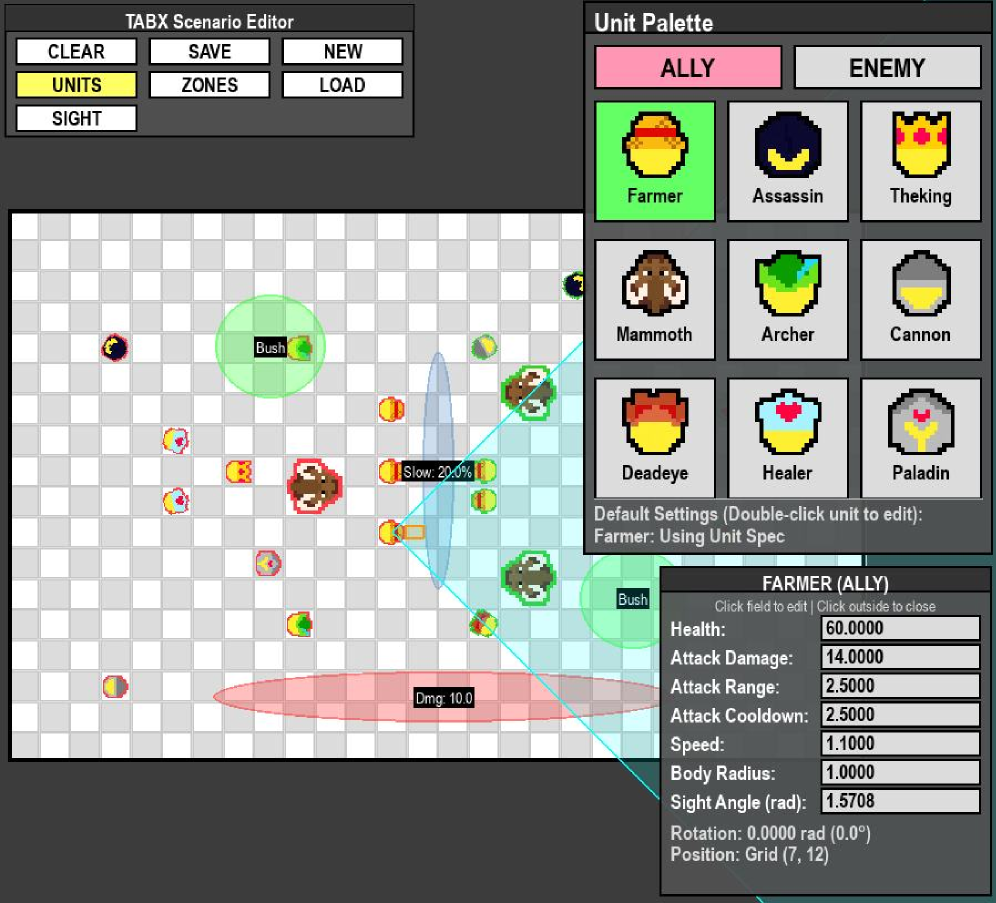
Fig 3: Figure 2 : Overview of the TABX scenario editor. The interface enables visual authoring of scenarios by allowing users to place ally and enemy units, configure unit specifications, and define environmental zones with adjustable functional effects. The editor provides direct access to key environment parameters through an interactive, code-free workflow.
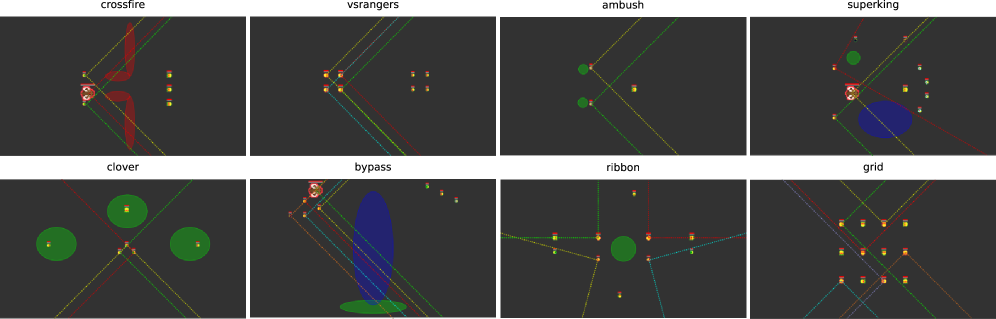
Fig 4: Figure 3 : Representative designed scenarios illustrating different degrees of dependence on global state information. Colored dashed lines indicate the fan-shaped fields of view of individual allies, highlighting how partial observability and viewpoint separation vary across scenarios. Colored ellipses represent terrain zones with distinct functional effects, such as movement speed reduction or visibility occlusions. Allies are denoted by a red outline, while enemies are indicated by a green outline.
Ready to evaluate your AI agents?
Learn how ReputAgent helps teams build trustworthy AI through systematic evaluation.
Learn MoreKeep in Mind
TABX focuses on structured, battle-style scenarios with symbolic observations rather than pixel-based inputs, so results may not transfer directly to visual perception tasks. Some advanced strategic elements—like line-of-sight blocking obstacles, fortifications, and active per-unit skills—are not yet implemented. Performance gains rely on JAX and accelerator hardware; users should expect compilation warm-up behavior and should provision GPU/accelerator resources accordingly. See the Planning Pattern for structured design approaches. Planning Pattern
Deep Dive
TABX is a highly configurable multi-agent battle simulator implemented in JAX that emphasizes throughput, parametrization, and ease of scenario authoring. Each agent has a forward-facing, fan-shaped observation and chooses among movement, rotate, and interaction actions; interactions are non-targeted and affect units inside a forward hurtbox, so positioning and heading are central strategic variables. Terrain zones (lava, swamp, bush) introduce persistent or asymmetric effects—bushes hide units from opponents unless revealed—creating partial observability and tactical tradeoffs. All key components (unit attributes, terrain layouts, heuristic opponent behaviors, and physics) are exposed through configuration files and a GUI editor, enabling rapid environment variation without touching simulation code. Experiments used standard multi-agent baselines (independent and centralized methods) plus environment-design techniques that randomize or adversarially select scenarios during training. Results show TABX makes it straightforward to run controlled studies on information-dependent value learning, sparse-reward exploration in long-horizon tasks, and zero-shot generalization across unit and zone variants. The environment was benchmarked for large-scale sampling (100 scenario tests, long training up to 10^9 steps) and demonstrates practical advantages for researchers who need to sweep environment parameters or evaluate robustness across many settings. Future extensions planned include visual (pixel) observations, line-of-sight obstacles, and richer active skills to broaden the range of tasks supported. This aligns with Guardrails for robust experimentation and evaluation patterns. Guardrails Pattern
Need expert guidance?We can help implement this
Credibility Assessment:
All authors have low h-indices and no affiliations; arXiv preprint with no citations.